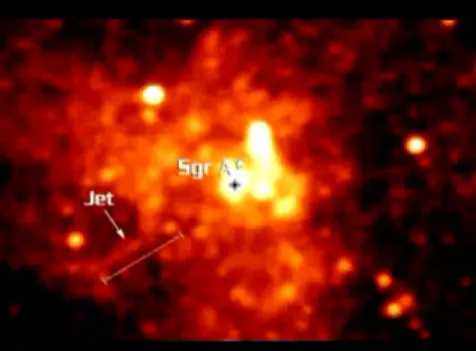
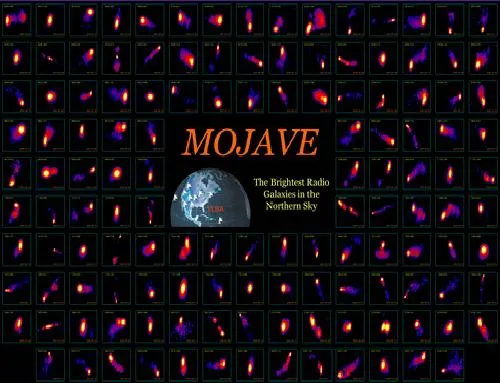
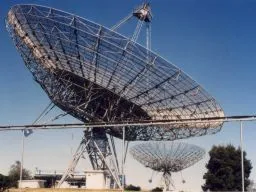
Having the sharpest images is always a great advantage and a sophisticated radio astronomy technique using continental or even intercontinental arrays is yielding excellent results. That is the message brought to the 211th Meeting of the American Astronomical Society in Austin, Texas by Mark Reid, of the Harvard-Smithsonian Center for Astrophysics, a leading researcher in the field of ultra-precise astronomical position measurements.
"Using radio telescopes we are measuring distances and motions of celestial bodies with unprecedented precision. That is helping us better understand many processes from star formation to the entire scale of the Universe," said Reid.
The technique, Very Long Baseline Interferometry (VLBI) or long baseline interferometry, was pioneered in the 60s but has been in continuous use only in the last 10-15 years. The VLBA, a system of 10 antennas from Hawaii to the Caribbean, was inaugurated in 1993. There are also other VLBI systems in Europe and Asia and large radio telescopes around the world cooperate regularly to increase sensitivity. VLBI observations produce images hundreds of times more detailed than those made in visible waves by the Hubble Space Telescope.
Several groups of researchers around the globe use the VLBA to study stellar nurseries in our galaxy and measure distances to the regions where stars are forming. The key was the improvement in measurement precision by a factor of 100. Using small clouds of gas in star-forming regions that strongly amplify radio waves, astronomers measured the small movements in the position of objects in the sky caused by Earth's orbit around the Sun. This, in turn, allows for precise calculation by the triangulation technique.
Knowing the distance precisely also means knowing the luminosity, mass and age of the young stars.
In 2005, Reid and his colleagues measured the rotation and motion in space of the galaxy M33, 2.4 million light-years from Earth. This work and subsequent ones placed a strong limit on the amount of dark matter around the Andromeda galaxy that M33 orbits. A continuous goal is to use VLBI observations to measure the orbits of these and other galaxies in the Local Group to which our Milky Way belongs.
In 1999, astronomers established a new standard for a distance measurement outside the Local Group when they used VLBA to make a direct geometric distance measurement to galaxy NGC 4258, 23.5 million light-years from Earth. The distance was calculated by measuring the motion of masers in a disk of gas containing water molecules and orbiting a supermassive black hole at the center of the galaxy.
"Now, other galaxies are being observed to extend the direct distance measurement even farther into the Universe. One candidate is UGC 3789, at a distance of about 160 million light-years, which will be measured with 10 percent precision. Our goal is to further improve these measurements and measure 5 to 10 more galaxies to determine the Hubble constant (the expansion rate of the Universe) to 3 percent precision. This would place limits on key parameters of the dark energy that is apparently accelerating the expansion of the Universe," added Reid.
The kind of precise distance and motion measurements that VLBI observations provide can benefit numerous areas of astronomy, Reid pointed out. For example, distances to pulsars have been measured directly with the VLBA. This technique could also reveal planets orbiting nearby stars.
VLBI Arrays
The most sensitive VLBI array in the world appears to be the European VLBI Network (EVN) which is a part-time array. In the USA, the VLBA operates year-round. The combination of both is known as Global VLBI.
e-VLBI
It has recently become possible to connect VLBI radio telescopes in real time, while still employing the local time references of the VLBI technique. In Europe, 6 EVN radio telescopes are now connected with gigabit-per-second links through the GEANT network, and the first astronomical experiments using this technique have been conducted successfully.
Space VLBI
The latest development in radio astronomical observations is the Space Very Long Baseline Interferometry (SVLBI) program, in which one of the elements is a space antenna.
The JPL SVLBI project supports the VSOP mission ((VLBI Space Observatory Program) developed by the ISAS Institute in Japan. The VSOP spacecraft, HALCA, is an 8-meter radio telescope and was launched in 1997. It is now in an elliptical orbit around Earth to allow VLBI observations.
Sources and related links
- *CfA: Radio Telescopes' Sharp Vision Yields Rich Payoffs
- *Wikipedia: Very Long Baseline Interferometry
- *Very Long Baseline Interferometry (IMLB-VLBI)
- The VLT Interferometer
About the images
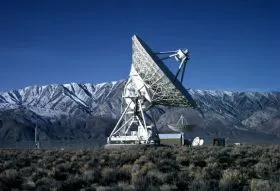
VLBA radio telescope at Owen Valley. Credit: NRAO/AUI