Astronomers from Rutgers and Penn State Universities discovered galaxies in the distant Universe that are ancestors of spiral galaxies like our Milky Way.
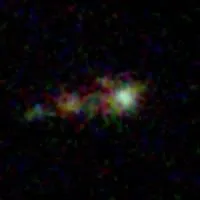
These old objects, some of the first galaxies to form, are being observed as they were when the Universe was only two billion years old.
The newly discovered galaxies are small - one tenth the size and one twentieth the mass of our galaxy. They also have fewer stars than the Milky Way. From ground-based telescopes they look like indivisible stars in size. Recent images taken with Hubble, however, revealed them as regions of active star formation.
"Finding these objects and discovering that they are a link in the evolution of our galaxy is like finding a key fossil in human evolution," says Eric Gawiser of Rutgers. The scientist presented the discoveries made by teams led by him and Caryl Gronwall, of Penn State, at the Meeting of the American Astronomical Society in Texas.
The researchers determined that these galaxies were fertile for new stars. These stars ionized the hydrogen atoms around them, stripping away their electrons and causing emission of ultraviolet light known as Lyman alpha.
The researchers also noted that several of these galaxies, sometimes 10 or more, clustered together to form a spiral galaxy.
The astronomers discovered these galaxies as part of the census of the early Universe, a project called MUSYC (Multi-Wavelength Survey by Yale and Chile). Gawiser initiated a search for several types of galaxies that could be predecessors of spirals like ours; Gronwall led an investigation into Lyman alpha emitters. Their statistical analyses and computer simulations led them to the conclusions reported in the December 10 edition of Astrophysical Journal: Lyman alpha are the ancestors of spiral galaxies (1).
"We know from our understanding of cosmological theory that spiral galaxies must evolve from low-mass galaxies like these. The challenge was to find them. We have seen other primitive galaxies but they were larger and destined to evolve into ellipticals, not spirals," says Gawiser.
The astronomers performed four types of observations. The first step, finding the Lyman alpha galaxies, they performed with the NSF's four-meter Blanco telescope at Cerro Tololo in Chile. To measure their distance, they used the Magellan Telescope at Las Campanas to measure their redshift (which in these galaxies is 3.1). To determine how many stars are in the galaxies, they used the Spitzer space telescope. And to find out how large the galaxies are, they used the Hubble space telescope.
Sources and related links
- *EurekAlert:Rutgers, Penn State astronomy teams discover ancestors of Milky Way-type galaxies
- *Rutgers:Rutgers, Penn State Astronomy Teams Discover Ancestors of Milky Way-Type Galaxies
- *(1)Lyα‐Emitting Galaxies at z = 3.1: L* Progenitors Experiencing Rapid Star Formation; by Eric Gawiser et al.
The Astrophysical Journal, 671:278–284, 2007 December 10
DOI: 10.1086/522955
About the images
Lyman alpha emitting galaxy by Hubble
Credit:NASA, ESA, Caryl Gronwall/Penn State