Natalie Webb and Didier Barret, from the Centre d’Etude Spatiale des Rayonnements in France, used the EPIC camera on XMM-Newton to find three neutron stars and precisely measure the amount of various X-rays coming from their surfaces. This allowed them to compare their results with theoretical predictions to deduce the internal composition of these objects. The three neutron stars reside in globular clusters orbiting the center of our galaxy.
Neutron stars are the remnants of exploded stars. Most of the outer layers of a massive star are ejected into space, while the heart at the center of the star implodes and forms the neutron star. Although they are the size of an asteroid, usually between 10 and 12 km across, they contain more mass than our Sun, making them very compact objects, so dense that, in fact, they cannot be made of normal atoms.
Initially, astronomers believed these objects were composed almost exclusively of neutrons, all packed tightly together as in a giant atomic nucleus. Doubts began when observations started to show that certain stars seemed to have more mass than expected, up to almost twice that of the Sun, while others seemed to have smaller radii, leading to the proposal of exotic models to try to explain these findings, which contained strange particles like pions or quarks.
Determining the mass and radius of a star of this type is a great challenge because they are small objects that cannot be seen directly. Astronomers must take the light coming from them and use computer models to determine size and mass.
"Knowing the distance to the neutron star precisely is crucial in this work," says Webb. This is why the researchers looked for objects in spherical clusters around the Milky Way. Known as globular clusters, these well-known objects have precise estimated distances that can be used for any star found in them. The team identified a possible neutron star in three different clusters: Omega Centauri, M13, and NGC 2808.
The neutron stars that were found orbit other stars and emit X-rays. The scientists compared their results with those produced by new theories using very recent computer models.
The analysis shows that astronomers have underestimated the mass and overestimated the radius of some neutron stars. They concluded that these objects can have masses of up to 2.4 solar masses and radii of at least 8 km.
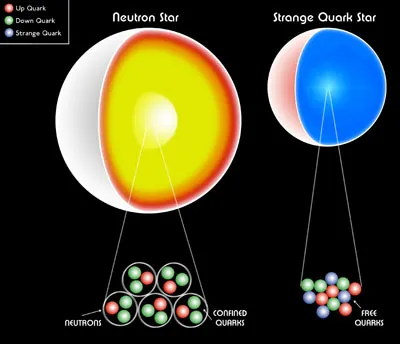
Furthermore, they found that regardless of the assumptions, the interiors of these stars were what was first supposed: neutrons. They found only one feasible exotic solution, an interior made of quarks. These particles are the constituents of the others and could be capable of packing together more densely.
Sources and related links
- *ESA: XMM-Newton gives new insight into neutron stars
- *The Astrophysical Journal, 671:727–733, 2007 December 10:
Constraining the Equation of State of Supranuclear Dense Matter from XMM-Newton Observations of Neutron Stars in Globular Clusters by Natalie A Webb and Didier Barret.
DOI: 10.1086/522877
About the images
In a neutron star, quarks are confined within neutrons. In a quark star (on the right) the quarks are free, so the diameter of the star is smaller.
Credit: NASA/CXC/M.Weiss