Contrary to what is expected for small icy bodies, the dust from comet Wild 2 formed very close to the young Sun and was altered by primitive materials from the solar system.
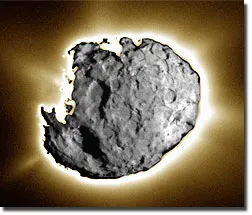
When the Stardust mission returned to Earth with samples from comet Wild 2 in 2006, scientists knew the material would provide new clues about the formation of our solar system, though they didn't know exactly how.
New research by scientists from Lawrence Livermore National Laboratory, and collaborators, revealed that, in addition to containing material that formed very close to the young Sun, the dust from Wild 2 lacks ingredients that would be expected in cometary dust. Surprisingly, the sample from comet Wild 2 looks more like a meteorite from the asteroid belt than an ancient and unaltered comet.
By comparing the Stardust samples with interplanetary dust particles (IDPs), the team found that two silicates normally found in cometary IDPs, along with other primitive materials including presolar dust grains from other stars, have not been found in the quantity expected for a comet from the Kuiper Belt like Wild 2. The very high-speed capture of the particles could be partially responsible; but refractory components that formed in the inner solar nebula a few astronomical units from the Sun indicate that the Stardust material looks like a chondrite from the asteroid belt.
"The material is much less primitive and more altered than the materials we have gathered through high-altitude captures in our own stratosphere from a variety of comets," says Hope Ishii, author of the research appearing in the January 25 edition of Science. "As a whole, the samples look more asteroidal than cometary."
Given its tail, Wild 2 is by definition a comet. "It's a reminder that we can't make black or white distinctions between asteroids and comets. There is a continuum between them," added the scientist.
The surprising findings contradict the initial expectations of researchers for a comet that has spent most of its life orbiting in the Kuiper Belt, beyond Neptune. In 1974, Wild 2 had a close encounter with Jupiter that placed it in its current orbit much closer to Earth.
Comets form far from the Sun where, due to the cold temperature, they preserve the primitive ingredients from the formation of the solar system 4.6 billion years ago. Stardust traveled for seven years to reach Wild 2 and returned to Earth in January 2006 with a cargo of samples to analyze.
The team looked for two specific silicates in the samples, which are believed to be identifiers of cometary IDPs: amorphous silicates known as GEMS and enstatite. Surprisingly, the team found very little enstatite and with the wrong crystallographic orientation.
Objects like GEMS were found, but Ishii and her team showed they were created during the comet's impact with Stardust.
"Wild 2 doesn't look like what we thought all comets should look like. The Stardust mission was a real success because without it we wouldn't have learned these things about our solar system. The sample was vital to continue revealing how our solar system formed and evolved."
Sources and related links
- *EurekAlert:Stardust comet dust resembles asteroid materials
- *Lawrence Livermore National:Stardust comet dust resembles asteroid materials
- *Comparison of Comet 81P/Wild 2 Dust with Interplanetary Dust from Comets
Hope A. Ishii, John P. Bradley, Zu Rong Dai, Miaofang Chi, Anton T. Kearsley, Mark J. Burchell, Nigel D. Browning, and Frank Molster
Science 25 January 2008: Vol. 319. no. 5862, pp. 447 - 450
DOI: 10.1126/science.1150683
About the images
Credit:NASA/JPL