Two weeks ago, NASA scientists said the chance of the asteroid colliding with the red planet was 1 in 75. But a young astrophysicist discovered archival data that raised the impact chances to 1 in 28. However, with new observations, NASA now estimates the chances are currently 1 in 40.
The story of the young astrophysicist is interesting, aside from the fact that it has already been corrected, because it still provided correction data that is still taken into account and because it shows that with enough knowledge one can contribute, among other things, thanks to the formidable possibility of accessing data through the web.
He is Andrew Puckett, 30 years old, who is conducting postdoctoral research at the University of Alaska Anchorage (UAA).
Working on his own during the holidays, Puckett discovered data that allowed NASA to refine its forecast for asteroid 2007 WD5.
"When I sent the information, all I knew was that it was going to change the (projected) orbit (of the asteroid)," said the young man.
"I was sure it would change the impact chances, but I had no idea if they would go up or down. So the fact that they went up, making it a big story, is really exciting for me."
If the collision were to occur, it would be equivalent to a 3-megaton nuclear bomb and would leave a crater half a mile wide. If that crater were explored with satellites and rovers, it could allow scientists to answer questions about whether life existed on the planet.
"If you consider the importance of that, it would be an incredible event if it happened," added Travis Rector, who supervises the young man's research.
Archival data increased the chances
Last year, after earning a doctorate in astronomy and astrophysics by studying comets and asteroids at the University of Chicago, Puckett was hired by UAA to help develop a new curriculum, an initiative supported by a $500,000 grant from the NSF.
Apart from that mission, however, Puckett continued to pay attention to obscure objects in our solar system and on December 21 began to hear news about 2007 WD5. Due to his familiarity with tracking asteroids through images available online in the SDSS database, the scientist was able to provide previous data on the asteroid. After working on the calculations on Christmas, he sent his findings to the Harvard Minor Planet Center. The University, in turn, sent the information to NASA's Jet Propulsion Laboratory. Then, the Agency readjusted the impact chances.
New data currently lower the impact probability
Today NASA publishes an update of the asteroid's orbit using new observations from the telescope at the Calar Alto Observatory in Spain, which incorporate the previously mentioned Sloan refinements, lowering the probability to 1 in 40.
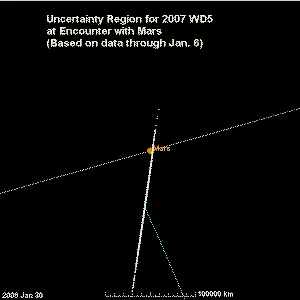
While the best estimate of the close approach distance remains at 30,000 km, the uncertainty in the position at the encounter has decreased by a factor of 3. As a result, the probability has fallen to 2.5% or a 1 in 40 chance that the impact of 2007 WD5 with Mars, predicted for January 30, will finally occur.
Sources and related links
- *Physorg:Alaska researcher changes asteroid orbit
- *The StarPress:Asteroid heading for Mars
- *ADN:UAA researcher gives Mars bad news
- *28-12-07NASA:Mars Impact Probability Increases to 4 Percent
- *08-01-08:NASA:Mars Impact Seems Less Likely
About the images
Updated uncertainty region for 2007 WD5 at the Mars encounter, shown as white dots. The thin white line is the orbit of Mars. The blue line traces the movement of the center of the uncertainty region, which is the most likely position of the asteroid.
Credit:NASA-JPL, Near Earth Object Program