A pair of meteorites found in Antarctica would be pieces of a planetoid that separated in the early history of the solar system, a new study suggests. Other pieces of the proto-world could be floating around the asteroid belt, and could be identifiable by the spectrum of sunlight they reflect.
In the first tens of millions of years of the solar system, collisions between rocky objects melted the interiors of large objects. Magma oceans -perhaps hundreds of kilometers deep- bathed the Moon, Earth and other large bodies, allowing dense materials to settle toward their centers in a process called differentiation.
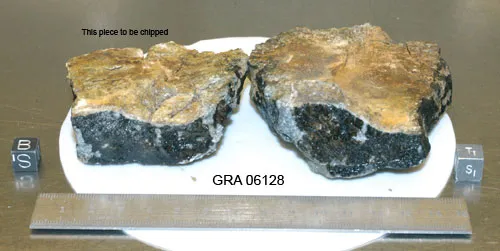
The two meteorites, called GRA 06128 and GRA06129 (named because they were found in the area of Antarctica called Graves Nunataks, in 2006), show evidence of that differentiation, suggesting they come from a massive object.
That is because the two objects are made mostly of a mineral called feldspar, which constitutes about 75 to 90% of their volume.
This mineral is even more abundant in some lunar rocks. It is thought to be the result of feldspar crystals solidified from the Moon's early magma ocean.
Since it is a relatively light mineral, it would have floated toward the top of the magma ocean, allowing the formation of a very concentrated layer of the mineral.
The amount of feldspar in the two different fragments suggests they are remnants of a very large object that differentiated in a similar way, according to Allan Treiman of the Lunar and Planetary Institute in Houston, who led a study on one of the fragments.
"Strange new world"
Other studies of the meteorite, including one led by Richard Ash of the University of Maryland, another by Chip Shearer of the University of New Mexico in Albuquerque and a third by Ryan Zeigler of the University of Washington in Missouri, agree that the parent body must have been one massive enough to separate.
The concentrations of feldspar suggest that body was probably smaller than the Moon's 3500-kilometer diameter but larger than Vesta, the third largest asteroid in the solar system at 578 kilometers, says Treiman. That is because meteorites believed to be from Vesta contain solidified lava, but not large concentrations of feldspar, suggesting its gravity was not strong enough to form a distinctive layer of the mineral.
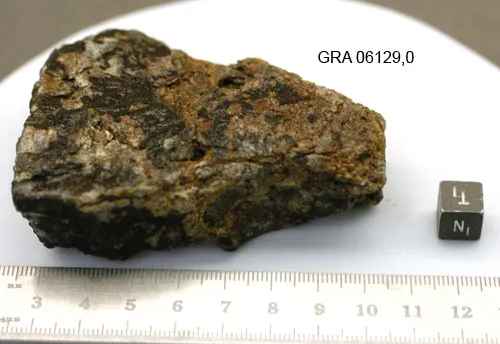
"This is a piece of a dwarf planet-sized body that apparently no longer exists," Treiman told New Scientist. "We have here a sample of a strange new world, a sample we have never seen before."
Ancient era
Zeigler, however, says the studied meteorites share similarities with a class of meteorites called brachinites, whose parent bodies appear to have been large enough to partially melt.
The composition of the meteorites has led scientists to rule out the possibility that they are pieces of the Moon, Mars, Venus or Earth.
By measuring the radioactive decay of elements in the meteorite, scientists led by Richard Ash showed that the rock must have formed about 4.5 billion years ago, when Earth and the other planets were forming.
Studying these fragments of a now-vanished object from that time provides a rare window into the early solar system, says Treiman. At that moment, a bunch of dwarf planet-sized objects orbited the solar system through gravitational interactions with other objects, while others collided to help create the planets present in today's solar system.
Some aspects of the meteorites, such as the high abundance of sodium in some of their minerals, hint that the parent object could have contained a lot of water, according to a study by Tomoko Arai of the National Institute for Polar Research, in Tokyo.
The research of the five teams was presented on Wednesday at the 39th Lunar and Planetary Science Conference held in Houston, Texas.
Sources and related links
- New Scientist: Meteorite pair may be remnants of destroyed dwarf planet
- The Meteoritical Society
- Petrography and Origin of the Unique Achondrite GRA 06128 and 06129: Preliminary Results
Treiman, A. H. et al.
39th Lunar and Planetary Science Conference, (Lunar and Planetary Science XXXIX), held March 10-14, 2008 in League City, Texas. LPI Contribution No. 1391., p.2215 - Unique Achondrites GRA 06128/06129: Andesitic Partial Melt from a Volatile-rich Parent Body
Arai, T.; Tomiyama, T.; Saiki, K.; Takeda, H.
39th Lunar and Planetary Science Conference, LPI Contribution No. 1391., p.2465 - Petrology, Geochemistry, and Likely Provenance of Unique Achondrite Graves Nunataks 06128
Zeigler, R. A et al.
39th Lunar and Planetary Science Conference, LPI Contribution No. 1391., p.2456 - Oxygen Isotopic and Petrological Diversity Among Brachinites NWA 4872, NWA 4874, NWA 4882 and NWA 4969: How Many Ancient Parent Bodies?
Rumble, D. et al.
39th Lunar and Planetary Science Conference, LPI Contribution No. 1391., p.1974 - Meteorites from Antarctica
About the images
Images from:
Astromaterials curation - Antarctic Meteorite Newsletter
Volume 30, No. 2 - August 2007