During the next encounter of Cassini with Titan, on January 5, its visual and infrared spectrometers will map the landing site of the Huygens probe.
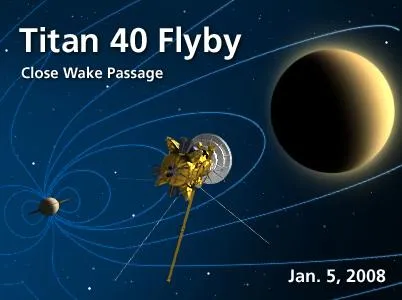
This flyby will include two stellar occultations to study the structure of the Saturnian moon's atmosphere.
The spectrometer will be observing the star Arcturus (Alpha Bootes) and the ultraviolet spectrograph will point toward Vega.
α Bootis, Arturo or Arcturus, with magnitude -0.04, is the third brightest star in the sky, in the constellation of Boötes. It is an orange giant 37 light-years away with a diameter 25 times greater than that of the Sun.
Vega or Alpha Lyrae (α Lyrae) is a first-magnitude star (in Ptolemy's classification) in the constellation of Lyra and the principal one of it.
Titan is a natural satellite or moon of Saturn. It is the largest satellite of Saturn and the second largest satellite in the Solar System. It was discovered on March 25, 1655 by the Dutch astronomer Christiaan Huygens and was the first satellite in the Solar System to be discovered after the Galilean satellites of Jupiter. Titan has a diameter of 5150 km and is the only moon in the Solar System that has a significant atmosphere.
The last flyby of the Cassini probe by Titan was on December 20.
Sources and related links
- *NASA JPL:Cassini's First Titan Visit in the New Year
- *To know where Cassini is now: CASSINI AT SATURN - Present Position
About the images
Credit: NASA/JPL