A gas cloud weighing millions of times the mass of the Sun is hurtling toward the Milky Way and would collide in 20 to 40 million years. A ring of stars in the vicinity of the Sun could be the signature of a previous impact of the cloud.
The cloud is made primarily of hydrogen and is 11,000 light-years long and 2,500 light-years wide, nearly half the size of a dwarf galaxy. It was discovered in 1963, but nothing was known about its motion toward our galaxy until now.
Using the Green Bank Telescope, a team led by Felix Lockman of NRAO made a detailed radio image of the cloud and measured its velocity.
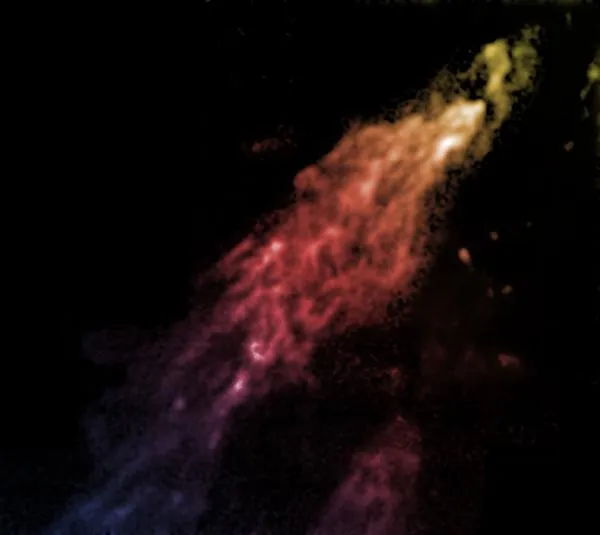
The new image shows the comet-like appearance of the cloud as it heads into the gaseous atmosphere of our galaxy. The measurements also reveal that the cloud is 8,000 light-years away and is approaching the Milky Way at 240 kilometers per second. When it will impact exactly is not clear because astronomers are not sure how much it will be slowed by our galaxy's envelope of gas.
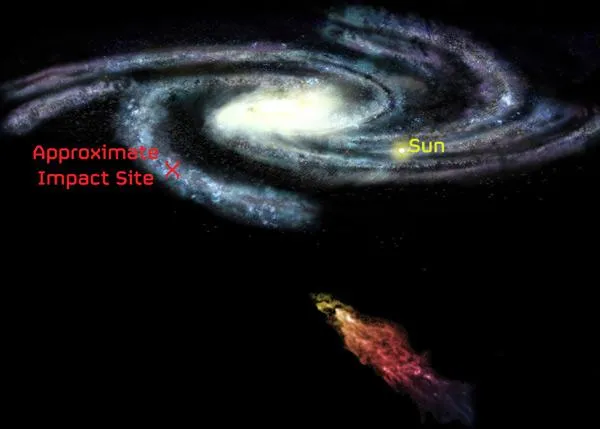
Based on its direction of motion, the cloud would collide with a region near the galaxy's Perseus arm.
Astronomers think the results of the collision will be spectacular. "Shock waves would trigger star formation in the region and a few million years later supernovae would begin."
Danger
The impact of the gas cloud poses no danger to any inhabitants of solar systems that might be in the region. Despite its great mass, it is so spread out that it will have no direct effect on existing stars and planets. But the supernovae that would be generated millions of years later could be dangerous for any life forms that might exist in solar systems that are unfortunately nearby, says Lockman.
A similar collision, tens of millions of years ago, could explain a zone of stars and gas about 2000 light-years across that is slowly expanding in the vicinity of the Sun. The zone includes most of the bright stars in the constellation Orion as well as the star-forming region.
Although the motions of other hydrogen clouds near our galaxy have not been measured, some are probably also heading toward the Milky Way. Those clouds likely fall regularly into our galaxy and provide it with new material for star formation.
The object is called the Smith Cloud after Gail Smith, now Gail Bieger, discovered it 45 years ago when she was an astronomy student. Lockman recently contacted Bieger to tell her about these results. "She was amazed. She told me it made her day."
The new observations of the Smith Cloud were revealed at the Meeting of the American Astronomical Society in Austin, Texas.
Sources and related links
- *NewScientist:Giant gas cloud to crash into our galaxy
- *NRAO:Massive Gas Cloud Speeding Toward Collision With Milky Way
About the images
Top illustration:
The drawing shows the Milky Way, locating the Sun and the presumed impact site, in the Perseus arm of our galaxy.
Illustration credit:Bill Saxton/NRAO/AUI/NSF
Image within the note:
The Smith Cloud. Credit;Bill Saxton/NRAO/AUI/NSF