The Hubble Space Telescope revealed an optical alignment never before seen in space: a pair of bright rings, one inside the other, like a bull's eye. The double-ring shape is caused by the curvature of light from two distant galaxies.
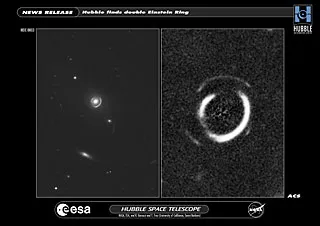
A double Einstein ring has been found by an international team of astronomers led by Raphael Gavazzi and Tommaso Treu of the University of California. The discovery is part of the Sloan Lens Advanced Camera for Surveys (SLACS) program.
The results were reported at the meeting of the American Astronomical Society in Texas and have been submitted to The Astrophysical Journal.
The phenomenon, called gravitational lensing, occurs when a massive galaxy in the foreground curves the light rays from a distant galaxy behind it, like a magnifying glass. When both galaxies are aligned, the light forms a circle around the foreground galaxy, which is called an Einstein Ring. If another, more distant galaxy lies precisely in the same line of sight, a second, larger ring will appear.
The chances of such an alignment are so slim that Tommaso says they "won the lottery" with the discovery.
The massive foreground galaxy is almost perfectly aligned in the sky with two background galaxies at different distances. The foreground galaxy is at 3 billion light-years. The inner and outer rings are comprised of multiple images of two galaxies at distances of 6 billion and 11 billion light-years.
Adam Bolton of the SLACS team identified the lens in the Sloan Digital Sky Survey (SDSS).
The distribution of dark matter in the foreground galaxies can be mapped precisely. Furthermore, the geometry of the two rings allowed the team to measure the mass of the middle galaxy at a value of one billion solar masses. The team reports that this is the first measurement of the mass of a dwarf galaxy at a cosmological distance (with a redshift of z=0.6).
A sample of several dozen double rings like this could offer a purely independent measurement. The comparative radii of the rings could also be used to provide an independent measure of the curvature of space by gravity.
Observations of the cosmic microwave background radiation (a relic of the Big Bang) favor a flat geometry. A sample of 50 suitable double rings could be enough to measure the dark matter content in the Universe and the equation of state of dark energy (a measure of its pressure). Other double Einstein rings could be found with wide-field space telescope surveys that are being proposed for the Joint Dark Energy Mission (JDEM).
Sources and related links
*Space Telescope:heic0803: Hubble finds double Einstein ring
About the images
Image of the gravitational lens SDSSJ0946+1006 photographed by Hubble.
Credits: NASA, ESA, R. Gavazzi and T. Treu (University of California, Santa Barbara), and the SLACS team.
More images at SpaceTelescope