The lack of gravitational waves prompts a new look at a gamma-ray burst. An international team of physicists concluded that an intense gamma-ray burst that possibly came from the Andromeda Galaxy lacks a gravitational wave. That absence, they say, rules out an initial interpretation that the burst originated from the merger of neutron stars or black holes in Andromeda.
A revised interpretation, presented last month by Isabel Leonor of the University of Oregon at the 12th Gravitational Wave Data Analysis Workshop in Cambridge, suggests two possible origins: a merger beyond Andromeda or a burst from an astronomical object known as a gamma-ray repeater in that galaxy. The latter, also called a magnetar, involves neutron stars with enormous magnetic fields that occasionally produce large gamma-ray bursts.
The new findings are based on a collaborative analysis by the Laser Interferometer Gravitational-Wave Observatory (LIGO), the gravitational-wave observatory.
Leonor, a research associate in the relativity group at the Univ. of Oregon and her colleague Ray Frey, a physics professor, initiated the discussion about the event known as GRB070201.
Gamma-ray bursts or GRBs are among the most violent and energetic events in the Universe. Scientists have only recently begun to understand their origins. In February 2007, four gamma-ray satellites measured a short but intense event originating in the direction of the Andromeda Galaxy 2.5 million light-years from Earth.
Most short GRBs (less than two seconds) are believed to originate from the merger of two massive objects like neutron stars or black holes. They can also come from magnetars, although they emit less intense rays.
In February, the LIGO interferometers were collecting data but did not detect any gravitational wave associated with it. The non-detection was significant, according to the scientists' report.
The burst occurred along a line of sight that was consistent with it originating in one of Andromeda's arms. Initially, a merger event of compact objects was considered the most likely explanation. But such an event should have generated gravitational waves that should have been easily measured by LIGO's detectors.
The LIGO collaboration includes 580 scientists from universities in 12 countries. Each of the interferometers uses a laser split into two beams that travel back and forth along long arms in vacuum tubes. The beams are used to monitor the distance between mirrors. According to the General Theory of Relativity, the relative distance of the mirrors changes slightly when a gravitational wave—a distortion in space-time produced by massive accelerating objects—passes through. An interferometer is built so that it can detect a change of less than a thousandth of the diameter of an atomic nucleus.
"This non-detection of a signal from GRB070201 is an important step toward a very productive synergy between the astronomical communities that will contribute to our understanding of the most energetic events in the cosmos," says Jay Marx, executive director of LIGO.
Until now, astronomers studying GRBs relied on data from telescopes conducting observations in the optical, infrared, radio, X-ray, and gamma-ray. Gravitational waves offer a new window into the nature of these events, according to David Reitze, a physics professor at the University of Florida and spokesperson for LIGO.
This year, construction of the Advanced LIGO project is expected to begin; it will be 10 times more sensitive, allowing scientists to detect events at distances 10 times greater.
Sources and related links
- -EurekAlert:UO plays key role in LIGO's new view of a cosmic event
- -LIGO, Caltech
- -Caltech:LIGO Sheds Light on Cosmic Event
- -UO participants play key role in LIGO's new view of a cosmic event
- -Gamma-ray eruptions
About the images
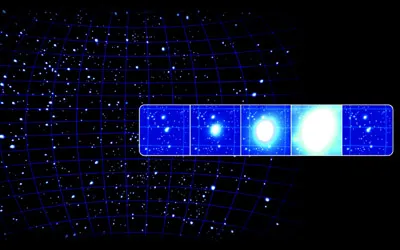
The illustration shows how a gamma-ray burst can shine dramatically in a short period of time.
In Are we safe from a gamma-ray burst explosion?
Credits: Copyright: ESA 2002. Illustration by Medialab