The news spread like wildfire. The LIGO collaboration announced the direct detection of gravitational waves. What are they and how were they detected?
A BIT OF HISTORY
What is gravity?
Isaac Newton realized that apparently different phenomena were similar in one sense: the orbit of the planets and the fall of an apple could be understood with a formula:
F= G.m1.m2 / r2
where m1 and m2 are the masses of two objects, r is the distance between them and G is the so-called Universal Gravitational Constant. The value of this constant was determined experimentally by Henry Cavendish.
Newton's law of gravity was a great advance because it allowed correctly describing the motion of most objects in the solar system and of objects here on Earth. But, in some cases, this law did not provide adequate answers, for example, the well-known "anomaly of Mercury".
At the end of the 19th century, the young Albert Einstein began to follow a path similar to James Clerk Maxwell who a few decades earlier had managed to unite the concepts of electricity and magnetism.
The young Einstein imagined what it would be like to move on a beam of light. He realized that in that frame of reference the light would seem frozen, which led him to think that the speed of light is the same for all observers, regardless of their motion, which is one of the principles of his Special Theory of Relativity, published in 1905.
But the geometric nature of gravity would come later, through his collaboration with Hermann Minkowski who developed the idea of "space-time" in which events occur in a four-dimensional "space", the three of space and one of time. The General Theory was published in 1915.
The theory managed to explain the anomaly of Mercury. Furthermore, if for Newton gravity was a force that acted instantaneously, for Einstein gravity is produced by the distortion of space-time.
That distortion is often called "curvature". The "fabric of space-time" as it is also called, would be like a cloth that covers everything and that can be deformed by the mass of the objects placed on that cloth, stretching it. More than a cotton cloth, space is like rubber.
This leads to thinking something counterintuitive: in some cases, one centimeter is shorter than another if the strength of the gravitational field is different. One second would be longer than in other places.
This "curvature" or "deformation" of space-time is usually visualized in this way:
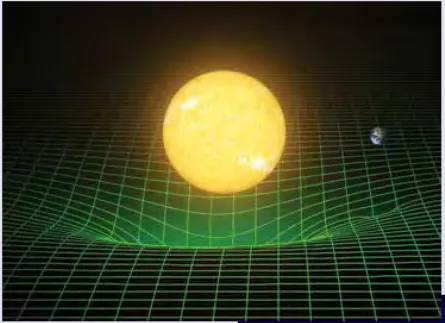
However, this visualization is only a visual aid, although sometimes, if interpreted literally, it's not so helpful...
If massive objects deform space-time and by changing the distribution of that mass-energy the curvature will change, the effects of these changes do not occur instantaneously.
The information is carried at the speed of light by waves in space-time, small expansions or contractions in the coordinates that describe space-time. Such waves are gravitational waves.
An example can help: If we live in a house by the sea (like in that fantastic song by the group Genesis) with a boat tied to the dock and we see a storm on the horizon, we will notice its effects even though it is far away and even if the storm itself never reaches us. The winds will generate waves in the sea that will make our boat rock.
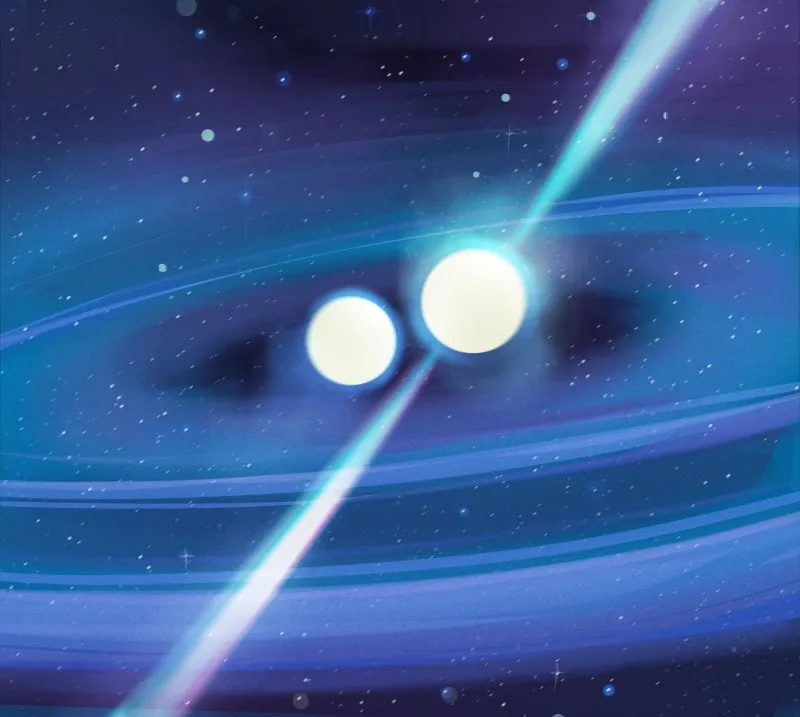
Let's replace the storm with a binary system (composed of two objects). Those gravitational waves carry energy and since they are produced by the motion of the stars in space, the stellar system must be losing energy.
If I throw a small stone into the sea, to do so I must use energy that I lose by using it, transferring it to the stone and it to the wave generated in the water.
In the same way, by generating gravitational waves, the two objects lose energy, so they slowly approach each other.
Einstein's theory predicts an exact relationship between the size of the orbit and the rate at which that orbit shrinks by emitting waves. Since these waves are small, the more massive the objects involved, the easier it will be to detect those waves.
INDIRECT DETECTION OF GRAVITATIONAL WAVES
In the 1970s at the Arecibo radio telescope, Russel Hulse was looking for pulsars which are magnetic, rapidly rotating neutron stars that emit pulses similar to a lighthouse. Since the separation between pulses is stable, they are also "clocks".
But one of the pulsars discovered by Hulse, called PSR 1913+16, showed a periodic variation in its pulses. When he consulted his advisor, Joseph Taylor, they concluded that they were observing a pair of pulsars orbiting each other. The period of these pulses was eight hours, so they inferred that the companion star must be small. With further observations they concluded that the companion star was also a neutron star, but not a pulsar.
These two stars were gradually spiraling closer to each other. The implied rate of energy loss could be compared with that predicted by Einstein as gravitational radiation. The agreement between the predicted and the observed was so exact that, although it was not a direct proof, there was no doubt that gravitational waves existed.
Hulse and Taylor received the Nobel Prize in 1993 for their discovery.
Since then, other systems have been found that show the same thing.
But detecting these waves directly is another matter, since we are talking about minuscule values.
THE DIRECT OBSERVATION OF GRAVITATIONAL WAVES
Like electromagnetic waves, gravitational waves are transverse waves that travel at the speed of light. The General Theory of Relativity allows predicting the strength and frequency of these waves, as also happens with Maxwell's equations. However, electromagnetism is a stronger force than gravity. The ingenuity of astrophysicists was put to the test.
The detectors of the LIGO observatory consist of mirrors suspended in separate detectors. The passage of gravitational waves through these detectors changes the separation between them. A violent event in space will produce gravitational waves that, when passing through a detector, will change the distance between the mirrors by a factor of 10-19 meters.
LIGO consists of two perpendicular arms 4 km long. A laser beam is emitted toward a splitter that sends half the light down one arm and the other half down the other. Mirrors reflect the light back to where it came from and the splitter combines them and sends them to a detector. The design allows the light from both arms to cancel out as destructive interference when recombined. But if the force is slightly different, due to the passage of gravitational waves, upon recombination a slight difference will be produced.
When a gravitational wave passes through, the expansion or contraction of space causes the interferometer arms to lengthen or shorten. As the length of these arms changes, the laser beam traveling through them will travel different distances, producing a difference in interference (not canceling out completely). The change in length of an arm divided by the length of the arm is a parameter called "strain" (or h).
Just as cosmic objects generate different wavelengths across the electromagnetic spectrum, different physical systems generate different gravitational wavelengths. The following figure illustrates the expected strengths of gravitational waves, usually called h, wavelength bands, and types of expected sources for each band. LIGO is sensitive to gravitational waves with frequencies in the range 10-2000 Hz.
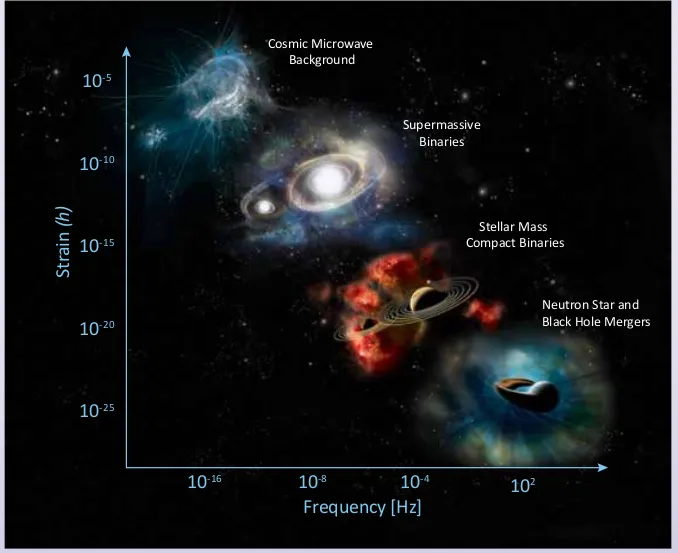
To illustrate the difference of the waves, let's look at the following graph:
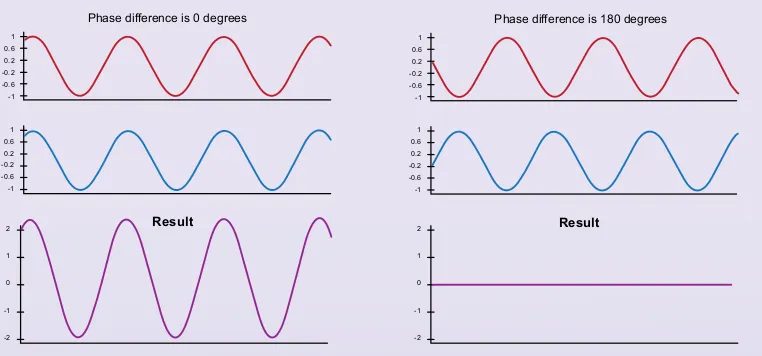
On the left, two waves with a phase difference of zero degrees, that is, "in phase". On the right, two waves with a 180-degree difference.
In the first case they add up, in the second, they cancel out.
LIGO scientists search the recorded data to find how the arm length pattern compares with different types of gravitational wave sources. The following figure shows the data received by the two LIGO interferometers, one in Livingston and the other in Hanford on September 14, 2015, along with the comparison with the prediction, which in this case matches a binary system composed of two black holes, each of 30 solar masses (approx.) located at a distance of one billion light-years!
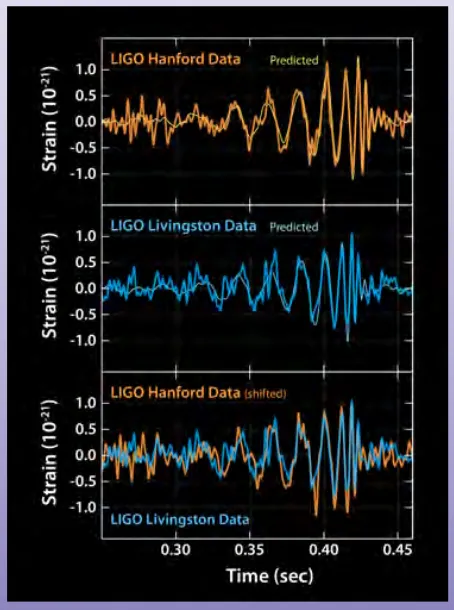
The final part of the graph shows an overlay of both detected signals. The Hanford data were inverted for comparison due to the different orientations of the detectors at both sites. The data were also corrected in time for the travel time between the two places (7 milliseconds difference). The amazing thing is that both detectors witness the same thing, which confirms the detection.
The approximate location of the source of these waves is seen in the following graph:
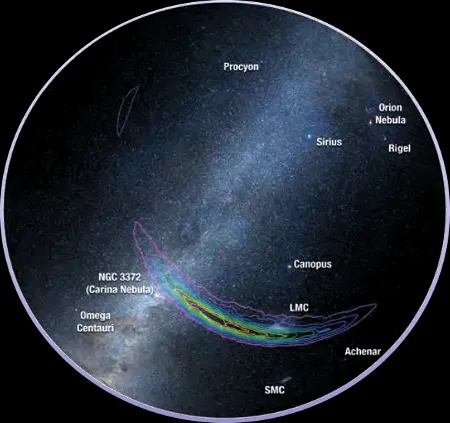
The image combines a visible-light map of the southern hemisphere of the sky and the different colors represent different probabilities of the origin of the signal: the purple line defines the region from which the signal was emitted with 90% confidence. The inner yellow region has a confidence of 10%.
In the future, with other similar observatories (Advanced Virgo in Italy and KAGRA in Japan), scientists will be able to improve the locations.
Data for the record
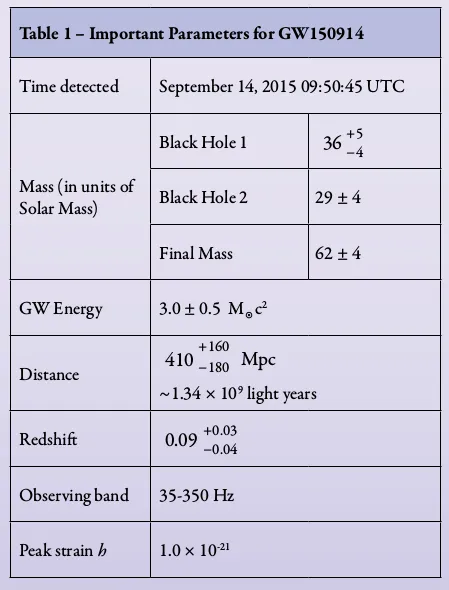
The discovery card is the one shown below, which includes the parameters of the detection of the Gravitational Waves found on 09-14-2015 (GW150914):
The mass in units of solar masses would be 36 and 29 (final mass 62).
Black holes
A black hole is NOT a hole. It is a place in space where gravity is so strong that matter or energy cannot escape (unless it has a speed greater than the speed of light, which is considered impossible).
What happens is that the escape velocity is greater than the speed of light. If we want to put a satellite into orbit or, with a single impulse, throw a tennis ball "up" and have it escape Earth's gravity and orbit the planet, we need a certain amount of energy that translates into escape velocity. In the case of our planet it is 11 km/s (approx.).
If such a speed were greater than the speed of light, then we could never leave Earth.
The distance at which light cannot escape is called the event horizon. A black hole with the mass of our Sun would have an event horizon with a radius of 3 km. In other words, if we compress the mass of the Sun to only a 3 km radius, we would have a black hole.
One way a black hole forms is from an exploding star that has 25 times the mass of the Sun.
CONSEQUENCES
It is difficult to predict the consequences of a discovery. "This detection is the beginning of a new era: the field of gravitational wave astronomy is now a reality", said Gabriela González, spokesperson for the LSC and professor of physics and astronomy at Louisiana State University.
It feels like a new chapter is opening in contemporary cosmology and a new field of exploration that receives the impulse of the empirical confirmation of a theoretical framework. However, it is necessary to remember that the General Theory of Relativity is incompatible with quantum mechanics.
The following reflection on the possible and the impossible is worth making: for a few decades now, "dark matter", "dark energy" or, as I said, a theoretical framework that interweaves the two great theories linked to cosmology has been sought.
Currently astrophysicists are thinking that perhaps there are several forms of dark matter. One might think they are in a dead end, going around in circles to maintain a theoretical framework that has not provided enough evidence. That's what science is about, evidence. But history also teaches that something impossible is not the same as something difficult.
Bruce Allen, director of the Max Planck Institute for Gravitational Physics (Albert Einstein Institute), adds: "Einstein thought gravitational waves were too weak to be detected, and he didn't believe in black holes. But I don't think he would have minded being wrong!"
Sources and related links
Direct observation of gravitational waves - Educators Guide
LIGO http://bit.ly/1T9d0PN
This guide was written by Kevin McLin, Carolyn Peruta and Lynn Cominsky. Layout and Design by
Aurore Simonnet. SSU Education and Public Outreach Group, Sonoma State University, Rohnert Park, CA
GRAVITATIONAL WAVES DETECTED 100 YEARS AFTER
EINSTEIN'S PREDICTION
Press release LIGO Collaboration https://www.ligo.caltech.edu/WA/news/ligo20160211
"Observation of Gravitational Waves from a Binary Black Hole Merger"
Phys. Rev. Lett. 116, 061102 – Published 11 February 2016 http://authors.library.caltech.edu/64405/
About the images
Figure 1: Curvature of spacetime
Credit: LIGO/T. Pyle
Figure 2: Gravitational wave spectrum
Credit: SSU E/PO/Aurore Simonnet
Figure 3: interference pattern
Credit: SSU E/PO Aurore Simonnet
Figure 4: Combined Hanford-Livingston data
Credit: LIGO
Figure 5: Approximate location of LIGO signals. Credit:
LIGO/Roy Williams, Shane Larson and Thomas Boch
Figure 6: Data from the LIGO GW150914 signals.
Credit: LIGO.
Initial image from https://www.black-holes.org/gw150914
Numerical-relativistic Simulation: S. Ossokine , A. Buonanno (Max Planck Institute for Gravitational Physics)
Scientific Visualization: W. Benger (Airborne Hydro Mapping GmbH)