A new study using data from the Chandra X-ray Observatory reveals that many supermassive black holes rotate extremely fast. This generates powerful jets that supply large amounts of energy to their surroundings and affects the growth of the galaxy.
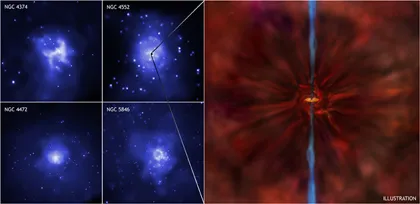
A team of scientists compared theories of jets produced by rotating supermassive black holes with Chandra data. A sample of nine giant galaxies exhibiting large disturbances showed that the central black holes in them must be rotating near the maximum rate.
"We think these monstrous black holes are spinning near the limit set by Einstein's Theory of Relativity, which means they can drag material around them near the speed of light," says Rodrigo Nemmen, of Penn State and author of a paper presented at the Meeting of the American Astronomical Society in Texas.
The research reinforces previous studies that had indicated this possibility. Computer simulations previously performed by other authors suggested that black holes could acquire their rapid spins when galaxies merge.
A consequence of this rapid rotation is the generation of powerful jets of matter that affect the galaxy's environment by heating the gas. By preventing the cooling of the gas through this heating, the star formation rate is affected, limiting the size of the galaxy. Understanding the details of this process between supermassive black holes and the formation of the most massive galaxies remains an important goal in astrophysics.
Sources and related links
*Chandra Data Reveal Rapidly Whirling Black Holes
About the images
Images of NGC 4374, NGC 4472, NGC 4552 & NGC 5846, 4 of the 9 large galaxies included in the study that contain large black holes in their centers.
Large cavities are shown in the hot gaseous atmospheres of the galaxies created in each case by jets produced by the black holes.
The four galaxies in the image belong to the constellation Virgo. The masses of the black holes (in billions of solar masses) are 0.6, 0.4, 0.7 and 0.4 respectively.
The distances of the galaxies to Earth (in millions of light-years) are 55 in the first three cases and 146 for NGC 5846.
Credit: NASA/CXC/UFRGS/R.Nemmen et al.; Illustration: NASA/CXC/M.Weiss
More images at More Images of Spinning Black Holes Survey