No. It's not a gigantic alien moth coming to devour our planet. It's the young star HD 61005 surrounded by a dust disk.
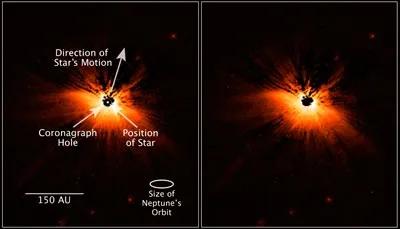
"It is completely unexpected to find a disk with this unusual shape," says Dean Hines, of the Space Science Institute, a member of the Hubble team that discovered the disk.
Scientists think the star is moving through very dense gas in the interstellar medium, causing the material in the star's disk to be swept behind it. The star is located 100 light-years (or 31 parsecs) away in the constellation Puppis.
The discovery was made as part of a study of Sun-like stars with the Hubble's near-infrared cameras and the NICMOS camera and Spitzer to study the formation and evolution of planetary systems.
Hines and his colleagues reported their results at the meeting of the American Astronomical Society in Austin. The results also appeared in the December 20 edition of Astrophysical Journal Letters.
Sources and related links
- *Nasa/Goddard:Circumstellar Dust Takes Flight in 'The Moth'
- *HubbleSite:Circumstellar Dust Takes Flight in 'The Moth'
- *The Astrophysical Journal Letters, 671:L165–L168, 2007 December 20
The Moth: An Unusual Circumstellar Structure Associated with HD 61005
Dean C. Hines, Glenn Schneider, David Hollenbach, Eric E. Mamajek, Lynne A. Hillenbrand, Stanimir A. Metchev, Michael R. Meyer, John M. Carpenter, Amaya Moro‐Martín, Murray D. Silverstone, Jinyoung Serena Kim, Thomas Henning, Jeroen Bouwman, and Sebastian Wolf
DOI: 10.1086/525016
About the images
Credit:NASA, D. Hines (Space Science Institute, Corrales, New Mexico), and G. Schneider (University of Arizona)