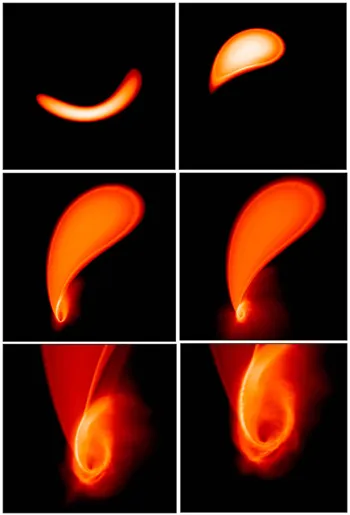
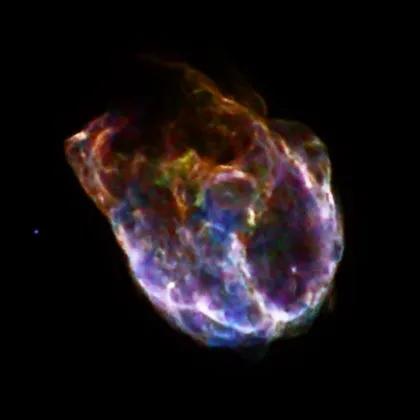
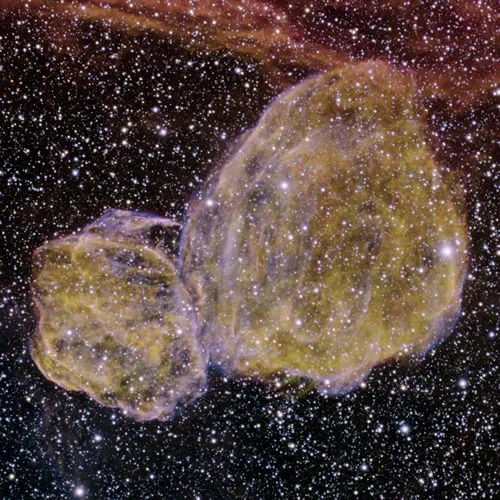
SN 2007on in NGC 1404: Using data from the Chandra X-ray Observatory, scientists reported the possible detection of a stellar binary system that was later destroyed in a supernova explosion. The new method used promises to find the detailed origins of these important cosmic events.
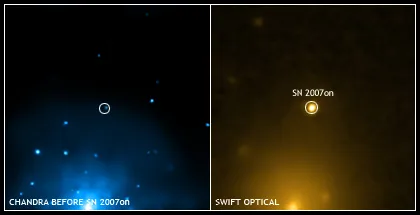
These images show evidence of the possible detection of a binary system that was later destroyed in a supernova explosion. The right panel shows an optical image from the SWIFT satellite of the elliptical galaxy NGC 1404. At the center of the image is supernova SN 2007on, originally discovered by the 0.25 m robotic TAROT telescope at La Silla in November 2007. The left panel shows an image from the Chandra X-ray Observatory of the same field taken four years before the supernova detection.
The position of SN 2007on in the Chandra image is shown with a white circle. The initial search for the supernova progenitor, reported in Nature, argued that the X-ray source lying within the circle is likely the progenitor of the explosion. This claim was based on two main pieces of evidence: (1) the probability of a source being so close by coincidence is small and (2) the X-ray source has properties similar to those expected for a particular type of progenitor predicted by theoretical work.
In an article in the February 14 issue of Nature, Rasmus Voss of the Max Planck Institute and Gijs Nelemans of Radboud University found an object near the position of a recently detected supernova, in an image taken four years before the explosion.
However, this study included a relatively large uncertainty in the supernova's position. Subsequent studies, to be published, used higher quality optical images to better determine the explosion's position. That work showed there is a small but significant difference in the measured positions of the supernova and the X-ray source, suggesting the source might not be the progenitor. The difference is visible in the left panel as the difference between the X-ray source and the center of the white circle. (Click the image to go to the Chandra site and see the enlarged image)
SN 2007on was a Type Ia supernova, an important class of object used to measure the expansion of the Universe. They are generally produced by the explosion of a white dwarf in a binary stellar system. The progenitor of a Type Ia supernova has never been detected, but it promises to answer important questions about the exact configuration and trigger of these explosions.
Is the explosion due to a collision between two white dwarfs or because a white dwarf becomes unstable after taking too much material from a companion?
If the second possibility is correct, the material on the star's surface should heat it and produce a powerful X-ray source before the explosion. Once the supernova occurs, the white dwarf would be completely destroyed and would be undetectable in X-rays.
Chandra follow-up observations indicate the object has indeed disappeared, but more observations are needed to decide if the source was the progenitor or not. Another possible explanation is that the nearby X-ray source is not related to the supernova explosion.
The team is applying this new method to other supernovas and has hopes of success in identifying the elusive causes of at least some of these explosions.
Voss says that, even if the X-ray source was not the progenitor of SN 2007on, the hunt is well worth the effort.
"Finding the progenitors of these Type Ia supernovas is a major pursuit in astronomy today. These supernovas are good tools for studying dark energy, but if we knew more about them, they would become even better tools," explain the scientists.
Sources and related links
- Chandra: Possible Progenitor of Special Supernova Type Detected
- Discovery of the progenitor of the type Ia supernova 2007on p802
Nature 451, 802-804 (14 February 2008) | doi:10.1038/nature06602; Received 22 November 2007; Accepted 13 December 2007
About the images
Credit: X-ray: NASA/CXC/MPE/R. Voss et al.; Optical: NASA/Swift