This image from the Chandra X-ray Observatory shows the remains of the explosion of a massive star -N132D- in the Large Magellanic Cloud, a small neighbor of the Milky Way, 160,000 light-years away.
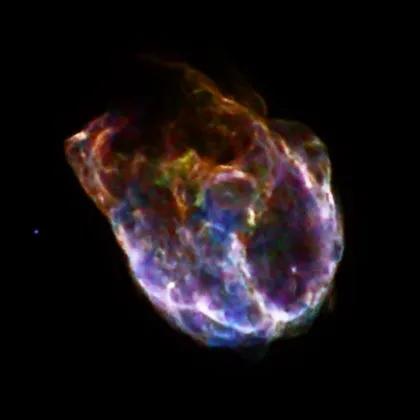
The supernova remnant, N132D, is the brightest in the Magellanic Clouds and belongs to a rare class of oxygen-rich remnants. Most of the oxygen we breathe on Earth is thought to come from explosions similar to this one.
The colors in the image show low-energy X-rays (red), intermediate and high-energy (blue) from the remnant located in the constellation Dorado. Considerable amounts of oxygen are detected in the image, particularly in the green regions near the center of the image. The location of these oxygen-rich areas, detected in the Chandra image, generally agrees with the areas detected by the Hubble telescope.[1]
However, the expanded, elliptical-shaped shell of oxygen seen here is not seen in either G292.0+1.8 or Puppis A, two oxygen-rich remnants in the galaxy with similar ages to N132D (about 3,000 years). The origin of this shell is unknown, but it could have been created by a "nickel bubble" shortly after the supernova explosion. The existence of such bubbles is predicted by theoretical work.
The essential goal of these observations is to limit the mass of an exploding star and learn how massive stars expel heavy elements like oxygen into the surrounding space.
Sources and related links
- Chandra:An Oxygen Factory in a Nearby Galaxy
- [1]See Hubblesite:Oxygen-Rich Supernova Remnant in the Large Magellanic Cloud
About the images
Credit:NASA/CXC/NCSU/K.J.Borkowski et al.