The Gemini South Multi-Object Spectrograph (GMOS) recently captured a stunning image of a vast cloudy complex called DEM L316 located in the Large Magellanic Cloud. The peanut-shaped nebula appears to be a solitary object, but according to the latest research, it would encompass two distinct clouds of gas and dust formed by different types of supernova explosions.
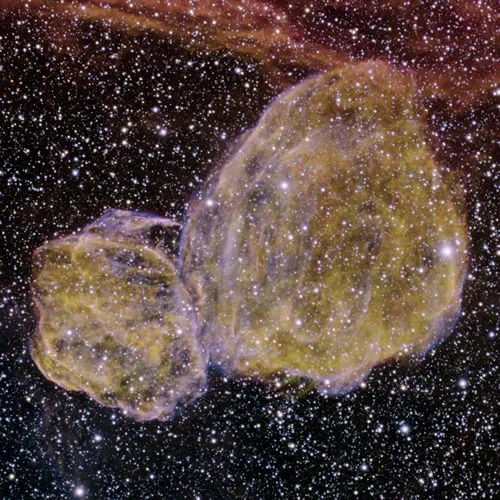
The new image shows the tangled filaments of gas and dust located in the remnants of the stellar explosions that created the cloudy complex which continues to expand. This object was first recognized in the early 70s as a supernova remnant, a type of object that is enriched with elements created in stellar explosions. The nebula likely formed a couple of 10 thousand years ago as a result of more than one supernova explosion in this region of the Large Magellanic Cloud.
"The incredible clarity of these observations made from Gemini South shows the complex shock structure of these two supernova remnants with impressive detail," notes Dr. Rosa Williams of Columbus State University, an astronomer who has studied DEM L316 in depth. "It is a great step forward in our efforts to understand this fascinating pair of remnants – whether they represent merely a chance alignment in the sky or some – still hidden physical relationships."
Other recent observations of DEM L316 made with Chandra and the XMM-Newton space X-ray telescopes have strengthened the idea that the cloud would be two supernova remnants that are aligned in the sky and not a single remnant with a distorted bipolar shape. Chandra observations reveal that the chemical compositions of the two shells are very different. This is a strong indication that they were created in different types of supernova explosions. The data show that the smaller shell (at the lower left in the GMOS image) contains significantly more iron than the larger one. This high abundance of iron in the small bubble indicates that the gas is the product of a Type Ia supernova. This type of explosion is triggered by the fall of material from a star onto a white dwarf. Because white dwarfs are extremely old objects, the system must have been a couple of billion years old when this supernova explosion occurred.
In contrast, the larger bubble, less rich in iron, is the result of a supernova Type II that was triggered by the collapse of a massive star (with a mass more than seven times the mass of our Sun) when it was only a couple of million years old. Since the two progenitor systems had different ages when they "went supernova," there is little chance they came from the same system. Therefore, although the detailed structure seen in the GMOS image makes them look like two colliding bubbles, it only seems that they are together in the sky due to an alignment from our point of view.
The Large Magellanic Cloud (LMC for its acronym in English) is a sister satellite galaxy to our Milky Way and is located about 160,000 light-years away in the direction of the constellation Dorado. The DEM L316 nebula is located within the LMC and its two bubbles extend over a distance close to 140 light-years (approximately 35 times larger than the distance between the Sun and our closest stellar neighbor).
The spectacular X-ray images of DEM L316 obtained with Chandra can be seen at: http://chandra.harvard.edu/photo/2005/d316/
DEM L316 was also photographed as part of The Magellanic Cloud Emission Line Survey (MCELS) survey. Wide-field images of the target and its surroundings in the LMC are available at:
30 Doradus, the Tarantula Nebula, in the Large Magellanic Cloud (LMC) and Large Magellanic Cloud
Rosa Williams of Columbus State University and You-Hua Chu of the University of Illinois published an extensive study of the double supernova remnants in the Astrophysical Journal (ApJ, 635, 1077, 2005). That paper also reviews previous work done on this target.
Sources and related links
- *Gemini:Supernova Remnants Dance in the Large Magellanic Cloud
- *Supernova Remnants in the Magellanic Clouds. VI. The DEM L316 Supernova Remnants
R. M. Williams and Y.‐H. Chu
The Astrophysical Journal, 635:1077–1086, 2005 December 20
DOI: 10.1086/497681 - *EurekAlert:Supernova remnants dance in the LMC
About the images
Recently published optical image of DEM L316 made with GMOS on Gemini South. This image was obtained as part of the Gemini Legacy Imaging Survey which is led by: P. Michaud, S. Fisher, and R. Carrasco of Gemini as well as T. Rector of the University of Alaska in Anchorage.