Astronomers from the University of Rochester announced that low-mass stars and even planets a bit larger than Jupiter could be responsible for the creation of the most impressive objects in the sky: planetary nebulae.
The news is ironic because the name "planetary" nebula has always been improper.
The great mistake that persists to this day is due to the fact that the English astronomer William Herschel discovered one of these objects when he was still euphoric due to his recent discovery of the planet Uranus in 1781. Observing the object that today bears the designation NGC 7009, he believed he was observing a nebulous celestial body "similar in appearance to the planet Uranus" and that pushed him to nickname it a "planetary nebula".
In the mid-19th century, scientists realized that they are, in fact, large clouds of dust emitted by dying stars.
Now, the Rochester researchers found that planets or low-mass stars could be responsible for the creation of these fantastic nebulae. That is to say, if confirmed, now the name would indeed make some sense.
In a new paper in Astrophysical Journal Letters, as well as in recent papers in Monthly Notices of the Royal Astronomical Society, a team of astronomers led by Eric Blackman studied the consequences of a dying star that has a companion orbiting it.
"Few researchers have explored how something as small as a low-mass star, a brown dwarf, or even a massive planet, can produce different types of nebulae and even change the chemical composition of the dust around these evolved stars," says Blackman.
Most medium-sized stars, like our Sun, will end their lives as planetary nebulae, says Blackman. The period lasts only several tens of thousands of years - a blink for stars that typically live ten billion years - so they are relatively rare. Of the 200 billion stars in our galaxy, only about 1500 have been identified in the planetary nebula stage.
As a star begins to exhaust its fuel, near the end of its life, its core contracts and its envelope expands, to finally eject the outer layers into space. This produces the distinct and colorful shapes of planetary nebulae.
The Rochester team explored the role of low-mass companions in shaping planetary nebulae, both if the companion is in a large orbit and interacts only with the outer parts of the star's envelope, and if the companion is in a tighter orbit and so close to the star that the companion is devoured by the envelope.
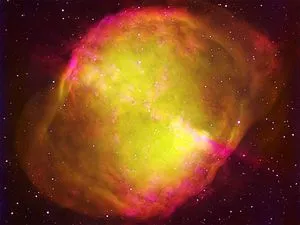
Blackman and his colleagues showed that in the first case, the gravity of the planet or stellar companion begins to drag some material from the envelope around it. The material - essentially a thin mixture of gas and dust - is compressed into spiral waves radiating from the central star. The gas and dust condense more and more in these spiral waves until finally a toroid of dust forms around the middle region of the star, probably blocking the expansion of the envelope like a belt around an inflating balloon. Over time, that limited contraction can lead to the surprising shapes like those seen in the Dumbbell Nebula.
"Originally we only wanted to model the geometry of the envelope under the influence of a binary companion, but Richard Edgar discovered that when the spiral wave breaks, it releases the pent-up energy in a burst of heat, enough to melt the dust into liquid globules," says Blackman. These globules cool slowly enough to give the molecules time to align into crystalline lattices. The work suggests an answer to why astronomers have detected the puzzling signature of crystallized dust around evolved stars before the nebula forms.
In the case where the planet orbits so close to the star that it is swallowed by the envelope, a new type of model is required. The scientists modeled what could happen and found that one of three outcomes is likely to occur.
First, as the companion is devoured by the envelope of material, it can accelerate the envelope so rapidly that the material is ejected, deforming into a long disk around the star's equator.
A second possibility is that the companion accelerates the envelope more gently. This causes the inner regions of the envelope to rotate around the primary star more rapidly than the outer envelope. This difference in rotation speed, combined with the convection of material in the envelope, stretches and amplifies the star's magnetic fields, which could act like a giant spring ejecting the envelope material from the star's poles as jets.
The third outcome is that the companion itself could be ejected from the star's jets. This would occur when the planet or star is too small to eject the envelope before falling to its violent fate. The primary star with its intense gravity would shred the companion into a disk of debris. This turbulent disk whose parts orbit at different speeds would generate a dynamo that, again, would hurl the material through the star's poles at tremendous speed. The ejected material would include the remains of the companion.
The team is calculating the dynamics of the binary relationship and the characteristics of the dynamos with greater precision. They hope to better understand how these dynamos could facilitate the mixing and transport of different elements in the nebula to help produce the distinctive chemical signatures that astronomers detect in a planetary nebula.
Sources and related links
- EurekAlert: Finally, the 'planet' in planetary nebulae?
- The Formation of Crystalline Dust in AGB Winds from Binary-induced Spiral Shocks
The Astrophysical Journal, 675:L101–L104, 2008 March 10 - DOI: 10.1086/533436
Richard G. Edgar, Jason Nordhaus, Eric G. Blackman, and Adam Frank - Univ. of Rochester: Finally, the 'Planet' in Planetary Nebulae?
- List of planetary nebulae on Wikipedia
About the images
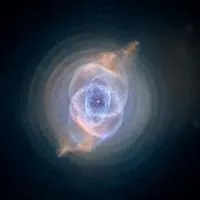
Cat's Eye Nebula or NGC 6543.
Credit: NASA
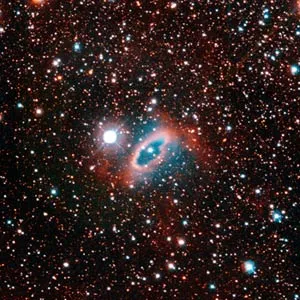
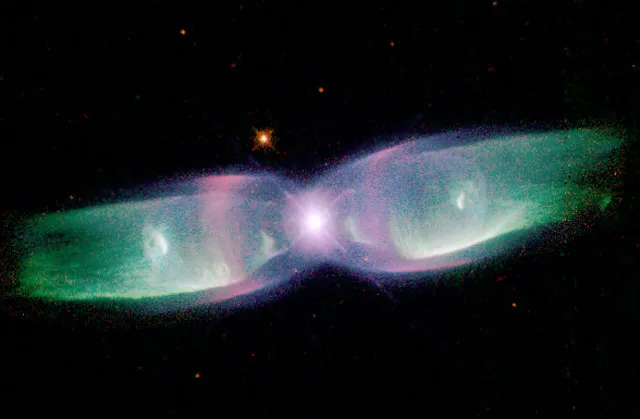
Nebula M2-9 or Butterfly Wings Nebula.
Credit: NASA
Dumbbell Nebula or NGC 6583 or Messier Object 27
Credit: NASA