A team of astronomers is busy with a detective investigation in which they have two suspects, traces of violence, but no corpse.
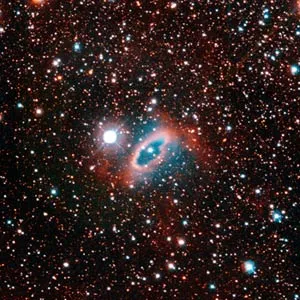
The southern planetary nebula SuWt 2 is the crime scene, about 6,500 light-years from Earth in the direction of the constellation Centaurus.
The nebula consists of a bright ring of gas. Faint lobes extend perpendicularly to the ring, giving the more diffuse parts of the nebula an hourglass shape.
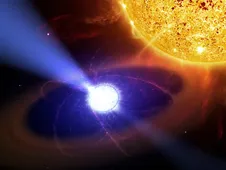
These bright ejections are suspected to have been energized by a star that has already collapsed into a white dwarf. The problem is they cannot find the white dwarf that should be there.
The mystery deepened when researchers obtained ultraviolet observations in the 1990s with the international Ultraviolet Explorer satellite, hoping to see signs of a faint but very hot star. However, no ultraviolet radiation was detected.
Instead, at the center of the nebular ring are two suspects: a pair of stars that orbit each other every five days, neither of which is a white dwarf. These stars are hotter than our Sun (their spectral class is A) but not hot enough to make the nebula glow. Only a flow of ultraviolet radiation, like that from white dwarfs, could achieve it.
The study is being conducted by Katrina Exter and Howard Bond of the Space Telescope Science Institute in Baltimore and a team of British and American colleagues. According to spectroscopy and photometry data, the two stars are larger than main-sequence stars of their masses. This implies they have begun to evolve into red giants. Both stars appear to be rotating more slowly than expected: they would be expected to always face each other, but they do not.
The astronomers suggest a simple explanation for the facts at the scene: the stars at the center of SuWt 2 were born as a family of three members, with A stars orbiting very closely and a more massive star orbiting farther out. This allowed the massive star to evolve into a red giant that only then engulfed the other pair of stars. Trapped in the common envelope of the red giant, the pair of stars spiraled inward toward the core, causing the envelope to rotate more rapidly. Finally, the outer layers of the red giant were ejected in the orbital plane, producing the ring-shaped nebula seen today. The unusual rotation speed of the two A stars would have been another consequence produced by the giant sister.
Ground-based observations were obtained with the Cerro Tololo telescopes in Chile, the ESO New Technology Telescope, also in Chile, the Anglo-Australian Telescope, and the South African Astronomical Observatory.
The ultraviolet radiation from the hot exposed core of the red giant would have caused the nebula to glow. If the core was massive enough, it would have shrunk and cooled rapidly into a faint white dwarf, which could explain its current invisibility.
The results are being presented at the 212th Meeting of the American Astronomical Society in St. Louis.
Sources and related links
White Dwarf Lost in Planetary Nebula
About the images
Credit: NASA, NOAO, H. Bond and K. Exter (STScI/AURA)