A galaxy cluster in a very primitive state of formation was discovered at 11.4 billion light-years from Earth, the most distant of its type ever detected. Those galaxies are so far away that the Universe was in its infancy when their light was emitted.
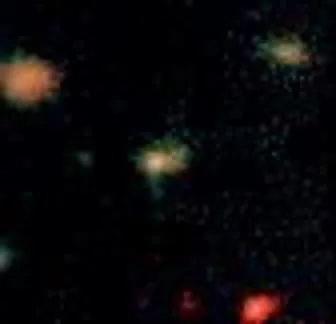
The proto-cluster of galaxies, called LBG-2377, is giving scientists an unprecedented look at galaxy formation and how the Universe evolved. Before this finding, the most distant similar event was at 9 billion light-years away.
"When you observe objects so distant, you are seeing the Universe as it was long ago," says Jeff Cooke, a scientist at the University of California Irvine (UCI) and lead author of the study.
Using the Keck telescope in Hawaii, Cooke detected the cluster while searching for galaxies. At first, it looked like a bright, single object. But after analyzing the wavelengths of its light he discovered it was three galaxies merging, and probably two other additional smaller galaxies.
Scientists use light to look back in time. Since light takes a measurable amount of time to travel, detecting it on Earth allows scientists to see the source as it was thousands or millions or billions of years ago. In this case, LBG-2377, scientists believe the light has traveled for 11.4 billion years, starting a few billion years after the Big Bang when the Universe was only 15% of its current age. In comparison, Earth formed 4.5 billion years ago.
The process of galaxy formation is, to a large extent, a mystery. The current theory is that larger galaxies formed over time from the interaction and merger of smaller galaxies. This process would have begun more than 12 billion years ago, shortly after the origin of the Universe. Scientists have observed galaxies merging across a large range of distances and time, which provides strong evidence to reaffirm the theory. However, using current technology, it is difficult to detect this process at the most extreme distances, when galaxy formation was in its infancy.
As scientists think, galaxy clusters form in a similar way. As galaxies congregate and interact in long, dense regions of space, the cluster grows over time. Witnessing this process helps astrophysicists confirm their theory and deepen their understanding of the Universe. Galaxy clusters can be detected at extreme distances with modern technology because they are bright, but they are equally difficult to find.
Clusters near our planet contain up to a thousand galaxies. Our Milky Way belongs to a smaller grouping called the Local Group, which contains more than 35, but only a few are bright.
"We believe LBG-2377 is a seed that finally grew into a massive galaxy cluster," says James Bullock, director of the cosmology center at UCI.
"Our discovery suggests this is a monstrous structure that was born in a very catastrophic and bright event with a lot of gas and matter collapsing at once. We are not seeing a solitary galaxy. We see a handful of bright galaxies coming together at the dawn of structure formation in the Universe."
Sources and related links
- EurekAlert:Newly discovered galaxy cluster in early stage of formation is farthest ever identified
- UCI:Newly discovered galaxy cluster in early stage of formation is farthest ever identified
- A Candidate Brightest Proto-Cluster Galaxy at z = 3.03
Authors: Jeff Cooke, Elizabeth J. Barton, James S. Bullock, Kyle R. Stewart, Arthur M. Wolfe
About the images
Proto-Cluster of galaxies LBG-2377
Credit:UCI