Some of the oldest objects in the Universe could still have much more to offer, according to a new study using the Chandra Observatory. These new results indicate that globular clusters could be surprisingly less mature in their development than previously thought.
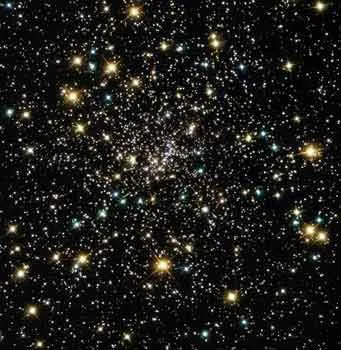
Globular clusters, dense groupings of millions of stars found in all galaxies, are among the oldest objects in the Universe, with ages between 9 to 13 billion years. Since they contain some of the first stars to form in a galaxy, they are vital in understanding the evolution of galaxies.
"For many years, globular clusters have been used as wonderful natural laboratories to study the evolution and interaction of stars," says John Fregeau of Northwestern University, who led the study.
Conventional wisdom is that globular clusters go through three phases of evolution or development of their structure, corresponding to adolescence, middle age, and old age. These stages refer to the evolutionary state of the cluster, not the physical ages of individual stars.
In the adolescent phase, stars near the center of the cluster collapse inward. Middle age refers to the phase in which interactions of double stars near the center of the cluster prevent further collapse. Finally, the last stage describes when the binaries in the center are disrupted or ejected and the cluster's center collapses inward.
For years, it was thought that most clusters are middle-aged with some toward the end of their evolution. However, data from Chandra along with theoretical work suggest this may not be the case.
When single and double stars interact in the crowded centers of globular clusters, the binaries can transfer mass and emit X-rays. Since double stars are expected to form mostly in the middle age of cluster evolution, the relative number of X-ray sources gives clues to the evolutionary stage of the clusters.
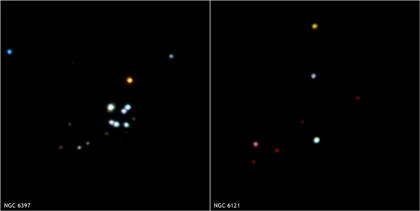
A new study by Fregeau of 13 globular clusters in the Milky Way shows that three of them have a large and unusual number of X-ray sources or X-ray binaries, suggesting the clusters are middle-aged. Previously, these clusters had been classified as old because they have a very tight concentration of stars in their centers, another "litmus test" of age used by astronomers.
The implication is that most globular clusters, including the other ten studied in this case, are not in their evolutionary middle age, as thought, but in their adolescence.
"It is remarkable that these objects, which were thought to be some of the oldest in the Universe, could actually be very immature in their development," says Fregeau, whose paper appears in The Astrophysical Journal. "This would represent a major shift in thinking about the current state of cluster evolution."
If confirmed, this result could help reconcile other observations with recent theoretical work suggesting that the tight concentration of stars in the centers of most evolved globular clusters is consistent with them being in their middle age rather than their advanced evolutionary phase. Other theoretical studies have suggested it could take longer than the current age of the Universe for a globular cluster to reach an old age.
Besides improving the understanding of the basic evolution of these objects, the result has implications for knowledge about stellar interactions in dense environments. Furthermore, it removes the need for exotic mechanisms—some that include black holes—that were thought to be necessary to prevent the many middle-aged clusters from collapsing.
"Some exotic scenarios, including some of my own authorship, have been evoked to try to make sense of the observations and save the old theory. If this result holds, we won't have to worry anymore about exotic scenarios," adds Fregeau.
Sources and related links
- Chandra: Oldest Known Objects May Be Surprisingly Immature
- X-Ray Binaries and the Current Dynamical States of Galactic Globular Clusters
John M. Fregeau
The Astrophysical Journal Letters. Volume 673, Issue 1, Page L25–L28, Jan 2008
arXiv:0801.1071v1
About the images
Chandra images of two globular clusters NGC 6121 & NGC 6397, located in the Milky Way.
Credit: NASA/CXC/Northwestern Univ/J.Fregau
The core of the globular cluster NGC 6397 seen by the Hubble Space Telescope. It is located 8200 light-years away in the constellation Ara.
Credit: NASA and The Hubble Heritage Team (AURA/STScI)