An international team of astronomers found a dozen planets orbiting stars other than our Sun.
Team leader Don Pollaco of Queen's University Belfast will announce the findings in his talk at the Royal Astronomical Society meeting.
The international collaboration is called "SuperWASP" for Wide Area Search for Planets. The team used a system of robotic cameras. This planet-finding technique yields more information about the formation and evolution of planets than the gravitational technique, according to the team.
Astronomers look for so-called "transits", moments when planets pass in front of their star, as in an eclipse, seen from our planet.
In the last six months, the SuperWASP team used two batteries of cameras, one in Spain, in the Canary Islands and another in South Africa, to discover a dozen new worlds.
With the gravitational technique, scientists have discovered around 270 exoplanets since the 1990s. That technique consists of measuring the gravitational pull on the star, exerted by an orbiting planet. As the planet moves, it tugs on the star, generating a small (very small) oscillation. However, to produce results, it is necessary to make observations over several weeks or months.
The technique applied by the team involves two sets of cameras to observe events known as transits, where planets pass directly in front of their star and partially block its light. These cameras probe a wide field of the sky. Each night astronomers receive data from millions of stars and can thus search for transits and therefore planets. The technique also allows scientists to deduce the size and mass of each planet.
A team of collaborators around the globe follows up each possible planet found by SuperWASP with more detailed observations to confirm or reject the discovery.
Astronomers working at the Las Cumbres Observatory use robotically controlled telescopes in Arizona, Hawaii and Australia that provide high-quality data to select the best candidates for intense observation. This, together with data from the Nordic Optical Telescope in La Palma, Spain, the Euler Telescope in Chile and the Haute Provence Observatory in southern France, provide the final confirmation of the new discoveries.
A total of 46 planets have been found transiting their stars. Since they began operating in 2004, the SuperWASP cameras have found 15 of these. The ones they recently found are the ten from WASP-6b to WASP-15b.
The discovered planets have masses ranging from a medium weight of half that of Jupiter to more than eight times the size of that planet.
Some of the discovered planets seem to be somewhat exotic. For example, WASP-12b, is a planet so close to its star that its daytime temperature can reach 2300 degrees Celsius. Furthermore, it takes just over a day to orbit its star. (The orbit of the Earth around the Sun is what we call a "Year". In this case, a "Year" on that planet would last just over 24 of our hours!)
Sources and related links
EurekAlert:Scientists discover 10 new planets outside solar system
About the images
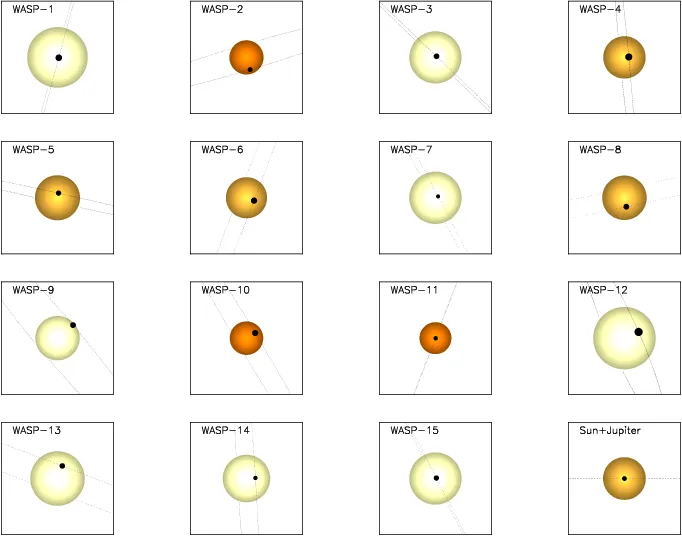
Scale diagram of the Planet/Star ratio for the 15 WASP planets, plus the Jupiter/Sun ratio
In Scale Diagram of Planet/Star Ratio for the WASP Planets