Dr. John C. Mather received the 2011 Daniel Chalonge Medal during the 15th Paris Colloquium. Furthermore, the Chalonge International School issued a statement in support of the James Webb project.
The International School of Astrophysics "Daniel Chalonge" awarded its 2011 medal to the distinguished 2006 Nobel Laureate, Dr. John Mather, for the results from the COBE satellite.
Dr. Mather is an astrophysicist at the Observational Cosmology Lab at NASA's Goddard Space Flight Center.
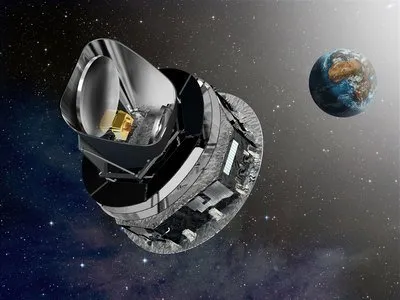
The prize was awarded in recognition of his enormous contribution to modern cosmology and, in particular, for his valued effort in promoting and leading key missions for the study of the universe, such as with the COBE satellite and now with the James Webb Space Telescope.
Mather was surprised with the award on July 22 during the final session of the 15th Paris Cosmology Colloquium at the city's Observatory, which was attended by about a hundred participants from around the world, including Dr. Mariano Javier de León Domínguez Romero (IATE-CONICET) and Félix Mirabel (IAFE).
Only eight medals in 20 years
John Mather received the eighth medal awarded by the School in its twenty-year history. The first was awarded in 1991 to astrophysicist and Nobel Laureate in physics Subramanyan Chandrasekhar (1910-1995). The second, in 1992, distinguished Bruno Pontecorvo (1913-1993), a pioneer of neutrino physics. In 2006, George F. Smoot, a cosmologist and also a Nobel Laureate that year -together with Mather-, received the third original copy of the medal. The notable French sculptor who designed it, Madeleine Pierre Quérolle, now 95 years old and still active in her Parisian workshop, offered her own original copy of the medal for Smoot. Motivated by the Nobel Prize in physics, the French Mint struck in February 2007, exclusively for the Chalonge School, a second limited edition of the medal. That made possible the subsequent awards to Carlos Frenk, Anthony Lasenby, Bernard Sadoulet, Peter Biermann and John Mather.
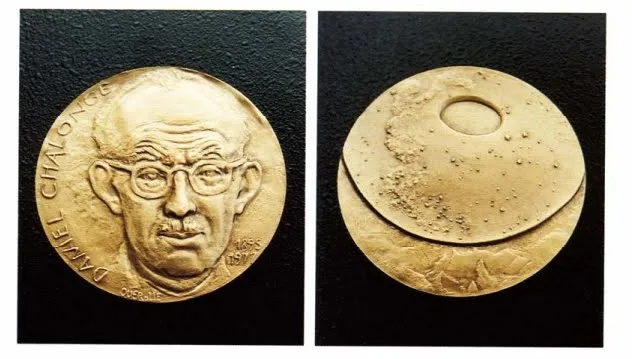
The coin features a portrait of Daniel Chalonge on one side, while the reverse is composed of two scenes: the upper half depicts the mirror of a telescope in which a portion of the Milky Way and the constellation Orion are reflected. The lower half depicts the French Alps and the "Chalonge Peak" at 3,343 m high, named in honor of the French astrophysicist.
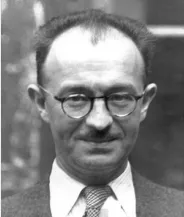
Daniel Chalonge (1895-1977) was a pioneer in France in introducing modern physics into astronomy, stellar spectroscopy and stellar and atmospheric spectrometry. He worked on the conception and construction of new instruments such as the hydrogen tube, the spectrograph to reach the far ultraviolet, and the microphotometer that bears his name. He was one of the founders of the Paris Institute of Astrophysics. The lunar crater Chalonge was named in his honor. The Daniel Chalonge Museum exists in Erice, Italy.
Two Argentines among the cream of astrophysics
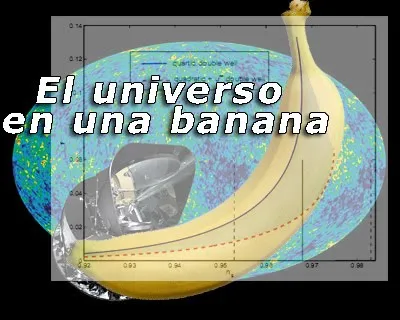
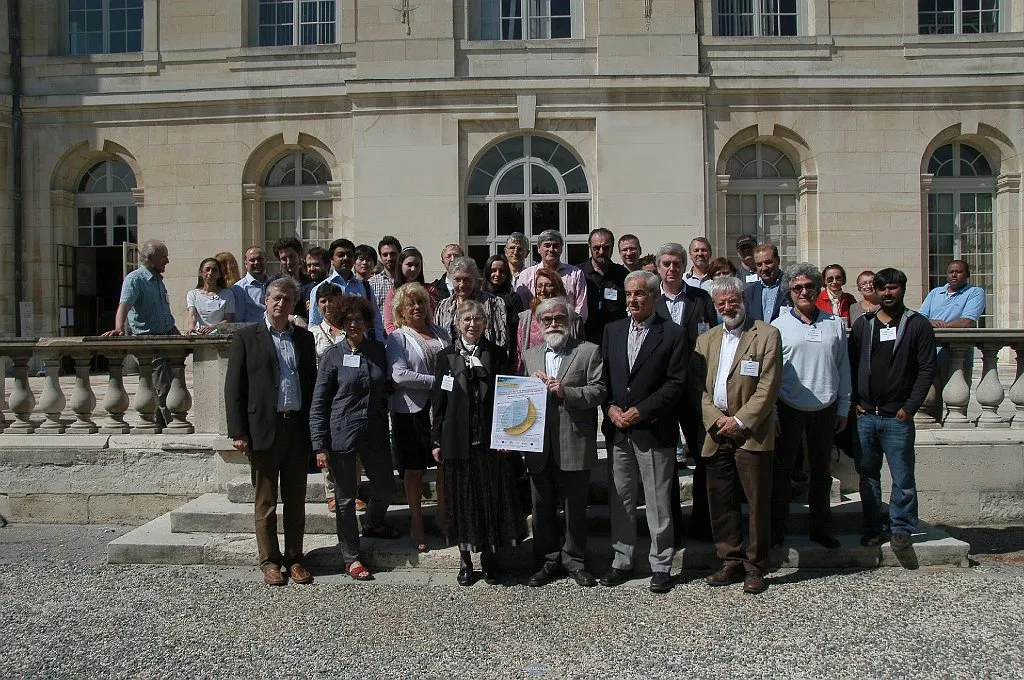
I have commented here on previous occasions about Dr. Norma Sánchez and Héctor de Vega, two Argentines residing in France, at the Paris Observatory. Dr. Sánchez is the director of the International School of Astrophysics "Daniel Chalonge". She is the author of more than a hundred publications in specialized journals, including a paper in Astrophysical Journal that I commented on here with the title "The universe in a banana" and which, as can be seen in the photo below, was the leitmotif of the recent cosmology colloquium in Paris.
Statement of support for the James Webb Telescope

During the 2011 Paris Cosmology Colloquium, the following statement was made:
The International Daniel Chalonge School considers the James Webb Space Telescope (JWST) to be an exceptional opportunity for the future of astrophysics and astronomy worldwide. The International Daniel Chalonge School recognizes the incredible scientific value of the JWST project, its potential and global impact, and strongly supports its development and successful completion.
Signed by Norma G. Sanchez, director of the International School (CNRS, Paris Observatory); Héctor J. de Vega (CNRS, Pierre and Marie Curie University); María Cristina Falvella (Italian Space Agency); Alba Zanini (National Institute of Nuclear Physics -INFN- of Turin).
The successor to Hubble adrift
The economic problems of the United States do not go unnoticed for that country's science. An example is the project of this phenomenal instrument that seems to consume a large part of the scientific budget. A committee of the U.S. Congress wants to stop that hemorrhage. They point to the astronomical budget increase, which went from 5,000 million dollars to 6,500 million according to a report from last year, but which would cost more and be put into orbit in 2018 and not in 2014 or 2015 as had been previously suggested.
NASA's annual budget is 17 billion U.S. dollars and the James Webb project consumes 40% of the budget. However, it must be said that the U.S. allocates 700 billion dollars to the defense budget.
It must be considered that Webb's mirror will be three times larger than Hubble's, in addition to having an infrared detector. If Hubble is an instrument that can be thought of as extraordinarily well paid for, Webb will surely surpass it.
That is why the entire scientific community, not only in that country, views with displeasure the budget cut that could cast doubt on the completion of the telescope's construction.
Other organizations such as the IAU (the International Astronomical Union), the Canadian Astronomical Society (CASCA), the European society (EAS) and the American society (AAS) have also spoken out on the matter.
Sources and related links
- International School of Astrophysics "Daniel Chalonge"
- 2006 Nobel Prize in Physics
- Two Argentines closer to the origin of the cosmos
- Argentines after the mass of dark matter
- Fears and uncertainties begin at NASA
About the images
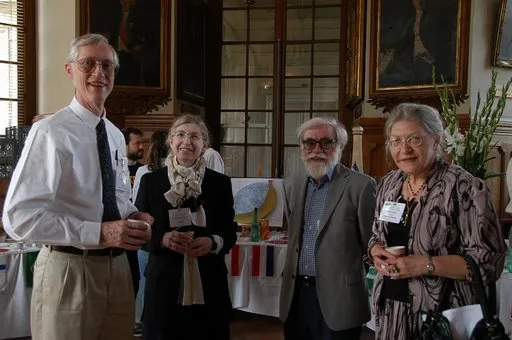
- Image 1: Photograph of the 15th Paris Cosmology Colloquium: From left to right: John C. Mather, Norma Sánchez, Héctor J. de Vega.
- Images 1 to 4: Credit: International School "Daniel Chalonge"/Paris Observatory.