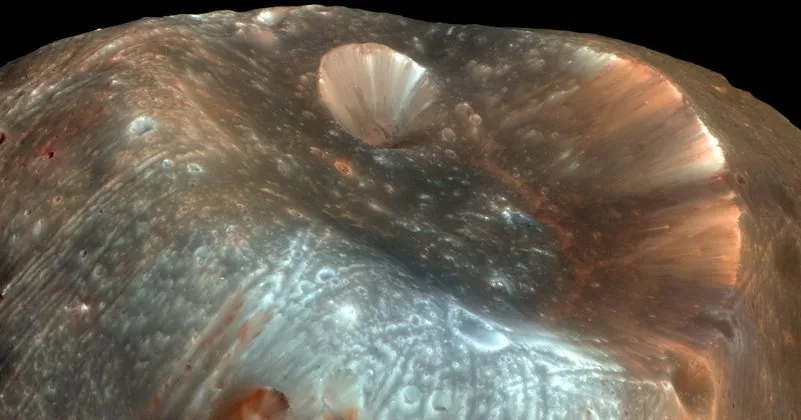
New images of Mars's largest moon have been captured by NASA's Mars Reconnaissance Orbiter (MRO). The images were taken by the HiRISE instrument (High Resolution Imaging Science Experiment). Scientists combined the photos to achieve a stereo image. A spectacular image of the crater Stickney, the largest on Phobos, is included.
"Phobos is of great interest because it could be rich in ice and carbon-rich materials," says Alfred McEwen, a HiRISE researcher at the Lunar and Planetary Laboratory of the University of Arizona.
The Mars Global Surveyor spacecraft had already taken high-resolution images of Phobos during a flyby. "But the HiRISE images are of higher quality," says Nathan Bridges, a team member at JPL.
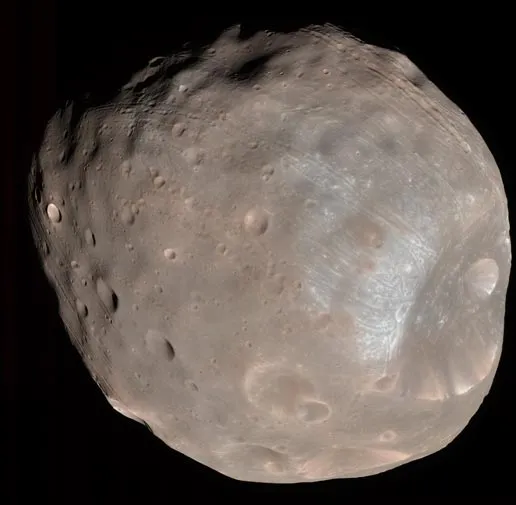
By combining information from the blue-green, red, and near-infrared filters, scientists confirmed that the material around the rim of the Stickney crater appears more bluish than the rest of the moon. The impact that excavated the crater's 9-kilometer diameter
"Based on analogy with material on our own moon, the bluish color could mean that the material is fresher or that it has not been exposed to space for as long as the rest of Phobos's surface," explains Bridges. The new view shows landslides along the walls of Stickney and other large craters; and craters hidden on the dark side of the moon illuminated by "Mars-shine" or Marsshine. This is the name for sunlight reflected by Mars onto the moon. The phenomenon is similar to "Earthshine," where our planet reflects sunlight that illuminates the dark side of our moon. Like our Moon, Phobos and Deimos always present the same side to the planet they orbit.
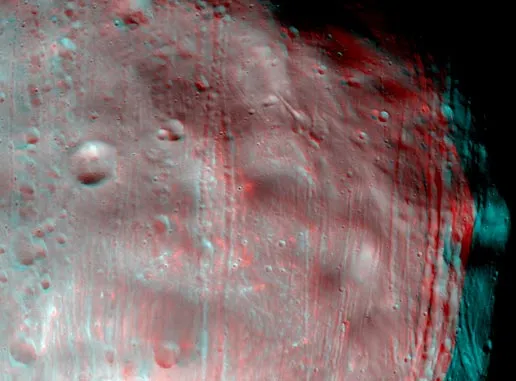
These images are among several new HiRISE shots released today. They include an anaglyph, that is, a 3D image of Phobos that can be viewed with red-blue glasses.
Phobos was 6,800 kilometers away when HiRISE took the first photograph. At that distance, the camera was able to capture the surface at a scale of 6.8 meters per pixel, and see features as small as 20 meters.
This moon of Mars is only 22 kilometers in diameter and has only one-thousandth of Earth's gravity. Given the low gravity, Phobos is not a sphere but is rectangular. Deimos, the other Martian moon, is even smaller, only 12 kilometers in diameter.
Sources and related links
- NASA JPL: NASA Spacecraft Images Mars Moon in Color and in 3D
- The images of Phobos on the NASA MRO site
- HiRISE site with these new images of Phobos and much more.
About the images
The first image shows the most prominent feature in the images is the huge crater Stickney, at the bottom right. With a diameter of 9 km, it is the most notable feature of Phobos. A series of grooves and crater chains are observed in other parts of the moon. Hypotheses about the formation of the grooves vary. Some scientists think they are related to the formation of Stickney.
Then you see an image of Phobos and finally the anaglyph.
Credit: NASA/JPL-Caltech/University of Arizona