Behold the full Moon. Ancient craters and icy seas of lava lie motionless under an airless sky of profound stillness. It is a world in slow motion where even a human footprint can last millions of years. Nothing else seems to happen there. Right?
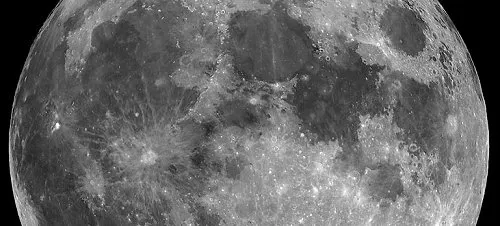
No. NASA scientists noticed that something happens every month when the Moon is struck by Earth's magnetic tail.
"Earth's magnetic tail extends beyond the Moon's orbit and, once a month, the Moon orbits through it," says Tim Stubbs, a scientist from the University of Maryland working at the Goddard Space Flight Center. "This can have consequences ranging from lunar 'dust storms' to electrostatic discharges."
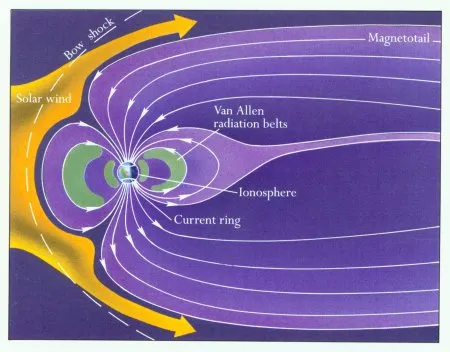
Yes, Earth has a magnetic tail. It is an extension of the familiar magnetic field we experience when using a compass. Our entire planet is wrapped in a bubble of magnetism that springs from a molten dynamo in Earth's core. In space, the solar wind presses against this bubble and stretches it, creating a long "magnetic tail" in the direction of the wind, as seen in the diagram.
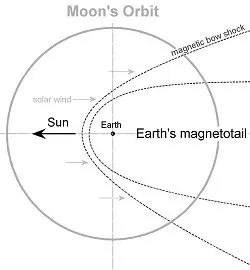
Anyone can tell when the Moon is inside the magnetic tail. Just look: "If the Moon is full, it is inside the magnetic tail," says Stubbs. "The Moon enters the magnetic tail three days before it is full and takes about six days to cross and exit on the other side."
It is during those six days that strange things can happen.
During the crossing, the Moon comes into contact with a giant sheet of plasma of hot charged particles trapped in the tail. The lightest and most mobile particles, electrons, pepper the Moon's surface and give it a negative charge.
On the illuminated side of the Moon, this effect is somewhat counteracted by sunlight: ultraviolet photons from the Sun knock electrons off the surface, keeping the charge buildup at relatively low levels. But on the cold, dark side of the Moon, electrons accumulate and voltages can rise to hundreds or thousands of volts.
Walking across the dusty, charged lunar terrain, astronauts might find themselves crackling with electricity like a sock fresh from the dryer. Touching another astronaut, a doorknob, a piece of electronics, any of these simple actions could produce an unwelcome shock. "Proper grounding is strongly recommended," warns Stubbs.
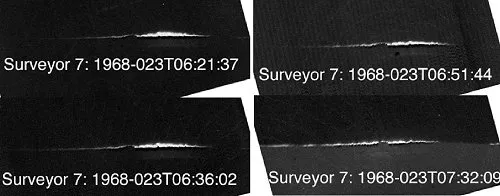
The ground, meanwhile, might leap into the sky. There is strong evidence (see for example, the Surveyor 7 image, below) that fine lunar dust particles, when sufficiently charged, float above the surface. This could create a temporary nighttime atmosphere of dust, ready to coat spacesuits, clog machinery, scratch the faceplates of space helmets (lunar dust is very abrasive) and generally make life difficult for astronauts.
Stranger still: lunar dust might gather in a kind of diaphanous wind. Driven by differences in global charge accumulation, the floating dust could naturally fly from the strongly negative night side to the weakly charged day side. This "dust storm" effect would be strongest at the dividing line between day and night on the Moon, called the "terminator."
Much of this is pure speculation, cautions Stubbs. No one can say for sure what happens on the Moon when it hits the magnetotail, because no one has been there at the crucial moment. "Apollo astronauts never landed on a full Moon and never experienced the magnetic tail."
The best direct evidence comes from NASA's Lunar Prospector spacecraft, which orbited the Moon in 1998-99 and monitored many magnetotail crossings. During some crossings, the spacecraft sensed large changes in voltage on the lunar night side, jumping "typically from -200 V to -1000 V," says Jasper Halekas of the University of California, Berkeley, who has been studying the decade-old data.
Diagram
"It's important to note," says Halekas, "that the plasma sheet (where all the electrons come from) is a very dynamic structure. This plasma sheet is in constant motion, flapping up and down all the time. So, when the Moon orbits through the magnetotail, the plasma sheet can sweep over it again and again. Depending on the dynamics, we can encounter the plasma sheet many times during a single pass through the magnetic tail with encounters lasting from minutes to hours or even days."
"As a result, you can imagine how dynamic the charging environment on the Moon is. The Moon can be sitting there in a quiet region of the magnetic tail and then, suddenly, all this hot plasma starts sweeping over, causing the night-side potential to soar to kilovolts. Then it drops back just as quickly."
The charging roller coaster would be at its peak during solar and geomagnetic storms. "That is a very dynamic time for the plasma sheet and we need to study what happens then," he adds.
What happens then? The next generation of astronauts will find out. NASA is returning to the Moon in the coming decades and plans to establish a base for long-term exploration. It seems they will be exploring the magnetic tail as well.
More information
Solar wind vs. magnetotail: Earth's magnetotail is not the only source of plasma to charge the Moon. The solar wind can provide charged particles as well; in fact, most of the time, the solar wind is the main source. But when the Moon enters the magnetotail, the solar wind is pushed away and the plasma sheet predominates. This plasma sheet is about 10 times hotter than the solar wind and that gives it more strength to alter the charge balance on the lunar surface.
Sources and related links
- Science@NASA: The Moon and the Magnetotail by Dr. Tony Phillips
- Ciencia@NASA
About the images
Credit: NASA