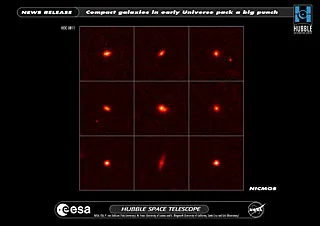
Astronomers, using the Hubble Space Telescope, made observations of young, surprisingly compact galaxies, each only 5,000 light-years across, but weighing 200 billion times the mass of the Sun.
Imagine receiving the announcement of the birth of a baby 50 centimeters long and 80 kg in weight. You would surely think the data is wrong.
Astronomers, observing galaxies in the distant Universe, received a similar announcement when they found nine young and compact galaxies, so small they could be contained in the center of the Milky Way, but dense enough to weigh 200 billion Suns.
Astronomers used Hubble and the W.M. Keck to study the galaxies as they existed 11 billion years ago, when the Universe was less than 3 billion years old.
"Seeing the compact size of these galaxies is a puzzle," says Pieter G. van Dokkum of Yale University, leader of the study. "No massive galaxy at that distance has been observed to be so compact. These galaxies must have changed a lot over 11 billion years, growing five times larger. They could have grown by colliding with other galaxies, but those collisions would not be the complete answer."
To determine the size of the galaxies, the team used Hubble's instruments like the Near Infrared Camera and Multi-Object Spectrometer. The Keck observations were made with the assistance of a powerful laser to correct the blurring caused by Earth's atmosphere. Only Hubble, Keck, and ESO's VLT are truly capable of measuring the sizes of these galaxies as they are so small and distant.
Van Dokkum and his colleagues studied the galaxies in 2006 with the Gemini South Telescope on Cerro Pachón. Those observations provided the distances to the galaxies and showed that the stars are between 500 million and 1,000 million years old.
"In the Hubble Deep Field, astronomers found that star formation in galaxies is small. However, those galaxies were also very low in mass. They weighed much less than our Milky Way. Our study, which probed a much larger area than the Hubble Deep Field, surprisingly shows that galaxies with the same weight as our galaxy were also small in the past. All galaxies really look different in primitive times, even the most massive ones that formed their stars early," says Marijn Franx of Leiden University.
The ultradense galaxies could comprise half of all galaxies of that mass 11 billion years ago, according to van Dokkum, forming the building blocks of today's largest galaxies.
How did these small, crowded galaxies form? One way, suggested by van Dokkum, involves the interaction of dark matter and hydrogen in the early Universe. Shortly after the Big Bang, the Universe contained an irregular landscape of dark matter. Hydrogen gas became trapped in "pockets" of dark matter and began to rotate rapidly in the gravitational whirlpool of the dark matter, forming stars at a furious rate.
Based on the mass of the galaxies, derived from their color, astronomers estimated that the stars are rotating around their galactic disk at 400 or 500 km/s. In today's galaxies, in contrast, they travel at half that speed because they are larger and rotate more slowly than the compact galaxies.
These galaxies are ideal for observation with the Wide Field Camera 3, which will be installed on Hubble during the servicing mission 4, expected this year.
The findings appeared in the April 10 edition of The Astrophysical Journal Letters.
Sources and related links
- SpaceTelescope: Compact galaxies in early Universe pack a big punch
- HubbleSite: Compact Galaxies in Early Universe Pack a Big Punch
A Near-Infrared Spectroscopic Survey of K-Selected Galaxies at z 2.3: Redshifts and Implications for Broadband Photometric Studies
The Astrophysical Journal, 677:219–237, 2008 April 10
DOI: 10.1086/528945
Mariska Kriek, Pieter G. van Dokkum, et al.
About the images
Credit: NASA, ESA, P. van Dokkum (Yale University), M. Franx (Leiden University, The Netherlands), and G. Illingworth (University of California and Lick Observatory, Santa Cruz)