New research on the Antennae Galaxies shows that this interacting pair of galaxies is in fact much closer than previously thought: 45 million light-years.
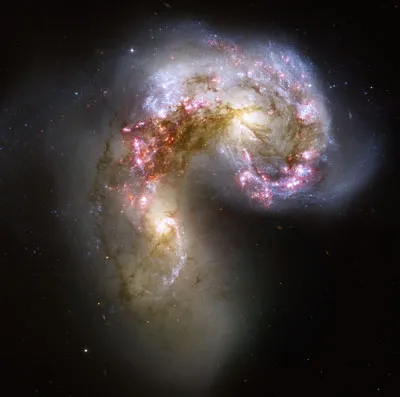
The Antennae Galaxies are among the closest known galaxies in the process of merging. The two galaxies, known as NGC 4038 and NGC 4039, began their interaction a few hundred million years ago, creating one of the most impressive sights in the night sky. They are considered by scientists as an archetypal system of merging galaxies and are used as a standard against which to validate theories about galactic evolution.
An international team of scientists led by Ivo Saviane of ESO, the European Southern Observatory, used the Advanced Camera for Surveys and the Wide Field Planetary Camera 2 of the Hubble Space Telescope to observe individual stars seeded by the colossal cosmic collision in the galaxies. And they reached an interesting and surprising conclusion. By measuring the colors and brightness of red giant stars in the system, the scientists found that these two galaxies are closer than previously thought: 45 million light-years instead of 65 million light-years.
The team targeted a region in the relatively quiet outer regions of the southern tidal tail, away from the active central regions. This tail consists of material pulled out from the main galaxies as they collided. The scientists needed to observe regions with old red giant stars to derive an accurate distance. Red giants are known to reach a standard brightness, which can be used to infer their distance. The method is known as the tip of the red giant branch (TRGB).
The proximity of the system means it is the best-studied galaxy merger in the sky, with a wealth of observational data to be compared with the predictions of theoretical models. Saviane says: "Any aspiring model for galactic evolution must be able to account for the observed features of the Antennae Galaxies, just as a respectable stellar model must be able to match the observed properties of the Sun. Accurate models require the correct merger parameters and of these, distance is the most essential."
The previous canonical distance to the Antennae Galaxies was 65 million light-years although values as high as 100 million light-years have been used. Our Sun is only 8 minutes away from us, so the Antennae Galaxies might seem quite far, but if we consider that we already know of galaxies that are more than 10 billion light-years away, the Antennae are really our neighbors.
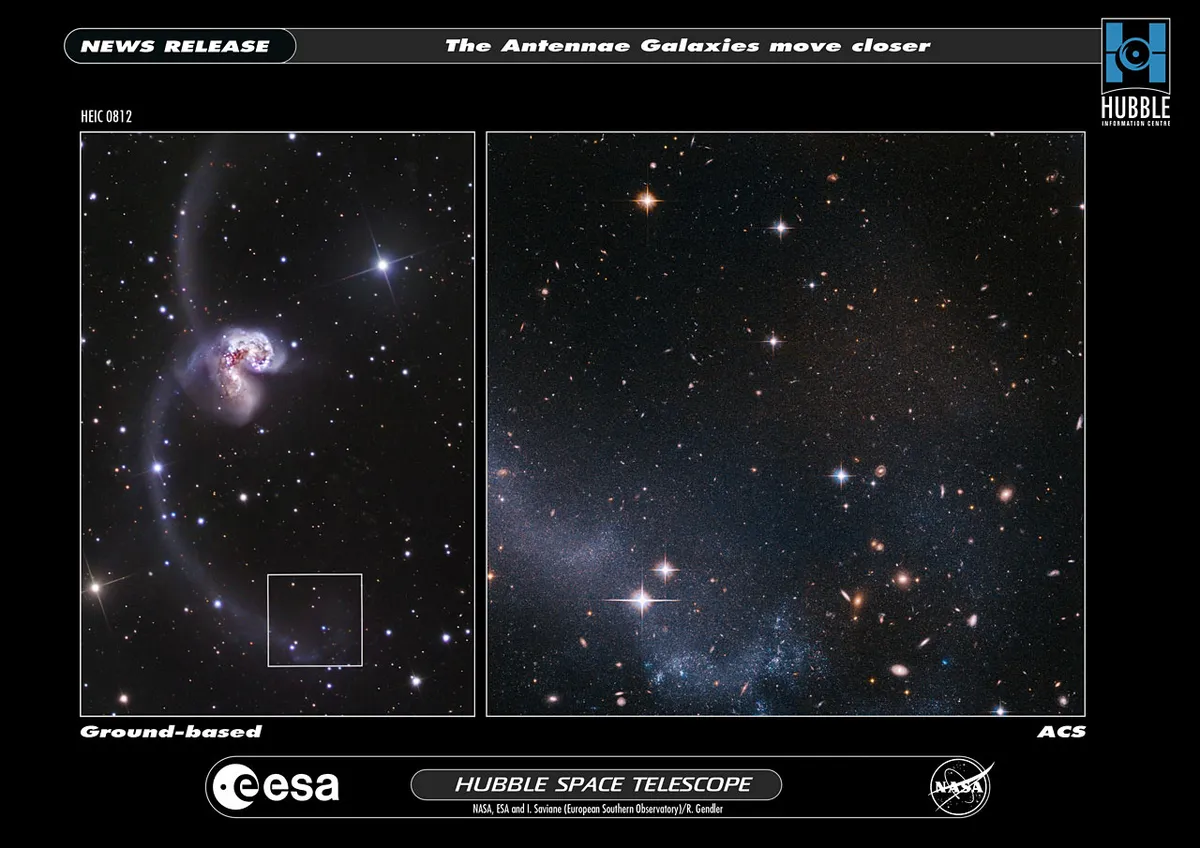
The Hubble image, on the right, shows a portion of the southern tail. The most important visible components consist of young blue stars recently formed and many red background galaxies can also be seen. The region is filled with thousands of faint red stars, only visible when zooming in.
The previous distance required astronomers to invoke some exceptional physical features to account for the spectacular system: very high star formation rates, supermassive star clusters, ultraluminous X-ray sources, etc. The new, smaller distance makes the system less extreme in terms of the physics needed to explain the observed phenomena. For example, with the smaller distance, its infrared radiation is now that expected for a "standard" merger event, instead of an ultraluminous infrared galaxy. The size of the star clusters formed as a consequence of the merger now matches those clusters created in other mergers instead of being 1.5 times larger.
The Antennae Galaxies are named for the two long tails of stars, gas and dust that resemble the antennae of an insect. These "antennae" are a physical result of the collision between the two galaxies.
Studying their properties gives us a preview of what might happen when our Milky Way collides with the neighboring Andromeda galaxy in several billion years. Although galactic mergers are currently not very common, they are believed to have been an important channel for galaxy evolution in the past. Therefore, understanding the physics of mergers is a very important task for astrophysicists.
The system is located in the constellation Corvus, the crow.
The findings appeared in the May edition of The Astrophysical Journal.
Sources and related links
- SpaceTelescope: The Antennae Galaxies move closer
- A New Red Giant–based Distance Modulus of 13.3 Mpc to the Antennae Galaxies and Its Consequences
Ivo Saviane
The Astrophysical Journal, 678:179–186, 2008 May 1
DOI: 10.1086/533408
About the images
The first image belongs to the gallery of HubbleSite
Credit: NASA, ESA, and the Hubble Heritage Team (STScI/AURA)-ESA/Hubble Collaboration
The second image is from SpaceTelescope:
Credit: NASA, ESA & Ivo Saviane (European Southern Observatory)/Robert Gendler