Why are astronomers so sure of its existence, despite not having detected it? Is it more than just a theory? How are maps of dark matter made? How are experiments done? The Argentine experiment.
When articles are published in mass media, web comments indicate that the general public does not understand and is not familiar with some basic issues. I intend here to explain some of them.
The first ideas linked to dark matter come from an astronomer named Fritz Zwicky who postulated the existence of an exotic matter as necessary to explain galaxy clusters. But the real push would come several decades later, around 1970, when Vera Rubin detected a galaxy in which the stars farthest from the center (in the halo) had velocities greater than expected according to Newton's laws. Although at first she was not taken seriously, new similar findings in other galaxies drew attention. So a first hint of something strange was found in the rotation curves of galaxies.
But there is more: This discrepancy between observations and theory is given by the rate or proportion between mass and light (M/L). In the literature, in English, it is called "mass-to-light ratio" and is designated by the Greek letter upsilon ϒ.
This value is much higher in galaxies than in the Sun. Which implies, in principle, that in galaxies there are stars different from our Sun. By definition, if in a galaxy the M/L relation were like in the Sun, it would be indicated as 1. But in galaxies the value reaches 30. Young and massive stars have values well below 1, because they are much more luminous. White dwarfs are much smaller than the Sun, but with a similar mass and low luminosity, so the M/L value is high. In galaxies, their stellar composition can be thought of in terms of age: irregular galaxies, with a high percentage of young stars, have low values. Spirals have medium values. And ellipticals, with a majority of older stars, have the higher values. But no population is older than 13 billion years, the age of globular clusters. So the oldest galaxies define the maximum value of the M/L relation. A proportion greater than 30 is difficult to explain by their stellar population.
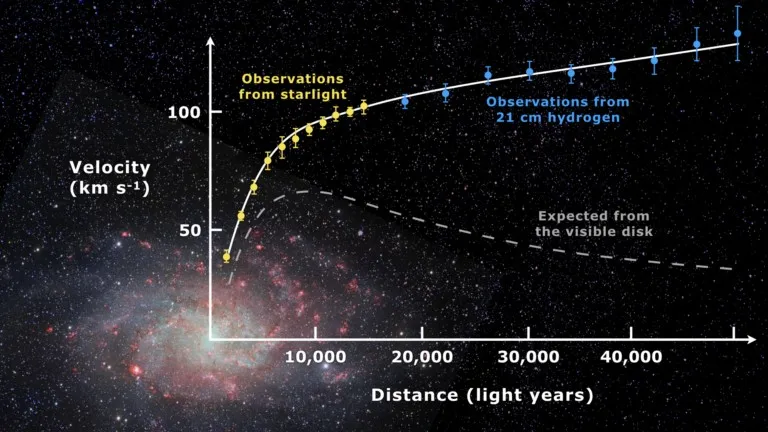
Fig. 1: Rotation curve of the spiral galaxy Messier 33 (points in yellow and blue, with error bars), and the curve predicted by the distribution of visible matter (gray line). At greater distance from the center, the velocities increase, instead of decreasing. In general, the curve flattens (does the concept sound familiar?), which implies that, despite the distance, the velocities remain constant.
To explain that discrepancy in the galaxies studied by Rubin and later in almost all others, different hypotheses were postulated, namely:
1-In galaxies there must be a significant amount of matter in the halos, which does not shine directly. They can be compact and massive objects, like black holes or planets. In general terms, they are called MACHOs, an acronym in English for Massive Compact Halo Objects. This hypothesis was never completely ruled out, but largely so. It has two defects: although they are difficult to detect, black holes can be found because the matter they absorb heats up and shines in X-rays. Planets, for their part, reflect starlight. With the development of better instruments, the paradox arose that an enormous number of such objects would have to be detected in the halos, which does not happen. On the other hand, why would such objects form more in the halos than in the galactic centers? However, it is possible that at least a small part of the discrepancy is due to objects of this type. But it is insufficient to explain things.
2-Perhaps there is nothing strange in galaxies, but Newton's theory is incorrect. Since then physicists have tried to find a correction that accounts for everything that Newton's laws do manage to explain and also, on a large scale, the observations of galaxies. They are called MOND Theories, which stands for Modified Newtonian Dynamics. So far no formulation has been found that works, although there are some very good suggestions that are still being investigated. For example, it was suggested that if relativistic effects were taken into account (even though galaxy rotation velocities are only a small fraction of the speed of light), the discrepancy in the rotation curves would be much smaller.
3-Another assumption is that in galaxies there is a large number of particles that have mass and gravity, but have no electromagnetic interaction (that is, with light) or their interaction is very weak. A particle that could meet such characteristics are neutrinos which are part of a class of particles called WIMPs, which stands for Weakly Interacting Massive Particles.
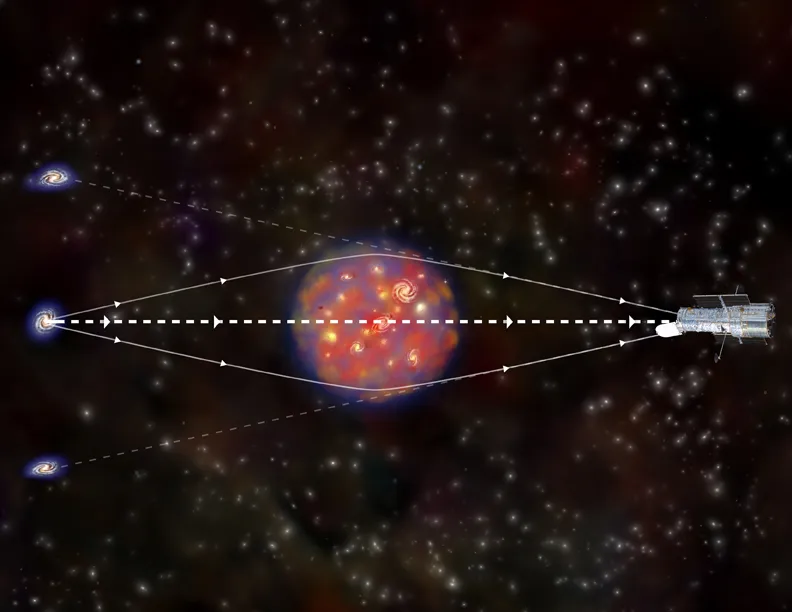
Fig. 2: Illustration of gravitational lenses.
MORE THAN AN ASSUMPTION
In addition to the discrepancy between observations and theory, due to the mass-luminosity relation, another key piece in giving astronomers a certain level of confidence in the existence of dark matter lies in galaxy clusters and gravitational lenses.
According to Relativity, matter can curve light, if a significant amount of mass is grouped together. This prediction of the theory was tested very soon after its publication by studying an eclipse. Since then, it has often been detected that such curvature indeed occurs. When images of galaxy clusters are taken, a curious phenomenon is observed: galaxies are seen that are not part of the cluster, but are much more distant. It can be explained as follows:
The more distant galaxy emits light towards Earth and between that galaxy and the terrestrial observers there is also a galaxy cluster with a large amount of matter. The light from the distant galaxy is curved by such mass, so the cluster functions as if it were a lens that allows us to see what is farther away. The phenomenon is known as "gravitational lenses".
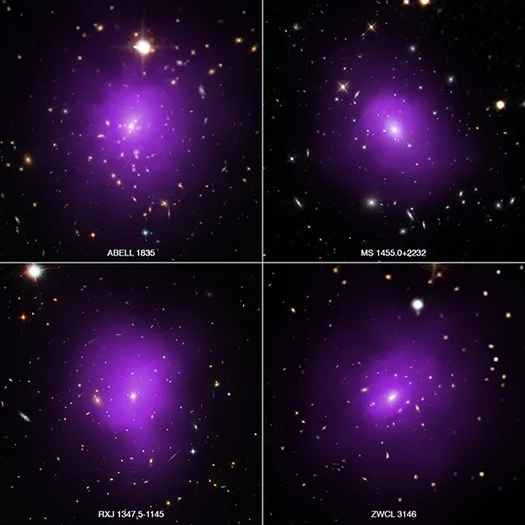
But for this to work, the clusters should have much more mass than is observed. That is, there is a second reason to postulate that an exotic form of matter exists. And these lenses also allow astronomers to do something incredible: map the dark matter in galaxy clusters. It is possible to detect where the light curves and there should be a lot of matter, which is not observed.
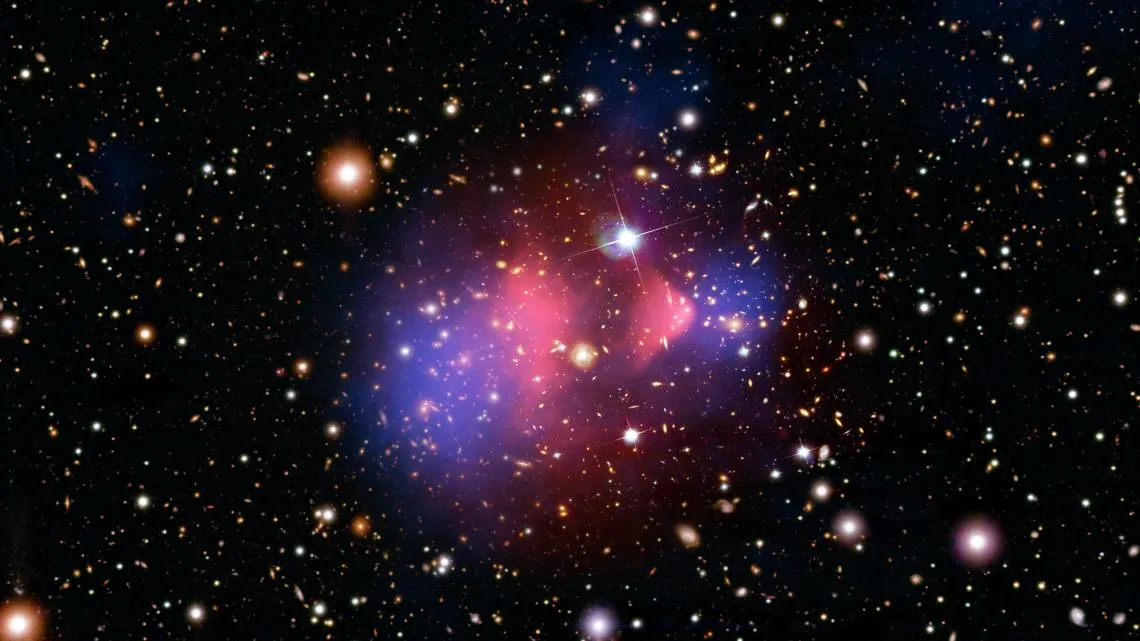
Fig. 3: The Bullet Cluster (1E 0657-56) has been the subject of study and is considered strong evidence in favor of dark matter. The pink area indicates the presence of hot gas in X-rays. But the greatest mass of the cluster is indicated in blue, separated from the gas region. It can be known that more mass accumulates in those zones or lobes from the location of the gravitational lenses.
A BACKGROUND ISSUE
One way to investigate dark matter is with the concept of Baryon Acoustic Oscillations (BAO), a concept that arises from already known data. In the early universe, atoms could not form, as it was very hot. Charged atomic nuclei and electrons could not come together. Light photons were absorbed and re-emitted. But if dark matter already existed, it would not have that problem and could form large gravitational structures. When later, due to expansion, the universe cooled and allowed atoms to form, they must have been attracted by the dark matter and coupled to form the current structures. In doing so, a signal of such behavior must have been generated: the Baryon Acoustic Oscillations, which are investigated by studying the Cosmic Microwave Background.
This means that, if dark matter did not exist, astronomers would have to explain how the stars in a galaxy manage to stay gravitationally bound, even though such galaxies do not seem to have the necessary matter/mass.
EXPERIMENTS: WHERE ARE THE SMURFS?
A large part of the experiments are based on the detection of Cherenkov radiation, which generates a bluish light. But since the effect could be produced by different particles, installations are created below the surface, hundreds of meters down, because the idea is to detect particles that have weak interaction, therefore, if they reach those distances underground, it is because they did not interact with other particles before.
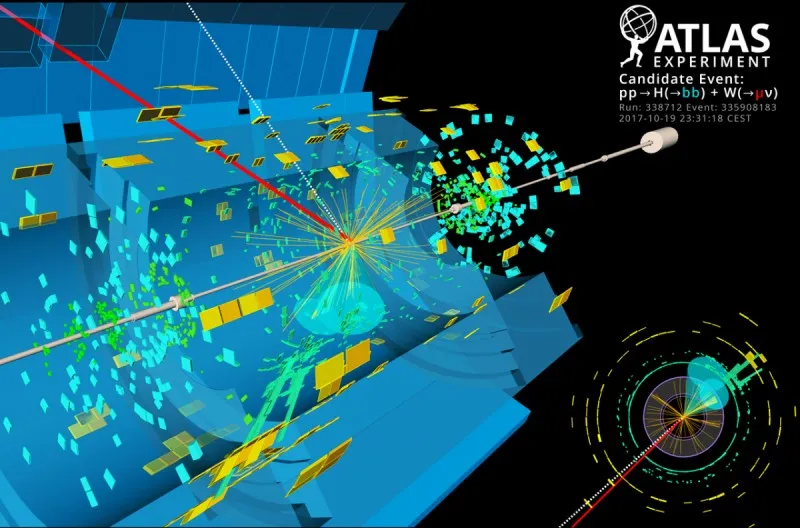
Some experiments try to reproduce extreme natural conditions, as happens at the LHC, the Large Hadron Collider. The idea is that by colliding protons at high speed, new particles arise. Research is also done in the opposite direction: if "normal" particles come in two versions, since anti-particles also exist, then perhaps the same happens with dark matter. In that way, dark matter could annihilate and as a consequence produce other particles that are known. That is why neutrinos are investigated, as in the Super Kamiokande experiment, since an excess of neutrinos could imply that they are a product of dark matter annihilation.
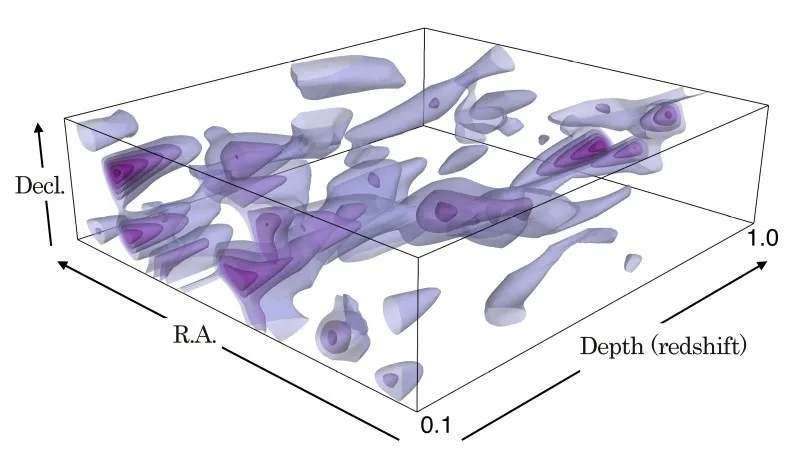
Fig. 4: "3D" map of dark matter made with data obtained with the Subaru telescope.
RESULTS AND ANTI-RESULTS
So far, dark matter has not been detected. But there has been progress in that its possibilities have been restricted, since by investigating possible dark matter candidates in certain energy ranges and finding nothing, the search can be narrowed. As a counterpart, the energy ranges that remain to be investigated are difficult.
As if this were not enough, the experiments themselves can produce false positives, since the matter surrounding the experiments can generate signals leading one to think that there was a detection of what was sought, although in reality it is something else.
It is worth remembering that in Argentina an experiment was done to search for dark matter, which I told about at the time in the post "DEMOS a look at dark matter" (see link below).
That the results of not finding are considered "positive" is not strange. It's like losing the house keys. If we don't find them, at least it's progress to know where they are not, since that reduces the search, but it also makes it more difficult, since many other options are no longer left or are difficult to investigate (for example, under the refrigerator).
CONCLUSION
The concept of dark matter is not "just" a hypothesis, a suspicion, or an assumption. It is a hypothesis based on many observational data confirmed and improved in recent decades. The discrepancy between theory and observation is so great that it can hardly be explained by already known phenomena.
However, the fact that dark matter has not been detected and characterized raises the possibility that, in the end, it does not exist. It is a challenge to arrogance: either what was known about the material composition of the universe was largely wrong and incomplete; or dark matter does not exist, but then there would have to be another explanation both for gravitational lenses in clusters, and for the rotation of galaxies and even for their formation. In any case, with or without dark matter, it is certain that something important is missing. Given the evidence and everything published, physicists and astronomers think that dark matter is an idea too good to be false. The same was said about caloric and the ether, which, however, do not exist.
The history of dark matter, whatever its outcome, will be part of the great book of the history of science, including the history of its name.
Invisible, transparent, exotic, hidden: Why "dark" matter?
Physicist Lisa Randall stated in Nature a few years ago that dark matter should be called "transparent matter." It wouldn't be a good idea either, since transparent materials do interact with light (the electrons in those materials absorb photons, but re-emit them, since they do not have enough energy to change levels).
The word "dark" has been used in astronomy on several occasions. Urbain Le Verrier considered, for example, the existence of a "dark planet" near Mercury. Black holes, brown and black dwarfs (or "dark stars") and absorption nebulae (dark nebulae) - like the Coalsack Nebula - are some examples of the use of the word in astronomy. In general, the sense given to it is that they are objects or phenomena difficult to observe.
Gianfranco Bertone and Dan Hooper published a history of dark matter (in English) that is worth knowing and includes the origin of the term. But it is an unfinished story.
Meanwhile, just in case, let's look under the washing machine. Maybe we'll find that dark matter is together with that sock we lost a long time ago.

Sources and related links
- NASA: A Matter of Fact
https://www.nasa.gov/vision/universe/starsgalaxies/dark_matter_proven.html - What dark matter is (probably) not
https://www.symmetrymagazine.org/article/what-dark-matter-is-probably-not - The Alternative to Dark Matter May be General Relativity Itself
https://astrobites.org/2020/08/17/the-alternative-to-dark-matter-may-be-general-relativity-itself/ - Mass to Light Ratios
https://www.teachastronomy.com/textbook/Galaxies/Mass-to-Light-Ratios/ - The mystery of dark matter
https://www.interactions.org/hub/dark-matter-hub - Baryon acoustic oscillations
https://es.qwe.wiki/wiki/Baryon_acoustic_oscillations - Subaru: Unprecedentedly Wide and Sharp Dark Matter Map
https://www.subarutelescope.org/en/results/2018/03/01/2251.html - Nature: What Is Dark Matter?, by Lisa Randall
https://www.nature.com/articles/d41586-018-05096-y - A History of Dark Matter
Gianfranco Bertone, Dan Hooper
arXiv:1605.04909 [astro-ph.CO]
https://arxiv.org/abs/1605.04909 - NASA Finds Direct Proof of Dark Matter
https://chandra.harvard.edu/photo/2006/1e0657/ - Let's take a look at dark matter
https://www.noticiasdelcosmos.com/2012/04/demos-un-vistazo-la-materia-oscura.html
About the images
Fig. 1: Wikipedia https://commons.wikimedia.org/wiki/File:Rotation_curve_of_spiral_galaxy_Messier_33_(Triangulum).png
Fig.2 : Gravitational lensing illustration: NASA/CXC/M. Weiss.
Fig. 3: X-ray: NASA/CXC/CfA/M.Markevitch et al.; Optical: NASA/STScI; Magellan/U.Arizona/D.Clowe et al.; Lensing Map: NASA/STScI; ESO WFI; Magellan/U.Arizona/D.Clowe et al.
Fig. 4: 3D dark matter map: Credit: University of Tokyo/NAOJ
Opening image: Hubble Makes Unexpected Dark Matter Discovery https://www.youtube.com/watch?v=Rwhv38BVjUM
Fig. 5: @buena.suertecba https://gramho.com/media/2116173043231860816