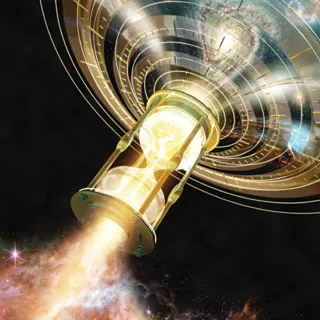
The basic laws of physics work equally well forward and backward in time, but we perceive time moving in only one direction, toward the future. Why?
To account for this, we must delve into the prehistory of the Universe, to a time before the Big Bang. Our Universe might be part of a much larger multiverse, which as a whole is time-symmetric. Time perhaps goes backward in other universes.
Continuation of The Arrow of Time (Part I)
What follows is a translation of the article by Sean M. Carroll in Scientific American, titled Does Time Run Backward in Other Universes?
Given the length of the article, it will be published in three parts.
If dark energy does not dilute, the universe will expand forever. Distant galaxies will disappear from view. [2]
Those that do not collapse into black holes will evaporate into the surrounding darkness like a puddle drying up on a hot day. What will remain is a universe that, for all intents and purposes, will be empty. Then, and only then, will the universe have truly maximized its entropy. The universe will be in equilibrium, and nothing more will happen.
It may seem strange that empty space has such enormous entropy. It sounds like saying the most disorganized desk in the world is a completely empty desk. Entropy requires microstates, and at first glance, empty space has none. However, empty space has a bunch of microstates - the quantum-gravitational microstates of the fabric of space. We do not yet know exactly what these states are, we only know that microstates account for the entropy of a black hole, but we do know that in an accelerating universe the entropy in the observable volume approaches a constant value proportional to the area of its boundary. It is a truly enormous amount of entropy, much more than the matter in that volume.
Past vs. Future
The most incredible feature of this story is the pronounced difference between the past and the future. The universe begins in a state of very low entropy: particles packed together smoothly. It evolves into a state of medium entropy: the lumpy distribution of stars and galaxies we see around us today. Finally it reaches a state of high entropy: nearly empty space, presenting only some occasional low-energy particle.
Why are the past and the future so different? It is not enough to simply propose a theory of initial conditions - a reason why the universe began with low entropy. As philosopher Huw Price of the University of Sydney pointed out, any reasoning that applies to the initial conditions should also apply to the final conditions, or else we will be guilty of assuming the very thing we were trying to prove - that the past was special. Either we must take the profound asymmetry of time as an abrupt feature of the universe that escapes explanation, or we must delve more deeply into the workings of space and time.
Many cosmologists have tried to attribute the asymmetry of time to the process of cosmic inflation. Inflation is an attractive explanation for many basic features of the universe. According to this idea, the very early universe (or at least a part of it) was filled not with particles but with a temporary form of dark energy, whose density was enormously greater than the dark energy we observe today. This energy caused the expansion of the universe at a fantastically accelerating rate, after which it decayed into matter and radiation, leaving behind a small remnant of dark energy that is becoming relevant again today. The rest of the Big Bang story, from the smooth primordial gas to galaxies and beyond, simply follows.
The original motivation for inflation was to provide a robust explanation for the fine-tuned conditions in the early universe - in particular, the remarkable uniformity of the matter density in widely separated regions. The acceleration generated by the temporary dark energy smoothed the universe almost perfectly. The previous distribution of matter and energy is irrelevant; once inflation began, it removed any trace of pre-existing conditions, leaving us with a hot, dense, and smooth early universe.
The inflationary paradigm has been successful in many ways. Its prediction of small deviations from perfect uniformity agrees with observations of density variations in the universe. As an explanation for the asymmetry of time, however, cosmologists increasingly consider it a bit misleading, for reasons that Roger Penrose of the University of Oxford and others have emphasized. For the process to work as desired, the ultradense dark energy had to begin in a specific configuration. In fact, its entropy had to be fantastically lower than the entropy of the hot, dense gas into which it decayed. This implies that inflation did not truly solve anything: it "explains" a state of unusually low entropy (a hot, dense, uniform gas) by invoking an earlier state of even lower entropy (a smooth patch of space dominated by ultradense dark energy). It simply pushes the puzzle one step back: Why did inflation ever occur?
One reason many cosmologists invoke inflation as an explanation for the asymmetry of time is that the initial configuration of dark energy does not seem so improbable. Throughout the time of inflation, our observable universe was less than a centimeter across. Intuitively, such a small region does not have many microstates, so it is not so unlikely for the universe to stumble by accident into a microstate corresponding to inflation.
Unfortunately, this intuition is misleading. The early universe, even if it is only a centimeter across, has exactly the same number of microstates as the entire observable universe today. According to the rules of quantum mechanics, the total number of microstates in a system never changes (Entropy grows not because the number of microstates does but because the system naturally ends up in the most generic macrostate possible). In fact, the early universe is the same physical system as the late universe. One evolves into the other, after all.
Among all the different ways the microstates of the universe can be ordered, only an incredibly tiny fraction corresponds to a smooth configuration of ultradense dark energy in a small volume. The conditions necessary for inflation to begin are extremely specialized and thus describe a configuration of very low entropy. If you were to choose configurations of the universe at random, it would be very unlikely to hit upon the conditions to start inflation. Inflation does not, by itself, explain why the early universe has low entropy; it simply assumes it from the beginning.
A Universe Symmetric in Time
Thus, inflation does not help explain why the past is different from the future. A bold but simple strategy is to say: perhaps the very distant past is not different from the future, after all. Perhaps the distant past, like the future, is actually a state of high entropy. If so, the hot, dense state we have been calling 'the early universe' is not actually the true beginning of the universe but a transitional state between states of its history.
Some cosmologists imagine that the universe went through a 'bounce.' Before this event, space was contracting, but instead of crashing into a point of infinite density, new physical principles—quantum gravity, extra dimensions, string theory, or some other exotic phenomenon—saved it at the last minute and the universe emerged on the other side into what we now perceive as the big bang. Although intriguing, 'bounce' cosmologies do not explain the arrow of time. Either entropy was increasing as the previous universe approached the crunch—in which case the arrow of time extends infinitely far into the past—or entropy was decreasing, in which case an unnatural low-entropy condition occurred in the middle of the universe's history (at the bounce). Either way, we have stopped answering why the entropy near what we call the big bang was small. (Note: See What Happened Before the Big Bang?)
Instead, let's suppose the universe began in a state of high entropy, which is the most natural state. A good candidate for such a state is empty space. Like any high-entropy state, the tendency of empty space is to remain that way, unchanged. So the problem is: How do we get our current universe from a desolate and quiet spacetime? The secret might lie in the existence of dark energy.
In the presence of dark energy, empty space is not completely empty. Fluctuations of quantum fields give rise to a very low temperature—enormously lower than the temperature of the current universe but not exactly absolute zero. All quantum fields experience thermal fluctuations in that universe. That means it is not perfectly inactive; if we wait long enough, individual particles and even substantial collections of particles will fluctuate into existence, only to disappear again into the vacuum. (These are real particles, as opposed to the short-lived 'virtual' particles that empty space contains even in the absence of dark energy).
This article continues in The Arrow of Time (Part III)
Sources and related links
- Does Time Run Backward in Other Universes?
- [2] "The End of Cosmology?" by Lawrence M. Krauss and Robert J. Scherrer; Scientific American, March
About the images