In what already seems like a case of planetary measles, a third red spot appeared next to its cousins, the Great and Little Red Spots, in Jupiter's turbulent atmosphere.
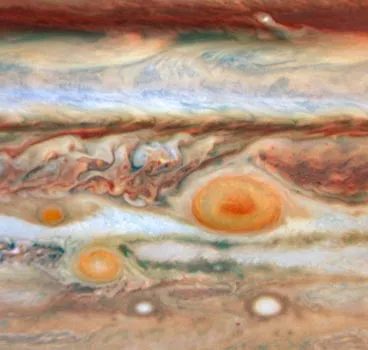
This third spot, which is only a fraction of the size of the other two, lies west of the Great Red Spot at the same cloud band latitude. The images in visible light were taken on May 9 and 10 by the Wide Field and Planetary Camera 2 of the Hubble Space Telescope.
The new red spot was previously a white oval-shaped storm. The color change to red indicates that its swirling storm clouds are rising in height like the clouds of the Great Red Spot. A possible explanation is that the storm is so powerful that it lifts cloud material to higher altitudes where solar ultraviolet radiation - via some unknown chemical reaction - produces the familiar brick color.
Detailed analysis of Hubble's visible images and near-infrared images taken by the W.M. Keck telescope reveals the relative altitude of the upper clouds of the three red ovals. Since the three oval storms shine in near-infrared wavelength light, they must be standing out above Jupiter's methane atmosphere, which absorbs infrared light from the Sun and therefore appears dark in the infrared images.
The Little Red Spot appeared in 2006. The Great one has persisted for 200 to 350 years, based on early telescopic observations. If the new spot and the larger one continue their courses, they will meet in August and the small oval will be absorbed or repelled by the Great Red Spot. The Little Red Spot, which lies between the other two and is at a lower latitude, will pass the Great Red Spot in June.
The images could support the idea that Jupiter is in the midst of a global climate change, as proposed in 2004 by Phil Marcus, a professor of mechanical engineering at the University of California, Berkeley. The planet's temperatures could be changing by 15 to 20 degrees Fahrenheit. The giant planet is becoming warmer near the equator and colder near the South Pole. Marcus proposed that major changes would begin in the southern hemisphere around 2006, causing instability in the jet streams and seeding new vortices.
The contributions of the amateur network JUPOS - Database for Object Positions on Jupiter were invaluable for this research.
Sources and related links
About the images
Credit: M. Wong and I. de Pater (University of California, Berkeley)