Although the Universe contains billions of galaxies, only a small amount of its matter is locked up in these colossi. Most of the matter in the Universe that was created during and just after the Big Bang must be found elsewhere. Now, in an extensive search of the Local Universe, astronomers say they have definitively found about half of the missing normal matter, called baryons, in the spaces between galaxies. This important component of the Universe is known as the intergalactic medium.
Questions like "Where did the local baryons go and what are their properties?" are being answered with greater certainty than ever.
"We think we are seeing the filaments of a web-like structure that forms the backbone of the Universe," explains Mike Shull of the University of Colorado. "What we are confirming in detail is that intergalactic space, which intuitively might seem empty, is in fact the reservoir of most of the normal, baryonic matter in the Universe."
We had already talked about the filaments in "Simulation of the Universe Seeks Missing Matter".
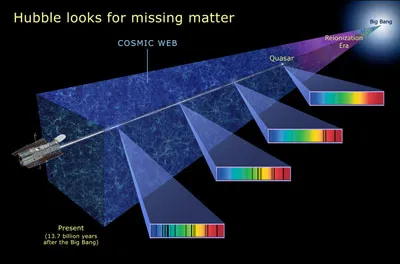
Observations by the Hubble Space Telescope almost a decade ago by Todd Tripp and colleagues reported having found the hottest portion of the missing matter in the local Universe. This study used spectroscopic observations of a quasar to search for intergalactic gas along the path to the quasar.
In the May 20 edition of The Astrophysical Journal, Charles Danforth and Shull report on observations taken along the lines of sight of 28 quasars. Their analysis represents the most detailed observations to date of how the intergalactic medium looks within four billion light-years of Earth.
Baryons are protons, neutrons and other subatomic particles that form ordinary matter like hydrogen, helium and heavy elements. Baryonic matter forms stars, planets, moons and even the gas and dust from which new stars are born.
This "missing matter" should not be confused with dark matter, a mysterious and exotic form of matter that is only detected by its gravitational pull.
Danforth and Shull searched for the missing baryonic matter using the light of distant quasars (the bright cores of galaxies with active black holes) to investigate the spider-web-like structure that permeates the seemingly invisible space between galaxies, as if shining a flashlight through fog.
Using the Space Telescope Imaging Spectrograph (STIS) instrument aboard the Hubble Space Telescope and the Far Ultraviolet Spectroscopic Explorer (FUSE), both from NASA, the astronomers found hot gas, mostly the traces of oxygen and hydrogen in the light of the quasars.
83 filaments intertwined with ionized oxygen from which five electrons have been removed were found.
The presence of this highly ionized oxygen (and other elements) between galaxies is believed to trace large amounts of ionized hydrogen in the Universe. These vast reservoirs of hydrogen would have escaped detection because they are too hot to be seen in visible light or too cold to be observed in X-rays.
The telltale oxygen was probably created when supernovae in galaxies spread oxygen into the medium where it mixed with pre-existing hydrogen, heating the oxygen to very high temperatures.
The team also found that about 20% of the baryons reside within the voids between the filaments. Within these voids there may be faint dwarf galaxies.
Investigating this vast cosmic web will be a key goal of the Cosmic Origins Spectrograph (COS), a new scientific instrument that astronauts plan to install on Hubble Servicing Mission 4 at the end of the year.
The COS team hopes to observe another 100 additional quasars and thus build a survey of more than 10,000 filaments of hydrogen in the cosmic web.
Let's hope this time it's not a false alarm as we reported in "A Piece of the Universe Was Lost, Again..."
Sources and related links
- Hubble Survey Finds Missing Matter, Probes Intergalactic Web
- The Low-z Intergalactic Medium. III. H i and Metal Absorbers at z < 0.4
Charles W. Danforth and J. Michael Shull
The Astrophysical Journal, 679:194–219, 2008 May 20
About the images
Credit: NASA, ESA, and A. Feild (STScI)