The basic laws of physics work equally well forward and backward in time, but we perceive time moving only in one direction, toward the future. Why?
To account for this, we must dig into the prehistory of the Universe, to a time before the Big Bang. Our Universe might be part of a much larger multiverse, which as a whole is time-symmetric. Time perhaps goes backward in other universes.
What follows is a translation of the article by Sean M. Carroll in Scientific American, titled Does Time Run Backward in Other Universes?
Given the length of the article, it will be published in three parts.
The Universe does not seem to be well. This seems strange to say, given that cosmologists have very little standard for comparison. How do we know how the Universe is supposed to look?
Nevertheless, over the years, we have developed a strong intuition for what counts as "natural," and the universe we see does not qualify.
Let's not be mistaken: cosmologists have put together an incredibly successful picture of how the Universe is formed and how it evolved. About 14 billion years ago, the cosmos was hotter and denser than the inside of a star and has been cooling as it expands since then. That picture accounts for every observation made, but a number of unusual features, especially in the early Universe, suggest there is more to the story than we understand.
Among the unnatural aspects of the Universe, one stands out: temporal asymmetry. The microscopic laws of physics that underlie the behavior of the Universe do not distinguish between past and future, although the early Universe—hot, dense, homogeneous—is completely different from the current one—cold, dilute, lumpy. The Universe began orderly and has become progressively more disordered since then. The asymmetry of time, the arrow that points from past to future, plays an unmistakable role in our daily lives: it accounts for why we cannot turn an omelet into an egg, why ice cubes never form spontaneously in a glass of water, and why we remember the past but not the future. And the origin of the asymmetry we experience can be traced back to the order of the Universe near the Big Bang. Every time you break an egg, you are doing observational cosmology.
The arrow of time is possibly the most striking feature of the universe that cosmologists are currently unable to explain.
Increasingly, however, the puzzle about the Universe we observe gives clues to the existence of a much larger spacetime that we do not see. It adds support to the notion that we are part of a multiverse whose dynamics help explain the seemingly unnatural features of our local neighborhood.
The Entropy Puzzle
Physicists encapsulate the concept of time asymmetry in the celebrated second law of thermodynamics: the entropy of a closed system never decreases. Roughly speaking: entropy is a measure of the disorder of a system. In the 19th century, physicist Ludwig Boltzmann explained entropy in terms of the distinction between the microstate of an object and its macrostate. If asked for a description of a cup of coffee, you would probably refer to its macrostate—its temperature, pressure, and other general characteristics. The microstate, on the other hand, specifies the precise position and velocity of every individual atom in the liquid. Many different microstates correspond to a particular macrostate: we can move an atom here and there, and no one looking at macroscopic scales would notice.
Entropy is the number of different microstates that correspond to the same macrostate. (Technically, it is the number of digits, or logarithm, of that number). Thus, there are more ways to arrange a given number of atoms in a high-entropy configuration than in a low-entropy one. Imagine you spill milk into your coffee. There are many ways to distribute the molecules so that the milk and coffee are completely mixed, but relatively few ways to arrange them to separate the milk from the coffee. Therefore, the mixture has higher entropy.
From this point of view, it is not surprising that entropy tends to increase over time. High-entropy states vastly outnumber low-entropy ones; almost any change in the system will result in a state of higher entropy. That is why milk mixes with coffee but never unmixes. Although it is physically possible for all the milk molecules to conspire spontaneously to arrange themselves side by side, it is statistically very unlikely.
If you wait for this to occur spontaneously, you should wait much longer than the current age of the observable universe. The arrow of time is simply the tendency of systems to evolve toward one of the numerous, natural, high-entropy states.
But explaining why low-entropy states evolve into high-entropy ones is different from explaining why entropy is increasing in our universe. The question remains: Why was entropy low to begin with? It seems unnatural, given that low-entropy states are so rare. Even granting that the current universe has average entropy, that does not explain why entropy used to be even lower. Of all the possible initial conditions that could have evolved into a Universe like ours, the overwhelming majority have much higher entropy, not lower.[1]
In other words, the real challenge is not to explain why the entropy of the Universe will be greater tomorrow than today, but to explain why entropy was lower yesterday and even lower the day before. We can trace this logic back to the beginning of time in our observable universe. Ultimately, the asymmetry of time is a question to be answered by cosmology.
The disorder of the vacuum
The early Universe was a remarkable place. All the particles that form the universe we observe today were squeezed into an extraordinarily hot and dense volume. More importantly: they were distributed almost uniformly throughout that small volume. On average, the density differed from one place to another by only about one part in 100,000. Gradually, as the universe expanded and cooled, the pull of gravity enhanced those differences. Regions with more particles formed stars and galaxies, and regions with fewer particles ended up forming the voids.
Clearly, gravity has been crucial for the evolution of the Universe. Unfortunately, we do not fully understand entropy when gravity is involved. Gravity arises from the shape of spacetime, but we do not have a detailed theory of spacetime; that is the goal of quantum gravity theory. While we can relate the entropy of a fluid to the behavior of the molecules that constitute it, we do not know what constitutes space, so we do not know what gravitational microstates correspond to a particular macrostate.
However, we have an idea of how entropy evolves. In situations where gravity is negligible, like a cup of coffee, a uniform distribution of particles has high entropy. This condition is a state of equilibrium. Even when the particles rearrange themselves, they are already so mixed that nothing more seems to happen macroscopically. But if gravity is important and the volume is fixed, a smooth distribution has relatively low entropy. In this case, the system is far from equilibrium. Gravity causes the particles to clump into stars and galaxies and the entropy grows notably, consistent with the second law (of thermodynamics).
Indeed, if we want to maximize the entropy of a volume when gravity is active, we know what we will get: a black hole. In the 1970s Stephen Hawking of the University of Cambridge confirmed a provocative suggestion by Jacob Bekenstein, now at the Hebrew University of Jerusalem, that black holes fit neatly with the second law. Like the hot objects that the second law originally described, black holes emit radiation and have entropy. A lot of entropy. A black hole of one million solar masses, like the one that lives at the center of our galaxy, has 100 times the entropy of all the ordinary particles in the observable Universe. (See: "Stephen Hawking and Black Holes")
Finally, even black holes evaporate by emitting Hawking radiation. A black hole does not have the maximum possible entropy, but the greatest entropy that can be packed into a certain volume. The volume of space in the Universe, however, seems to be growing without limit. In 1998 astronomers discovered that the cosmic expansion is accelerating. The simplest explanation is the existence of dark energy, a form of energy that exists even in empty space and that does not dilute as the Universe expands. It is not the only explanation for the cosmic acceleration, but attempts to come up with a better idea have failed so far.
The article continues in The Arrow of Time (Part II)
----------
[1]PDF: "The Arrow of Time" by David Layzer; Scientific American, December 1975
Sources and related links
About the images
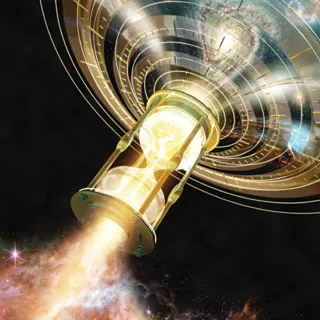
Credit: Kenn Brown