Argentine researchers presented to the Provincial Government the possibility of siting the world's largest optical telescope in Tolar Grande, Los Andes department. The research team from Córdoba is made up of astronomers Diego García Lambas and Hernán Muriel and engineer Pablo Recabarren.
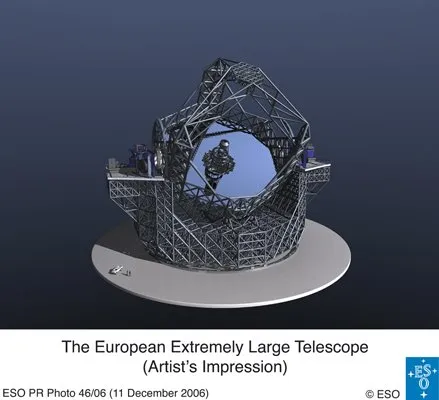
Last year we reported that ESO agreed to proceed with detailed studies for a new Extremely Large Telescope.
Argentine researchers presented to the Provincial Government the possibility of siting the world's largest optical telescope in Tolar Grande, Los Andes department. The president of the Fundación CapacitAr del Noa, José Viramonte, received the group of experts on Saturday and received specific information about the E-ELT, the acronym that defines the European extremely large telescope.
The possibilities of Tolar Grande becoming the chosen site to locate the world's largest optical telescope are increasingly feasible since, according to the studies carried out, the area has optimal conditions for astronomical observations.
Northwestern Argentina, specifically the Macón ridge in Tolar Grande, is one of the regions being studied to carry out this project because the Puna is the second largest and highest plateau on Earth with an average altitude of 4,000 meters above sea level. It is also a very dry place, suitable for the installation of the telescope. The megatelescope is projected to be operational in 2017.
The research team from Córdoba is made up of astronomers Diego García Lambas and Hernán Muriel and engineer Pablo Recabarren. Also present at the presentation were the deputy for Los Andes department Leopoldo Salva, and the mayor of Tolar Grande, Sergio Villanueva.
The researchers pointed out that this is a very ambitious project, perhaps the largest in the world, because it is estimated that the telescope's diameter would be approximately 40 meters and the investment is around one million euros. From the Province, support has been provided through the various soil studies necessary to corroborate the siting and stability.
Tolar Grande is one of the sites chosen by ESO, the world's largest organization in astronomy, for the siting of the telescope. The Macón ridge, in Tolar Grande, is a candidate site for the installation of the telescope along with the Canary Islands, Ventarrones in Chile, and Morocco.
What will it be like?
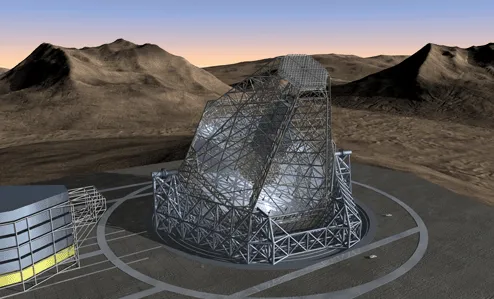
The primary mirror of 42 meters in diameter will be composed of 906 hexagonal segments, each 1.45 meters, while the secondary mirror will have a diameter of 6 meters. To compensate for the distortion introduced by atmospheric turbulence in the images of celestial objects, the telescope will need to incorporate adaptive optics elements. The Post-Focal Adaptive Optics, built into the instruments and not included in the telescope design itself, is a consolidated technology that currently has 7 systems and a laser guide star in operation at Paranal. Incorporating adaptive optics into the telescope design is the next natural step in telescope design and construction. The tertiary mirror, 4.2 meters in diameter, directs the light to the adaptive optics system composed of two mirrors: one of 2.5 meters supported by a minimum of 5000 actuators capable of deforming it thousands of times per second and another of 2.7 meters in diameter that will allow the final image corrections. These five mirrors will provide exceptional image quality, without significant aberrations in the field of view; this system is located on the Nasmyth platforms on the sides of the telescope.
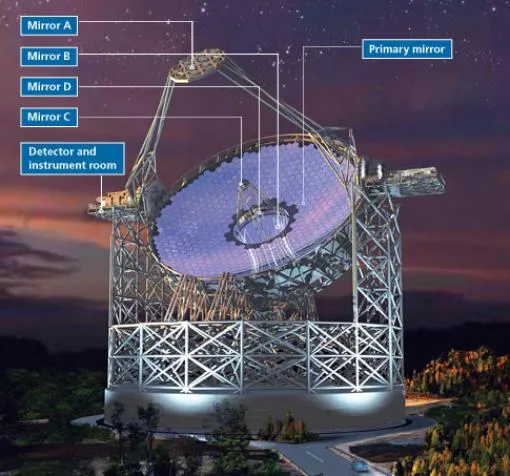
Extremely large telescopes are considered one of the highest priorities in ground-based astronomy worldwide; they will allow considerable advances in astrophysical knowledge, enabling detailed studies of topics such as extrasolar planets, the first objects that formed in the universe, supermassive black holes and the nature and distribution of the dark matter and energy that dominate the universe and it is expected that the E-ELT site will be designated in 2008. With a diameter of 42 meters and its adaptive optics system, the E-ELT will be more than a hundred times more sensitive than the largest current optical telescopes, "This is really the beginning of a new era in optical and infrared astronomy," concluded Cesarsky, director general of E.S.O.
The project
The Theoretical and Experimental Astronomy Research group (IATE) of the Astronomical Observatory of the National University of Córdoba and the European Southern Observatory (ESO) agreed to extend a joint agreement until the end of 2007 for the development of a project to site "Extremely Large Telescopes," whose objective is to obtain distant sources of radiation, on the Macón ridge, Salta province.
The framework of understanding was initially signed in 2001, by which both parties committed to the search for a site for the siting of a large-scale telescope in northwestern Argentina. The Argentine Institute of Radio Astronomy (IAR) also joined the agreement, with the objective of installing a tipper radiometer to measure water vapor concentrations at 210 GHz, at a site with low relative humidity content.
ESO (which already has joint sites in the Canary Islands and seeks to explore other regions of the world) funds the local project including covering costs and providing scientific equipment. IATE, for its part, is responsible for the observations and analysis of the data obtained, as well as providing the salaries of the professionals.
The extension of the agreement (initially its completion was foreseen in 2006) until December 2007 has implied an increase in the number of observation nights. This assumes and makes necessary the construction of a road for the mobilization of specialized personnel and technical equipment to the observation site.
Studies of the region
The Puna, besides being a very dry region, is the second largest and highest plateau on Earth with an average altitude of 4000 m.a.s.l., which provides, from a geographical point of view, a large number of candidate sites. The area originally selected is framed between the parallels 22:8± to 32:0± south and the meridians 66:0± to 69:9± west.
Based on a significant number of exploratory trips as well as a detailed analysis of cloud cover (GOES satellite images), seismic records, logistical, topological, meteorological, etc. aspects, the Cordón Macón (24± 38:082 S, 67± 20:024 W at 4609 m.a.s.l.) was selected as the first site to carry out a systematic study of image quality as well as other parameters of interest. This mountain range is located next to the town of Tolar Grande in Salta, next to the third largest salt flat in the world, the Salar de Arizaro (see Figure 1).
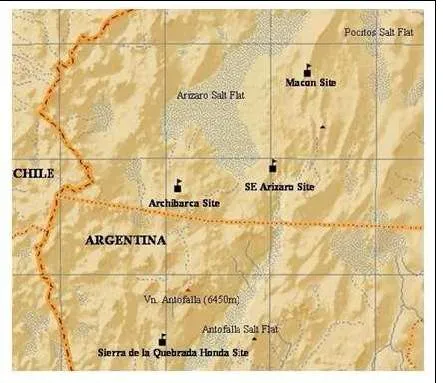
The studies carried out have been conducted both in Tolar Grande and on the Cordón del Macón. From the former, atmospheric turbulence is studied using a MASS (Multi-Aperture Scintillation Sensor) with which more than 150 nights of measurements have been obtained over a period of one year (3/2005 to 4/2006). On the Cordón del Macón, which is in fact where the potentially suitable sites are located, an autonomous meteorological station (in operation for more than two years), a shelter, and an observation tower have been installed from where a DIMM (Differential Image Motion Monitor) that measures image quality is operated. The DIMM allows estimating the average size of a point image (seeing), this being one of the fundamental parameters in the process of astronomical characterization of a site. The DIMM has been operated for 30 nights simultaneously with the MASS during the same period. To the described equipment is added a TIPPER opacity meter operated by the IAR (Instituto Argentino de Radioastronomía) that allows estimating the water vapor content in the atmosphere.
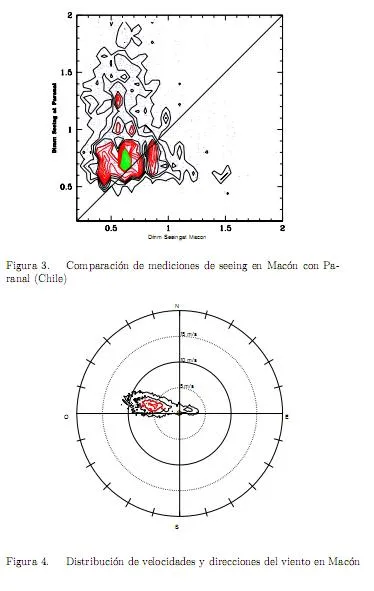
As a result of the first year of observation, it has been possible to establish that the site presents optimal conditions for astronomical observation. With the aim of making a comparison with high-quality and well-studied sites, figure 2 shows the comparison between the values obtained at Macón and those determined at Paranal (Chile) during the same observation nights. It should be noted that Paranal is located at a very similar latitude to that of Cordón del Macón.
The excellent seeing values obtained at Macón are partly due to the absence of mountain ranges to the northwest and east, which are the directions from which the winds preferentially come (see figure 3).
Seismic studies carried out by the GeoNorte group of the University of Salta indicate that the selected region presents seismic risks significantly lower than the vast majority of sites characterized in Chile. Another relevant aspect of the region is the total absence of light pollution, which is a recurring problem in almost all traditional astronomical observatories.
Will it be built in Salta?
Well, it is not yet known. It is a decision that ESO will have to make and it is scheduled for this year. Based on what has been stated throughout this note, the Argentine Puna has very good chances, but it is not the only possible location. Even if Tolar Grande on the Cordón Macón were the best site from an atmospheric-climatological point of view, there are other determining aspects of a political, social and economic nature. Other very strong candidates are the Observatorio Roque de los Muchachos and Chile itself.
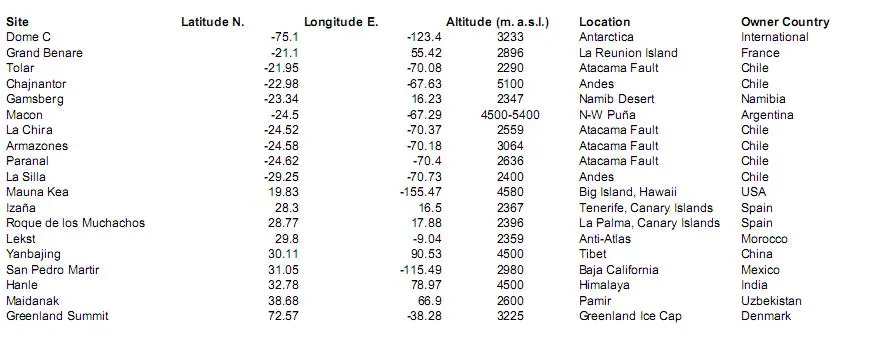
According to the WG3 - ELT Site Evaluation Working Group Final Report (April 13, 2006), the candidates are those listed in the figure below:
Synergy considerations
Given the distribution of potential sites around the world, the ELT will be located either a few degrees from ALMA or more than 40-50 degrees in geographic latitude. A large difference will have serious negative consequences for the scientific synergy between the two facilities. Considering the importance of both in the coming decades, this should be an important factor in the site selection.
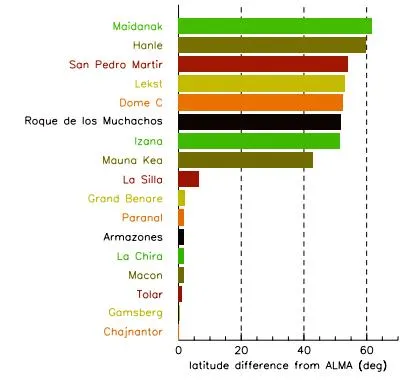
ALMA is being built on the Chajnantor Plain in the Atacama region of Chile, at a latitude of -23 degrees. Several potential sites are a few degrees from this latitude. Almost all the remaining ones are in the northern hemisphere, at latitudes between 43 to 62 degrees north. The only site significantly south of ALMA is Dome C in Antarctica, 52 degrees away.
We should not declare victory prematurely. It is one of the most ambitious astronomy projects and must be considered from multiple points of view, as we said before, not only from the aspect of its optimal geographic location. Let us remember, without going any further, that our country was a candidate for the world's largest radio telescope, the SKA, which will finally not be built in our country, but in Australia or South Africa.
Sources and related links
- Government of Salta:They could install the world's largest telescope in Salta
- ESO:THE EUROPEAN EXTREMELY LARGE TELESCOPE ("E-ELT") PROJECT
- ESO Chile:Science with the E-ELT
- Macon-Tolar Grande site
Recabarren, P.; Muriel, H.; García Lambas, D.; Vrech, R.; Renzi, V.; Stasyszyn, F.
Boletín de la Asociación Argentina de Astronomía, vol.49, p. 370-373
AdsAbs - Secretaría de ciencia y técnica de la UNC:Agreement for the installation of a Telescope in northern Argentina
- Workshop on Observational Astronomy in Argentina:Problems and Perspectives
La Plata, April 4 and 5, 2006
Asociación Argentina de Astronomía
About the images
E-ELT illustration: Credit ESO
Detailed E-ELT illustration:Simulation by Peter Bollinger
Figures 1,2 and 3:Workshop on Observational Astronomy in Argentina
Figures a and b: WG3 - ELT Site Evaluation Working Group Final Report