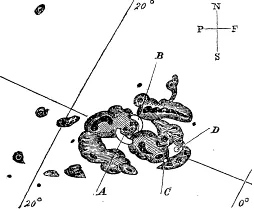
At 11:18 AM on a clear Thursday morning, September 1, 1859, Richard Carrington, 33 years old, widely recognized as one of England's leading solar astronomers, was in his observatory. As on every sunny day, his telescope was projecting an 11-inch-wide image of the Sun onto a screen and Carrington skillfully drew the sunspot he saw.
That morning, he was capturing the likeness of an enormous group of sunspots. Suddenly, before his eyes, two brilliant drops of blinding white light appeared over the spots, intensified rapidly and became kidney-shaped.
Realizing he was witnessing something unprecedented and "being somewhat flurried by the surprise," Carrington wrote later, "I hastily ran to call someone to witness the exhibition with me. On returning within 60 seconds, I was mortified to find that it had already much changed and diminished." He and his witness saw the white spots contract and disappear.
It was 11:23 AM. Only five minutes had passed.
Just before dawn the next day, the skies all over planet Earth exploded in red, green and purple auroras so bright that newspapers could be read as easily as by daylight. In fact, the incredible auroras pulsated even near tropical latitudes over Cuba, the Bahamas, Jamaica, El Salvador and Hawaii.
Even more puzzling, telegraph systems around the world went crazy. Electric shocks struck telegraph operators and set papers on fire. Even when telegraphers disconnected the batteries powering the lines, the electric currents induced by the auroras in the wires still allowed messages to be transmitted.
"What Carrington saw was a white light solar flare - a magnetic explosion on the Sun," explains David Hathaway, a solar physicist at the Marshall Space Flight Center.
We now know that solar flares occur frequently, especially during solar maximum activity. Most reveal their existence by releasing X-rays (recorded by space telescopes) and radio noise (recorded by radio telescopes in space and on Earth). In Carrington's day, however, there were no X-ray satellites or radio telescopes. No one knew that solar flares existed until that September morning when a super flare produced enough light to rival the brightness of the Sun itself.
"It is rare for one to actually see the solar surface light up. It takes a lot of energy to heat the surface of the Sun," says Hathaway.
The explosion produced not only an overload of visible light but also a mastodonic cloud of charged particles and detached magnetic loops -a "CME", Coronal Mass Ejection- and launched that cloud directly toward Earth. The next morning when the CME arrived, it collided with Earth's magnetic field, causing the global bubble of magnetism that envelops our planet to tremble and shake. Researchers call this a "geomagnetic storm." Quickly, moving fields induced huge electric currents that overloaded telegraph lines and disrupted communications.
"More than 35 years ago, I began calling the attention of the space physics community to the 1859 flare and its impact on telecommunications," says Louis J. Lanzerotti, retired distinguished member of the technical staff at Bell Laboratories and current editor of the journal Space Weather. He became aware of the effects of solar geomagnetic storms on terrestrial communications when a huge solar flare on August 4, 1972, knocked out long-distance communications across Illinois. That effect, in fact, caused AT&T to redesign its power system for transatlantic cables. A similar flare on March 13, 1989, triggered geomagnetic storms that disrupted the electrical power transmission from the Hydro Québec station in Canada, leaving 6 million people in the dark for 9 hours; these overloads even melted power transformers in New Jersey.
In December 2005, X-rays from another solar storm disrupted satellite communications and Global Positioning System (GPS) navigation signals for about 10 minutes. That may not sound like much, but as Lanzerotti noted, "I would not have wanted to be on a commercial airplane being guided for landing by GPS or on a ship docking by GPS during those 10 minutes."
Another Carrington-class flare would dwarf these events. Fortunately, says Hathaway, they seem to be rare:
"In the 160 years of recorded geomagnetic storms, the Carrington event is the biggest." It is possible to dig further back in time by examining Arctic ice. "Energetic particles leave a record in nitrates in ice cores. Here too the Carrington event is the biggest in 500 years and almost twice as big as the next one."
These statistics suggest that Carrington-type flares occur once in half a million events. However, these statistics are far from solid and Hathaway warns that we do not understand flares well enough to rule out a repeat in our lifetime.
So what?
Lanzerotti points out that as electronic technologies become more sophisticated and more embedded in our daily lives, they have also become more vulnerable to solar activity. On Earth, power lines and long-distance telephone cables could be affected by auroral currents, as happened in 1989. Radars, cellular communications, and GPS receivers could be disrupted by solar radio noise. Experts who have studied the issue say there is little to be done to protect satellites from a Carrington-type flare. In fact, a recent paper estimates the potential damage to the more than 900 satellites currently in orbit could cost between $30 billion and $70 billion dollars. The best solution, they say: have a pipeline of communications satellites ready for launch.
Humans in space would be in danger too. Astronauts on spacewalks might have only minutes after the first flash of light to find shelter from the energetic solar particles that follow hot on the heels of the initial photons. Their spacecraft would likely have adequate shielding, the key would be to get inside in time.
It is no wonder that NASA and other space agencies around the world have made the study and prediction of eruptions a priority. At this moment, a fleet of spacecraft is monitoring the Sun, gathering data on large and small eruptions that could ultimately reveal what triggers the explosions. SOHO, Hinode, STEREO, ACE, and others are already in orbit while new spacecraft like the Solar Dynamics Observatory are preparing for launch.
The research does not prevent another Carrington-type eruption, but it will make the "surprise stir" a thing of the past.
Sources and related links
- Science@NASA: A Super Solar Flare by Trudy Bell & Dr. Tony Phillips.
- Ciencia@NASA: Supertormenta solar
- Description of a singular appearance seen in the Sun on September 1, 1859, Monthly Notices of the Royal Astronomical Society, Vol. 20, p.13-15, the original report by R.C. Carrington.
- A recent analysis of the effects of potential future solar eruptions of similar magnitude is "The Carrington event: Possible doses to crews in Space from a comparable event," by L. W. Townsend et al., Advances in Space Research 38 (2006): 226–231, one of 16 articles in a special issue entirely dedicated to the Carrington eruption of 1859.
- See also "The 1859 Solar–Terrestrial Disturbance and the Current Limits of Extreme Space Weather Activity", by E.W. Cliver and L. Svalgaard, Solar Physics (2004) 224: 407–422 and "Forecasting the impact of an 1859-caliber superstorm on geosynchronous Earth-orbiting satellites: Transponder resources" by Sten F. Odenwald and James L. Green, Space Weather (2007) 5: 1-16.
- NASA is well aware of the danger of radiation in space and is taking mitigation measures. A long report from a 2005 workshop on the topic is Space Radiation Hazards and the Vision for Space Exploration: Report published by the National Research Council in 2006.
About the images
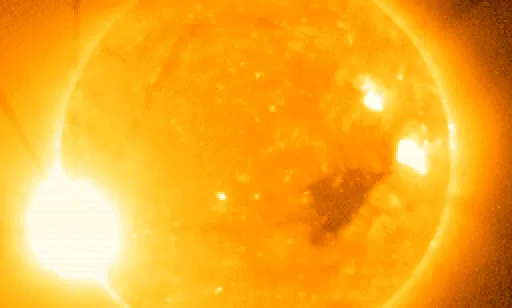
A solar flare recorded on December 5, 2006 by the X-ray instrument aboard the GOES-13 satellite. The flare was so intense that it damaged the instrument that took the picture. Researchers believe the Carrington flare was much more energetic than this.
Credit: NASA
Sunspots drawn by Richard Carrington on September 1, 1859. Copyright: Royal Astronomical Society