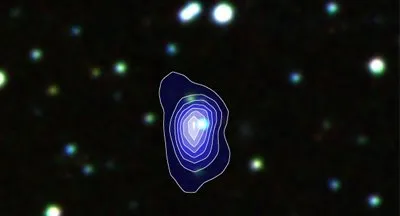
A study being conducted with the Arecibo radio telescope in Puerto Rico discovered a rare pulsar, with rapid rotation and a mysterious elongated orbit. The discovery challenges current views on the formation of pulsating binaries and gives scientists an opportunity to understand the fundamental properties of very dense matter.

At the end of the life of a massive star, the core collapses, the outer layers are ejected as a supernova and the core can remain as a black hole or a neutron star.
The gravity of a neutron star is billions of times that of Earth and the magnetic field is even more powerful. Furthermore, due to conservation of angular momentum, it can rotate rapidly. Very rapidly. The combination of rapid rotation and a powerful magnetic field generates a beam of radiation that from Earth is seen as if it were a pulse every time the beam points towards us. This is what is known as a pulsar.
If such an object orbits close to a star, its gravity can steal matter from the companion and add rotation to the pulsar, speeding it up. We are talking about rotations of milliseconds, or a thousandth of a second or 10-3. These are MSPs, Millisecond Pulsars, which are always found with another star.
The pair of objects recently found is peculiar in several ways, according to Jim Cordes, a professor at Cornell and one of the authors of the paper reported today in Science Express.
The pulsar, JI903+0327, rotates once every 2.15 milliseconds, making it one of the fastest among known pulsars. It is a pulsar classified as MSP (Millisecond Pulsar) for being an object that rotates once every 10 milliseconds or faster.
According to Cordes, MSPs found in binary systems orbit in tight and precise circles. But the system JI903+0327, on the other hand, does so in a highly eccentric form.
"These are [usually] the most perfect circles in the Universe. When we come across an object that has high eccentricity, it really stands out. We don't know of another MSP like this."
The stellar companion is also abnormal: Apparently, it is a star on the main sequence (similar to the Sun) instead of a white dwarf or a neutron star.
According to conventional scenarios for the evolution of pulsating binaries, slower-rotating pulsars are isolated or if they are in a binary system, they have probably been brought into an eccentric orbit by the explosion of a supernova that created the pulsar. The faster MSPs, on the other hand, orbit in almost perfect circles.
Taken together, the new pulsar's rapid rotation, eccentric orbit, and unusual companion require an alternative explanation, possibly the interaction of a third object or a recent ejection from a globular cluster.
"In a globular cluster you have all these other things happening: collisions, other interactions... that provide numerous formation paths," explains Cordes.
Scientists are considering three possibilities.
First, that the pulsar was simply born rotating rapidly, which does not seem likely. Another option, they say, is that the pulsar formed in a globular cluster, where it had a companion that accelerated its rotation. Then, a close encounter with another star ejected the object from the cluster. For several reasons, including that they do not see a nearby cluster it could have come from, they doubt this chance.
A third scenario involves the pulsar possibly being part of a triple system, not a double one. In that case, the pulsar orbits a neutron star or a white dwarf, and not a Sun-like star seen in the infrared images. The Sun-like star would be in a more distant orbit around the pulsar and its close companion.
"We have found about 50 pulsars in binary systems. Perhaps now we have found the first one in a triple stellar system," says Scott Ransom of NRAO.
The international team is very busy trying to get answers. They will conduct more studies to confirm that the companion is on the main sequence. Additional radio observations of the pulsar's orbit and they will try to measure its motion in space.
The pulsar is also massive: 1.74 solar masses, which can help astrophysicists better understand how matter behaves under extreme conditions.
Astronomers detected JI903+0327 in October 2005 as part of the Pulsar Alpha survey or PALFA at Arecibo. Other observations of the pulsar and its companion also used the Robert C. Byrd Telescope at Green Bank, the Westerbork radio telescope and Gemini North in Hawaii.
Sources and related links
- Cornell: Quirky pulsar system discovered at Arecibo challenges theories of binary formation
- NRAO: Weird Stellar Pair Puzzles Scientists
- Bad Astronomy: The odd couple and the missing neutron star
- An Eccentric Binary Millisecond Pulsar in the Galactic Plane
David J. Champion , Scott M. Ransom, et al.
Science DOI: 10.1126/science.1157580
About the images
A comparison of the orbits of pulsar J1903+0327 and its possible companion with the orbit of Earth around the Sun. (Not to scale)
Bill Saxton, NRAO/AUI/NSF