XMM-Newton discovered an explosive star in the Milky Way. Usually that would be important in itself, but this time it's special. Calculations show that the explosion must have been clearly visible to the naked eye but the legions of star observers around the planet seem to have missed it.
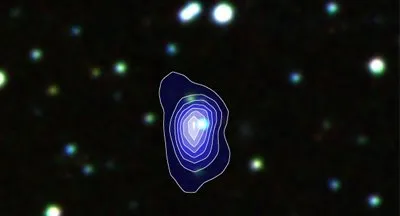
On October 9, 2007, the European Space Agency's X-ray observatory, XMM-Newton, was switching from one target to another. In doing so, it passed over a bright X-ray source that no one expected. This source was not listed in any previous X-ray catalog, even though the observatory was receiving 50 X-rays per second from this mysterious object.
The only celestial object the team could find at that location was a faint star, known as USNO-A2.0 0450-03360039. Astronomers Andy Read from the University of Leicester and Richard Saxton from ESA's Astronomy Centre in Spain acted quickly to inform other colleagues of the newly discovered source.
At Las Campanas, Chile, using the Magellan-Clay telescope they found that the object had brightened dramatically by more than 600 times. By analyzing the object's light they classified it as a nova.
Novas occur when a compact star, a white dwarf, steals gas from a close companion. At a critical moment, a nuclear reaction occurs that releases large amounts of energy, increasing the star's brightness.
The incandescent explosion did not release X-rays immediately. The cloud of debris created in the detonation masked them temporarily. Therefore, only after a few days could the X-rays shine through, as this cloud cleared away. So the explosion must have occurred several days earlier, although no one seemed to have reported it.
Usually, professional and amateur astronomers find novas by sweeping their observations across the night sky looking for stars that suddenly brighten.
Saxon contacted the robotic survey project ASAS (All Sky Automated Survey) and asked them to search their data. And they found the nova. It took place on June 5, 2007 and was clearly visible, even to the naked eye.
"Anyone who went out that night and looked toward the constellation of Puppis would have seen it," says Saxton.
The nova is now officially designated V598 Puppis and is one of the brightest in the last decade, ironically not observed at its peak brightness.
A systematic data processing of XMM-Newton (the XMM-Newton Slew Survey) of the data taken when the satellite moves between objects enabled this discovery. To date, this survey has covered 30% of the sky and produced a catalog of 7700 X-ray sources that has been released to the public. The discovery of the nova XMMSL1 J070542.7-381442 (V598 Puppis) is published by Astronomy and Astrophysics.
Since its detection, a global effort has been made to collect all possible data on the star. As the star faded, the data began to 'shine,' thanks to the invaluable collaboration of the amateur community, at least as important as the professional contribution.
Thanks to XMM-Newton, this story has a happy ending, but it worries astronomers that the event was not noticed earlier. Out there, in the vast cosmos, there are formidable events waiting to be discovered.
Sources and related links
- XMM-Newton discovers the star that everyone missed
- XMM-Newton slew survey discovery of the nova XMMSL1 J070542.7-381442 (V598 Puppis)
A. M. Read, R. D. Saxton et al.
A&A 482, L1-L4 (2008)
DOI:10.1051/0004-6361:200809456
About the images
Credit:Contours: ESA/ XMM-Newton/ EPIC (adapted from A. Read et al.), Background: Digitised Sky Survey