The most recent supernova in our Galaxy has been discovered by tracking the rapid expansion of its remains. This result has implications for understanding the frequency of these events in the Milky Way.
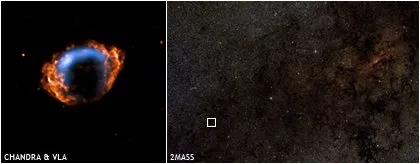
The discovery came from studies made with the Very Large Array (VLA) of NRAO and the Chandra X-ray Observatory.
The supernova occurred about 140 years ago. Previously, the last known supernova occurred around 1680, based on studies of the expansion of its remnant Cassiopeia A.
The recent supernova explosion was not seen in optical light at the time because it occurred near the center of the Galaxy and is embedded in a dense field of gas and dust. However, the supernova remnant generated by the explosion, G1.9+0.3, is now seen in radio and X-ray images.
"We can see some supernova explosions with optical telescopes across half the Universe, but when they are in this darkness we can miss seeing it in our own backyard," says Stephen Reynolds of the University of North Carolina, who led the Chandra X-ray Observatory study. "Fortunately, the expanding gas cloud from the explosion glows in radio and X-ray waves for hundreds of years. X-ray telescopes and radio telescopes can see through all that darkness and show us what we were missing."
Astronomers regularly observe supernovae in other galaxies like ours, and based on those rates, estimate that about three should explode every century in our Milky Way, although these estimates have large margins of error.
"If the supernova rate estimates are correct, there should be remnants of about 10 supernova explosions that are younger than Cassiopeia A," explains David Green of the University of Cambridge, who led the VLA study.
The tracking of this source began in 1985 when astronomers, led by Green, used the VLA to identify G1.9+0.3 as a supernova remnant near the galactic center. Based on its small size, it was thought to be the result of a supernova that exploded 400 to 1000 years ago.
Twenty years later, Chandra observations of this object revealed that the remnant had expanded surprisingly by a large amount, about 16% since 1985. This indicates that the remnant is much younger than previously thought.
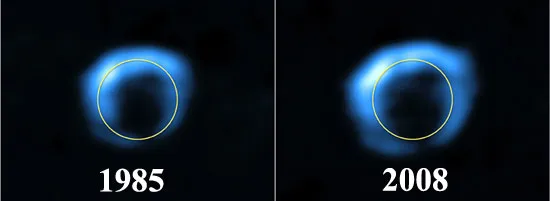
The young age was confirmed when new radio observations from the VLA were made in recent weeks. This allowed inferring that the event is about 140 years old, making it the youngest in our Galaxy. This means it would have occurred around 1868. (Einstein would have been 11 years old
Finding such a dark, recent supernova is a vital first step to better estimate the supernova rate in our Milky Way. Knowing this rate is important because supernovae heat and redistribute large amounts of gas, supply many heavy elements to their surroundings, and can trigger the formation of new stars, closing the cycle of stellar birth and death. The explosion could have left, besides the remnant, a central neutron star or a black hole.
G1.9+0.3 is of considerable interest for other reasons as well. The high expansion speed and the extreme energy particles it has been generating are unprecedented and should stimulate deeper studies of this object with Chandra and the VLA.
The distance to the remnant is known. And the amount of dust and gas between us and the remnant can be measured and compared with maps of the galaxy. By combining the distance with the measured expansion, a speed for the gas can be obtained: 14,000 km/s! or 5% of the speed of light. The amount of energy released in a supernova is truly incredible.
"No other object in the Galaxy has properties like this. Finding this object is extremely important for learning more about how some stars explode and what happens after their death," adds Reynolds.
These results will appear in The Astrophysical Journal Letters.
Sources and related links
- NASA:Discovery of Most Recent Supernova in Our Galaxy
- Chandra:Discovery of Most Recent Supernova in Our Galaxy
About the images
Credit: X-ray (NASA/CXC/NCSU/S.Reynolds et al.); Radio (NSF/NRAO/VLA/Cambridge/D.Green et al.); Infrared (2MASS/UMass/IPAC-Caltech/NASA/NSF/CfA/E.Bressert)
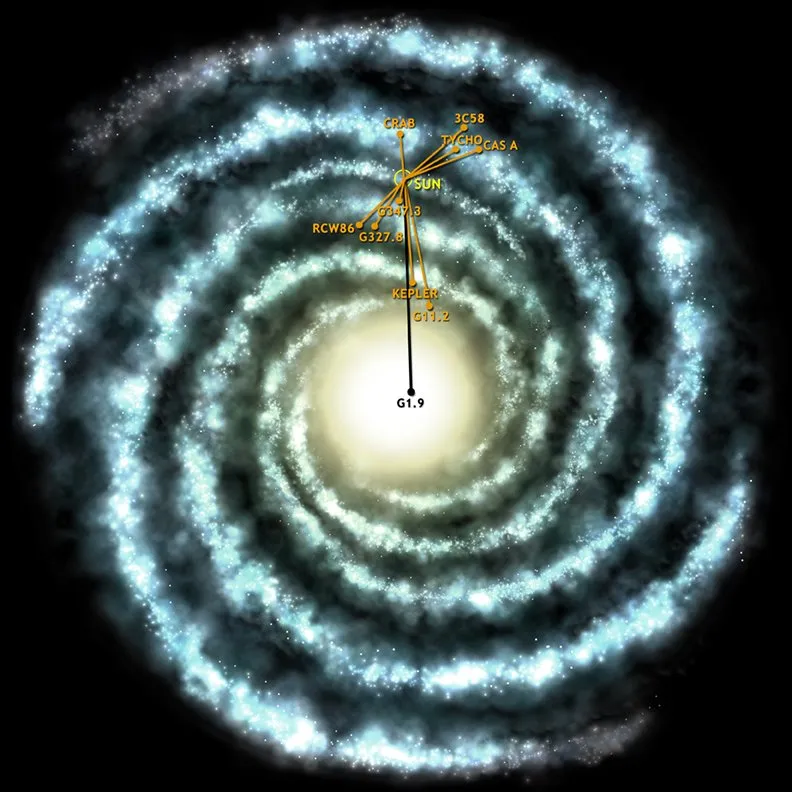
Location in the Milky Way of other historical Supernova events
Artistic impression showing a view of the Milky Way. The position of the Sun and the approximate positions and names of historical supernovae.
Note that G1.9+0.3 is the only object found in the galaxy's bulge.
Credit:NASA/CXC/M.Weiss