New and very precise measurements have shown that the rotation of our Milky Way is simpler than previously thought. A remarkable result shows that the much-debated motion of Cepheids toward the Sun stems from an intrinsic property of this type of star.
The result, obtained by a group of astrophysicists led by Nicolas Nardetto, will appear in an upcoming edition of Astronomy & Astrophysics.
Since Henrietta Leavitt discovered the unique properties of Cepheid variable stars in 1912, they have been used as distance indicators. Combined with velocity measurements, the properties of Cepheids are also very valuable tools in investigations of how our galaxy rotates.
Cepheids are variable stars, whose luminosity varies with a certain regularity.
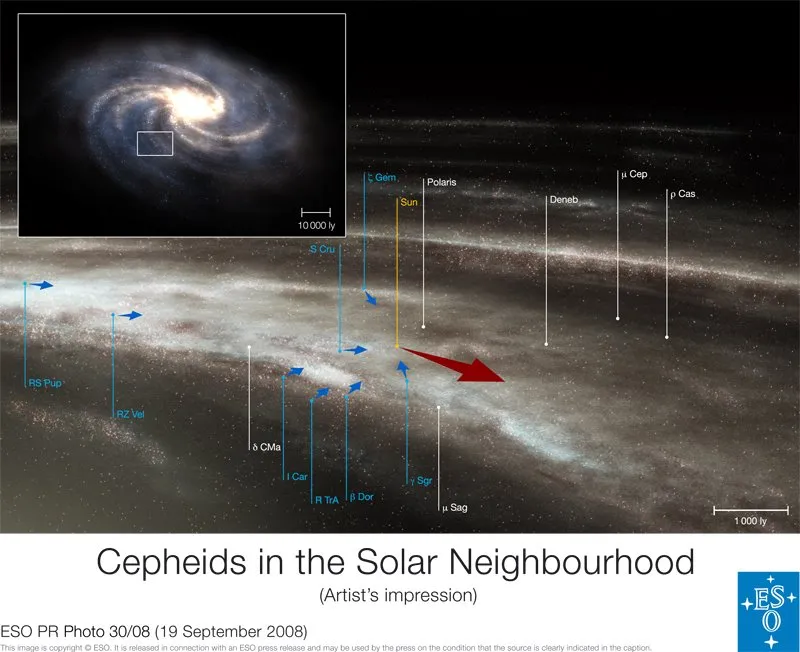
"The motion of Milky Way Cepheids is confusing and has led to disagreements among researchers," says Nardetto. "If the rotation of the Galaxy is taken into account, the Cepheids appear to be 'falling' toward the Sun with a speed of about 2 km/s."
The debate has gone on for decades over whether the phenomenon is truly related to the motion of the Cepheids and, consequently, to a complex model of our galaxy's rotation, or if it is the result of effects in the atmospheres of these variable stars.
Nardetto and his colleagues observed eight Cepheids with the high-precision spectrograph HARPS, on ESO's 3.6 m telescope at La Silla. HARPS is a high-precision planet-hunting instrument for radial velocity measurements. Besides 'planet hunting,' it can be used for other investigations where its ability to determine radial velocities—the speed at which something moves toward our direction or away from us—with great precision is invaluable.
"Our observations show that this apparent motion toward us almost certainly stems from an intrinsic property of the Cepheids," says Nardetto.
The astronomers found that the deviations in the measured velocities of the Cepheids were related to the chemical elements in the atmospheres of the stars considered. "This result, if generalized to all Cepheids, would imply that the rotation of the Milky Way is simpler than previously thought and is certainly symmetric with respect to its axis," concludes Nardetto.
Sources and related links
- ESO: Pinning down the Milky Way's spin
- High resolution spectroscopy for Cepheids distance determination. III. A relation between γ-velocities and γ-asymmetries
Nardetto, N., Stoekl, A., Bersier, D. & Barnes, T. G.,
Forthcoming in Astronomy & Astrophysics
DOI:10.1051/0004-6361:200809587
About the images
Illustration: ESO PR Photo 30/08
Cepheids in the Solar Neighbourhood