Astronomers have discovered a rare object that emitted 40 flares of light before disappearing. It is likely, according to the researchers, a missing link in the family of neutron stars, the first case of an object with an incredibly powerful magnetic field that showed, for a brief time, strong visible light activity.
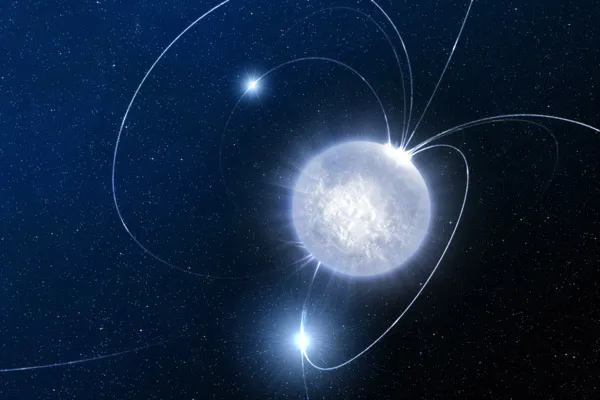
Neutron stars are the ultradense remains of massive stars (between eight and fifteen times the mass of our Sun), which have expelled their outer layers following a supernova explosion. They are objects only 20 kilometers in diameter, yet more massive than the Sun. Magnetars are neutron stars with magnetic fields hundreds of times more intense than average neutron stars. The energy released during a flare in the course of an active period is comparable to the energy released by the Sun in 10,000 years.
The rare object initially fooled its discoverers by appearing as a gamma-ray burst, suggesting the death of a star in the distant universe. But it soon exhibited unique behavior indicating that its origin was closer to us. After the initial pulse, there was a three-day period of activity in which 40 flares were observed, followed by a flare in the near-infrared 11 days later, which was recorded by ESO's VLT. Then, the source returned to its inactive state.
"We are dealing with an object that has been hibernating for decades before entering a brief period of activity," explains Alberto J. Castro-Tirado, lead author of research to be published tomorrow, September 25, in Nature.
The most likely candidate for this mysterious object is a "magnetar" located in our Milky Way, about 15,000 light-years away toward the constellation Vulpecula. Magnetars are young neutron stars with an ultra-powerful magnetic field. "Magnetars remain inactive for decades. It is likely that a considerable population exists in the Milky Way, although only about a dozen have been identified," notes co-author Antonio de Ugarte Postigo.
Some scientists have noted that magnetars should be evolving toward a quieter retirement as their magnetic fields decay, but no suitable source had been identified until now as evidence of that scheme. The newly discovered object, known as SWIFT J195509+261406, initially appearing as a gamma-ray burst (GRB 070610), is the first candidate. The hypothesis was reinforced by another analysis, based on another set of data, to appear in the same issue of Nature.
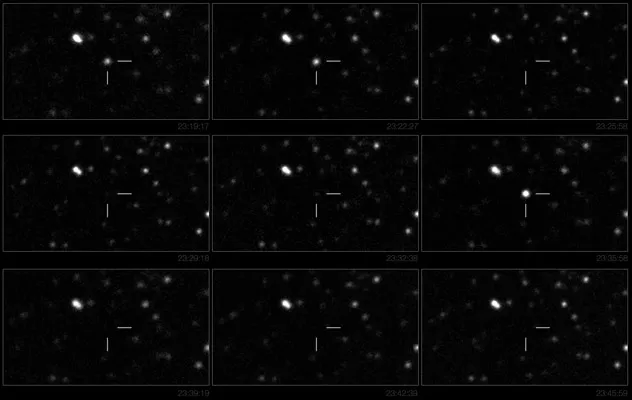
The study was conducted by 42 scientists who used data from eight telescopes around the world, including the robotic telescope BOOTES-2, the WATCHER telescope of Boyden Observatory (South Africa), the 0.8m IAC80 telescope of Teide Observatory (Spain), the 1.2m Mercator of Roque de los Muchachos Observatory (Spain), the 1.34m Tautenburg telescope in Germany, the 1.5 m telescope of Sierra Nevada Observatory, the BTA in Russia, the 8.2m VLT of ESO in Chile and the IRAM 30-m Pico Veleta, along with NASA's SWIFT satellite and ESA's XMM-Newton.
Sources and related links
- ESO: The Hibernating Stellar Magnet
- Flares from a candidate Galactic magnetar suggest a missing link to dim isolated neutron stars
A. J. Castro-Tirado, A. de Ugarte Postigo et al.
Nature 455, 506-509 (25 September 2008)
DOI:10.1038/nature07328 - Very fast optical flaring from a possible new Galactic magnetar
A. Stefanescu et al.
Nature 455, 503-505 (25 September 2008)
DOI:10.1038/nature07308
About the images
Illustration of a possible magnetar.
ESO PR Photo 31a/08
Credit: ESO/L.Calçada.
ESO PR Photo 31b/08
Flare from a magnetar candidate
A flare from SWIFT J195509+261406. Images obtained with the telescope of Teide Observatory (Spain), showing the source over a period of about 30 minutes, during which the source rapidly brightens and fades.
Credit: A.J. Castro-Tirado/IAC80/ESO.
ESO PR Video 31/08
An animation of SWIFT J195509+261406. In the ESO press release, an animation (MOV or GIF) can be obtained.
Credit: A.J. Castro-Tirado/IAC80/ESO.