NASA's Phoenix spacecraft successfully descended in the North Polar region of Mars on May 25 to begin its three-month investigation. The site was chosen for its likelihood of having water ice that will be sought by the spacecraft's robotic arm.
Its 422-million-mile flight from Earth to Mars began on August 4, 2007, the day of its launch.
A telescopic camera in orbit around Mars captured a view of the Phoenix Mars Lander suspended from its parachute during the spacecraft's successful arrival.
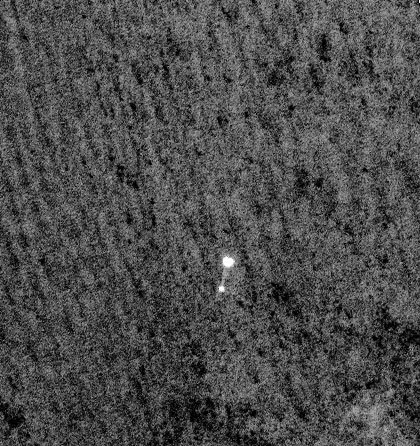
The image from the High Resolution Imaging Science Experiment (HiRISE) on the Mars Reconnaissance Orbiter (MRO) spacecraft marks the first time a spacecraft has photographed another in the act of descending on Mars.

The spacecraft uses materials from a previous spacecraft created for a 2001 launch that was canceled in response to the loss of a similar spacecraft in a 1999 landing attempt. Researchers who proposed the Phoenix mission in 2002 saw the unused spacecraft as a resource for a new scientific opportunity. Thus, that old and unused spacecraft was reborn from its ashes and gave the mission its name, like the Phoenix Bird.
Sources and related links
- Mars Phoenix Mission
- Phoenix at NASA
- Phoenix at ESA
About the images
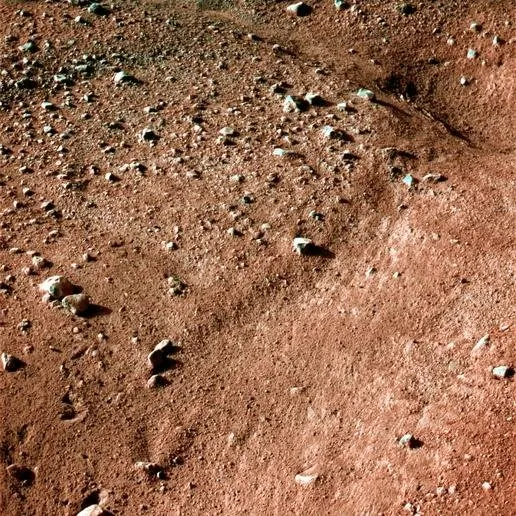
Image of Mars by Phoenix
Credit: NASA/JPL-Caltech/University of Arizona
Image of Phoenix on parachute over Mars by HiRISE
Credit: NASA/JPL/University of Arizona
Phoenix mission logo