Cosmologist Max Tegmark says mathematical formulas create reality. Cosmologists are not common thinkers and Max Tegmark is not one. In a series of papers that captured the attention of physicists and philosophers around the world, he explores not what the laws of nature say but why these laws exist. Second part.
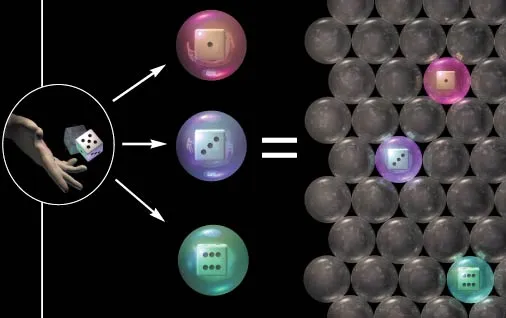
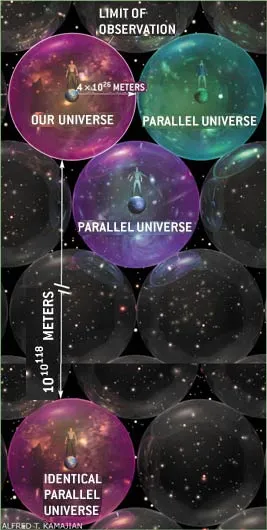
By Adam Frank. Photo by Erika Larsen. Adapted from the Discover article Is the Universe Actually Made of Math? Given the length of the article, it will be published in three parts. The first part, already published, is: The Universe Is Made of Mathematics (Part I) What is the first level of the multiverse? Level I is simply infinite space. Space is infinite, but it is not infinitely old—it is 14 billion years old. That is why we cannot see all of space but only a part—the part from which light has had time to reach us. Light has not had time to get here from everywhere. But if space lasts forever, then there must be other regions like ours—in fact, an infinite number of them. No matter how improbable it is that there is another planet just like Earth, we know that in an infinite universe it is destined to happen again. You're saying that we must all have doppelgängers somewhere due to the mathematics of infinity. [Note: doppelgängers: German word for the ghostly double of a living person.] It's pretty weird, isn't it? But I'm not even asking you to believe anything weird yet. All you need for a level I multiverse is an infinite universe: if you travel far enough you will find another Earth with another version of yourself.
So we are at level I. What is the next level of the multiverse? Level II emerges if the fundamental equations of physics, those that govern the behavior of the universe after the Big Bang, have more than one solution. It's like water, which can be a solid, a liquid, or a gas. In string theory, there could be 10500 types or even infinite types of possible universes. Of course, string theory could be incorrect, but it is perfectly plausible that whatever replaces it also has many solutions. Why should there be more than one type of universe after the Big Bang? Inflationary cosmology, which is our best theory for what happened just after the Big Bang, says that a small portion of space had a period of rapid expansion to become our universe. That is our level I multiverse. But other regions could have had inflation too, from other Big Bangs. These would be parallel universes with different kinds of physical laws, different solutions to those equations. This kind of parallel universe is very different from what happens in level I. Why? Well, in level I, students in different parallel universes could learn a different history from ours, but their physics would be the same. Students in level II parallel universes learn different histories and different physics. They might learn that there are 67 stable elements in the periodic table, not the 80 that we have. Or they might learn that there are four kinds of quarks instead of the six we have in our world. Do level II universes inhabit different dimensions? No, they share the same space, but we could never communicate with them because we are being swept away from each other as space expands faster than light can travel. Okay, to level III. Level III comes from a radical solution to the measurement problem proposed by a physicist named Hugh Everett back in the 1950s. [Everett left physics after completing his doctorate at Princeton due to a mediocre response to his theories]. Everett said that every time a measurement is made, the universe splits into parallel versions of itself. In one universe you see result A on the measuring device, but in another universe, a parallel version of you reads result B. After the measurement, there will be two versions of you. So there is another parallel self at level III too. Sure. You are made of quantum particles, so if they can be in two places at the same time, so can you. It's a controversial idea, of course, and people love to argue about it, but this "many-worlds" interpretation, as it is called, maintains the integrity of the mathematics. In Everett's view, the wave function does not collapse, and Schrödinger's equation always holds. Level I and level II of the multiverse all exist in the same spatial dimensions as ours. Is this true for level III? No. The parallel universes of level III exist in an abstract mathematical structure called Hilbert space, which can have infinite spatial dimensions. Each universe is real, but each exists in different dimensions of Hilbert space. The parallel universes are like different pages in a book, existing independently, simultaneously, and contiguously with each other. In a way, all these infinite level III universes exist here, now. This brings us to the last level: level IV of the multiverse, intimately linked with your mathematical universe, the "crazy idea" you were once warned about. Perhaps we should start there. I'll start with something more basic. You can call it the external reality hypothesis, which is the assumption that there is a reality out there that is independent of us. I think many physicists would agree with this idea. The question then would be, what is the nature of this external reality? If a reality exists independently of us, it must be free of the language we use to describe it. There should be no human baggage. I see where you're heading. Without these descriptors, only mathematics remains. Physicist Eugene Wigner wrote a famous essay in the 1960s, called "The Unreasonable Effectiveness of Mathematics in the Natural Sciences"[1] In that essay he wondered why nature is so precisely described by mathematics. The question didn't start with him. Since Pythagoras in Ancient Greece, there was the idea that the universe was built with mathematics. In the 17th century Galileo wrote eloquently that nature is a "great book" that is "written in the language of mathematics". Then, of course, the great Greek philosopher Plato said that the objects of mathematics truly exist. How does the mathematical universe hypothesis fit? The article continues in the third part. Sources and related links
Discover Is the Universe Actually Made of Math? Parallel Universes Max Tegmark (Penn) In "Science and Ultimate Reality: From Quantum to Cosmos", honoring John Wheeler's 90th birthday. J. D. Barrow, P.C.W. Davies, & C.L. Harper eds. Cambridge University Press (2003) arXiv:astro-ph/0302131v1 Scientific American:Parallel Universes Max Tegmark's page [1]"The Unreasonable Effectiveness of Mathematics in the Natural Sciences." About the images
Credit:ALFRED T. KAMAJIAN, in Sciam