Cosmologist Max Tengmark says that mathematical formulas create reality. Cosmologists are not common thinkers and Max Tengmark is not one. In a series of documents that captured the attention of physicists and philosophers around the world, he explores not what the laws of nature say but about why these laws exist.
Third part.

By Adam Frank. Photo by Erika Larsen
Adaptation from the Discover article Is the Universe Actually Made of Math?
Given the length of the article, it will be published in three parts. The previous parts, already published, are:
The Universe is made of mathematics (Part I)
The Universe is made of mathematics (Part II)
How does the mathematical universe hypothesis fit?
Well, Galileo and Wigner and many other scientists would argue that abstract mathematics "describes" reality. Plato would say that mathematics exists somewhere out there as an ideal reality. I am working in the middle. I have this kind of crazy idea that the reason why mathematics is so effective in describing reality is that IT IS reality. That is the mathematical hypothesis of the universe: mathematical things truly exist, and they are truly a physical reality.
OK, but what do you mean when you say the universe is mathematics? I don't feel like a set of equations. My breakfast seems quite solid. Most people will find it hard to accept that their fundamental existence becomes something they hated in school.
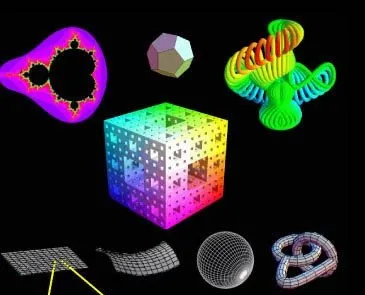
For most people, mathematics seems like a sadistic form of punishment or a bag of tricks for manipulating numbers. But, just like physics, mathematics evolved to ask broader questions. These days, mathematicians think of their field as the study of "mathematical structures", sets of abstract entities and the relationships between them. What has happened in physics is that, over the years, more complicated and sophisticated mathematical structures have proven to be invaluable.
Can you give an example of a mathematical structure?
The integers 1, 2, 3 are a mathematical structure if you include operations like addition, subtraction, and equality. Of course, integers are very simple. The mathematical structure that must be our universe would be sufficiently complex for creatures like us to exist. Some people think that string theory is the final theory of the universe, the so-called theory of everything. If that were true, then string theory would be a mathematical structure sufficiently complex for self-awareness to exist in it.
But self-awareness includes the feeling of being alive. That seems a bit hard to capture in mathematics.
To understand the concept, you must distinguish two ways of viewing reality. The first is from the outside, like the overall view of a physicist studying its mathematical structure. The second way is the internal manner of an observer living in the structure. You can think of a frog living in a field as the interior view and a bird flying high over the field as the external view. These two perspectives are connected to each other through time.
In what way does time provide a bridge between the two perspectives?
Well, all mathematical structures are abstract, immutable entities. The integers and their relationships to each other, all these things exist outside of time.
Do you mean there is no such thing as time for these structures?
Yes, from the outside. But you can have time inside some of them. Integers are not a mathematical structure that includes time, but Einstein's beautiful theory of Relativity certainly has parts that correspond to time. Einstein's theory has a four-dimensional mathematical structure called spacetime, in which there are three dimensions of space and one dimension of time.
So the mathematical structure that is the Theory of Relativity has a part that explicitly describes time, or rather, its time. But integers have nothing similar.
Yes, and the important thing to remember is that Einstein's theory taken as a whole represents the bird's perspective. In relativity all time already exists. All events, including your entire life, already exist as a mathematical structure called spacetime. In spacetime, nothing happens or changes because it contains all time at once. From the frog's perspective it seems that time is flowing, but that is just an illusion. The frog looks out and sees the Moon in space, orbiting the Earth. But from the bird's perspective, the Moon's orbit is a static spiral in spacetime.
The frog feels time flowing, but from the bird's perspective it is all an unalterable, eternal mathematical structure.
That's it. If the history of our universe were a movie, the mathematical structure would correspond not to a single frame, but to the entire DVD. That explains how change can be an illusion.
Of course, quantum mechanics with its notorious uncertainty principle and its Schrödinger equation will have to be part of the theory of everything.
Correct. Things are more complicated than relativity. If Einstein's theory described all physics, then all events would be predetermined. But thanks to quantum mechanics, it is more interesting.
But why do some equations describe our universe so perfectly and others not so much?
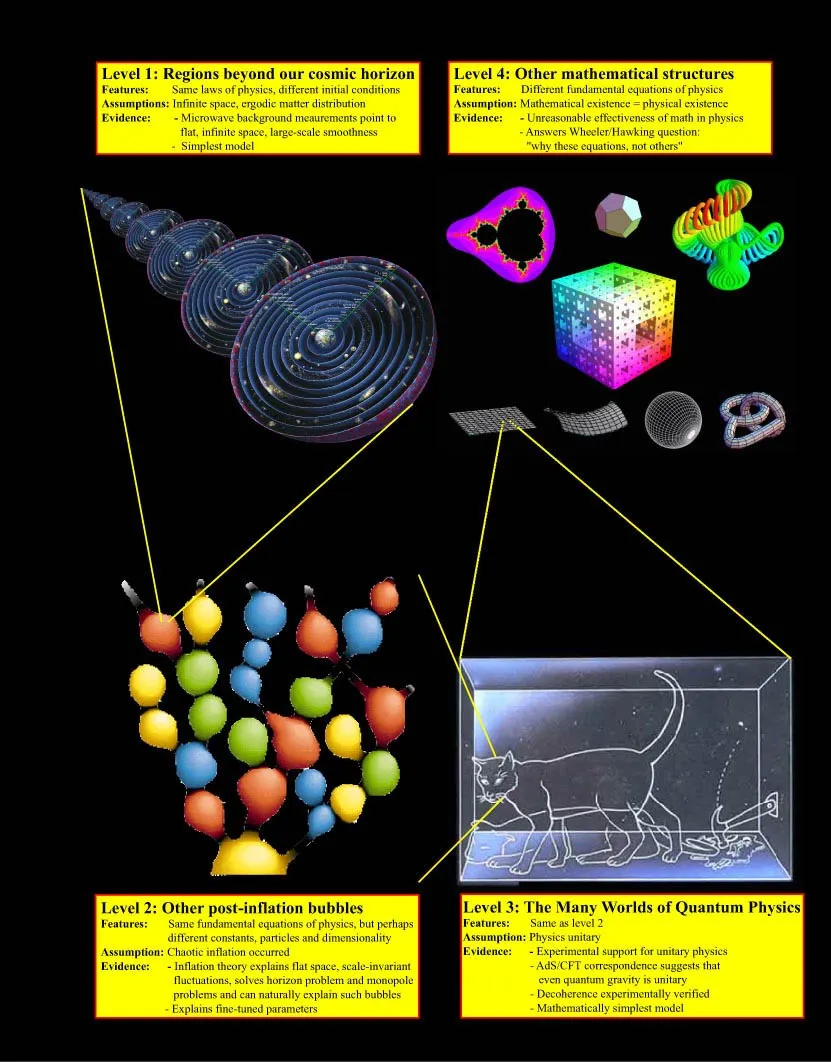
Stephen Hawking once asked it this way: "What is it that breathes fire into the equations and makes a universe for them to describe?". If I am right and the cosmos is just mathematics, then no fire is required. A mathematical structure does not describe a universe, it is a universe. The existence of a level IV multiverse also answers another question that has worried people for a long time. John Wheeler put it this way: even if we find equations that describe our universe perfectly, then, why those particular equations and not others. The answer is that other equations govern other, parallel universes, and that our universe has these particular equations because they are statistically probable, given the distribution of mathematical structures that can support observers like us.
These are quite broad and general ideas. Are they just philosophical reflections or is there something that can actually be tested?
Well, the hypothesis predicts much more of reality than we think, since each mathematical structure is another universe. Just as our Sun is not the center of the galaxy, but just another star, so too our universe is just another mathematical structure in a cosmos full of mathematical structures. From there we can make all kinds of predictions.
So, instead of exploring only our universe, you look for all possible mathematical structures in this much larger cosmos.
If the mathematical universe hypothesis is correct, then we will not be asking what particular mathematical equations describe all of reality ever again. Instead, we must understand how to separate the frog's view of the universe—our observations—from the bird's view. Once we distinguish them we can determine if we have unveiled the true structure of our universe and understand which corner of the mathematical cosmos is our home.
Max, this is pretty rarefied territory. On a personal level, how do you reconcile this pursuit of ultimate truth with your daily life?
Sometimes it's quite comical. I'll be thinking about the ultimate nature of reality and then my wife says, "Hey, you forgot to take out the trash". The big picture and the small one just collide.
Your wife is a respected cosmologist. Do you talk about this over breakfast with your kids?
She teases me about my ideas, but we try not to talk about it much. We have two kids to raise.
Do your theories help in raising your kids or do they also seem like two different worlds?
The interaction with the kids is great because they ask the same things I do. I gave a presentation about space for my son Alexander's preschool when he was 4 years old. I showed them videos of the moon landing and brought a rocket. Then a little boy raised his hand and said: "I have a question. Does space end or does it go on forever?"
Yeah, that's exactly what I'm thinking about now.
Sources and related links
- Discover
Is the Universe Actually Made of Math? - Parallel Universes
Max Tegmark (Penn)
In "Science and Ultimate Reality: From Quantum to Cosmos", honoring John Wheeler's 90th birthday. J. D. Barrow, P.C.W. Davies, & C.L. Harper eds. Cambridge University Press (2003)
arXiv:astro-ph/0302131v1 - Scientific American:Parallel Universes
- Max Tegmark's page
About the images
Graphic from Tegmark's page.