Is matter in the universe arranged in a fractal pattern? A new study of nearly one million galaxies suggests that it is, although there are no accepted theories to explain why this would be the case.

Cosmologists are trying to reconstruct the entire history of the universe, through some precious clues to work with. One of them is the distribution of matter through space, which has been ordered by 14 billion years of competition between gravity and cosmic expansion. There is a lot at stake: if there is a pattern in the distribution of matter, it encodes the secrets of the universe, and the distribution of matter has become a source of passionate debates between those who say the distribution is smooth and homogeneous and those who say it is hierarchically structured and clustered, like a fractal. Almost all physicists agree that on relatively small scales the distribution is fractal-like: hundreds of billions of stars clustered together to form galaxies, galaxies clustered to form clusters, and clusters forming superclusters. The point of discussion is what happens on large scales. According to physicists, this Russian doll clustering ends on large scales and the universe becomes homogeneous. But a small group of physicists, including Francesco Sylos Labini of the Enrico Fermi Center in Rome and Luciano Pietronero of the University of Rome, argue that the data show the opposite: the universe continues to appear fractal, as far as our telescopes can see. 3D Maps The best data to search for the distribution of galaxies comes from the Sloan Digital Sky Survey (SDSS), which is building the largest 3D map of the universe. When complete, it will map the positions of almost one million galaxies and quasars. When the SDSS data were published in 2004, physicists David Hogg of New York University and Daniel Eisenstein of the University of Arizona published an analysis of 55,000 luminous red galaxies, suggesting that the fractal pattern smoothed out on scales larger than 200 million light-years. But Sylos Labini and Pietronero were not convinced. They believed the apparent smoothness was an illusion caused by weak statistics: homogeneity seemed to occur on the largest scales the survey was capable of studying. Only a larger map could resolve the debate. Now, the SDSS has already revealed its sixth round of data, which determines the location of about 800,000 galaxies and 100,000 quasars. Large scales According to their latest paper, which has been submitted to Nature Physics, Sylos Labini and Pietronero, along with physicists Nikolay Vasilyev and Yurij Baryshev of Saint Petersburg University in Russia, argue that the new data show that galaxies exhibit an explicitly fractal pattern up to a scale of 100 million light-years. And they say that if the universe becomes homogeneous at some point, it must be on a scale larger than 300 million light-years. That is so because, even at that scale, they continue to observe large fluctuations, a cluster here, a void there, in the distribution of matter. Most cosmologists interpret those fluctuations as being no more significant than small waves on the surface of the sea, but Sylos Labini and his colleagues say they are more like tsunamis. No model The problem posed by the possible fractality of the universe on a large scale is that it undermines the standard model of cosmology. According to the accepted story of cosmic evolution, there simply has not been enough time since the big bang, 14 billion years ago, for gravity to build such large structures. Furthermore, the suggestion that the distribution is homogeneous has allowed cosmologists to model the universe quite simply using Einstein's general theory of relativity, which relates the shape of space to the distribution of matter. Modeling a fractal universe with general relativity is possible in theory, but in practice it would be very complicated. That would leave cosmologists without a model to work with, like acrobats without a net. Relic radiation To support the assumption of homogeneity, cosmologists point to the smoothness of the cosmic microwave background (CMB), relic radiation from the early universe. The CMB is perfectly uniform to one part in 100,000, suggesting the early universe was almost homogeneous. "The standard picture of a homogeneous universe on large scales holds up very well when tested with very large-scale observations such as those mapping cosmic background radiation, X-rays and radio galaxies," says physicist Neil Turok of the University of Cambridge. He adds: "If observations of galaxies in optical surveys do not agree, there could be a number of possible explanations, without resorting to an extremely non-homogeneous, fractal universe." Optical illusion? But inferring the distribution of matter from the CMB is not always simple. The maps show a 3D distribution projected onto a 2D surface, and it is possible for a clustered 3D distribution to appear smooth when projected into 2D. The same is true for the X-ray background, which appears homogeneous in two dimensions. Finally, using galaxies that are bright at radio wavelengths is also problematic, as it is difficult to measure their distances with enough precision to determine their positions in 3D. What could produce a fractal pattern in galaxy surveys like Sloan? Part of the clustering could be a kind of optical illusion known as the bull's-eye effect, says Adrian Melott of the University of Kansas. That is because nearby galaxies approach each other due to their mutual gravitational attraction, even with the universe expanding. The motion can enhance the apparent clustering of matter in surveys like Sloan, since those surveys rely on measurements of galaxy velocities to determine their distance from Earth. The bet But according to their paper, Sylos Labini's team says that effect is only relevant on very small scales, about 16 million light-years and less, and has no influence on the clustering at the large scales under discussion. Melott disagrees, as it would magnify clustering at any scale. But he adds that the effect only enhances structures that already exist. What is at stake if the universe were fractal on large scales? Besides a radical rethinking of the laws and history of the cosmos, the researchers put something more earthly on the line. More than a decade ago, Sylos Labini and Pietronero made a bet with physicist Marc Davis of the University of California. The bet, arbitrated by Turok, holds that if the distribution of matter were fractal beyond scales of approximately 50 million light-years, Davis would owe the Italian physicists a case of California wine. If the opposite were true, Davis would receive a case of Italian wine, which some would say is a better deal. Turok has yet to declare a winner. Sources and related links
Galaxy map hints at fractal universe, by Amanda Gefter in NewScientist. The large scale inhomogeneity of the galaxy distribution Francesco Sylos Labini, Nikolay L. Vasilyev, Luciano Pietronero, Yurij V. Baryshev arXiv:0805.1132v1 Fractal Geometry About the images
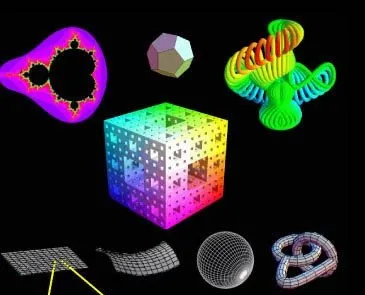
Fractal image from Fractal Geometry.