Astronomers presume that stars born at the same moment, in the same cloud and that have the same mass would have, like human twins, the same physical attributes. The analysis of the youngest pair of twin stars discovered to date revealed surprising differences in temperature and brightness, and possibly even in the size of the two.
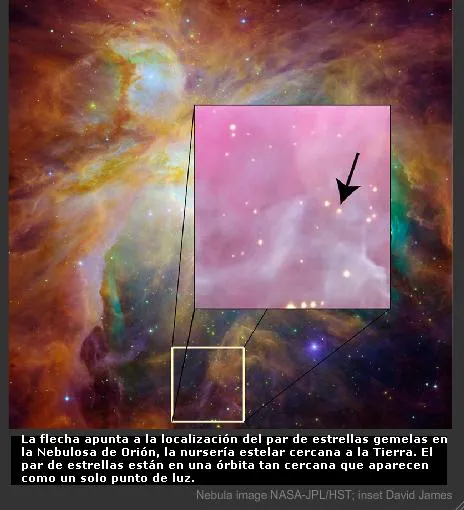
The study, which was published in the June 19 edition of Nature, suggests that one of the stars formed significantly earlier than its twin. The discovery provides an important test for stellar formation theories, forcing theorists to determine if their models can produce binaries with stars that form at different times.
The twin stars were discovered in the Orion Nebula, a well-known stellar nursery, which is 1,500 light-years away. The stars are one million years old, which makes them very young, given that their expected lifespan is 50 billion years.
"Eclipsing binary stars as young as these are the Rosetta Stone that tells us the life history of recently born stars," says Keivan Stassun, associate professor of astronomy at Vanderbilt University. He and Robert D. Mattieu of the University of Wisconsin-Madison headed the project.
Eclipsing binary stars are pairs of stars that orbit around an axis. This allows astronomers to determine the rate at which they orbit by measuring the periodic variations in brightness that result when the stars pass in front of each other. With this information, astronomers can determine the mass of the two stars, using Newton's laws of motion.
The mass calculation indicated that the stars have an almost identical mass, 41 percent of the mass of our Sun. According to current theories, mass and composition are two factors that determine the physical characteristics and dictate their life cycle. Since the two stars formed from the same cloud of gas and dust, they should have the same composition. With the same mass and composition, they should be identical. So the surprise came when discovering that the twins exhibit significant differences in brightness, surface temperature and, possibly, in size.
The astronomers made the initial measurements by examining 15 years of observations using the telescope at Kitt Peak Observatory in Arizona and the telescopes at Cerro Tololo, in Chile. To gain more information, measurements were made using the Hobby Eberly Telescope in Texas.
The results indicate that one of the two stars, known as Par 1802, is twice as bright as the other and they calculate that this star has a surface temperature 300 degrees higher than its twin. A further analysis of the stellar pair's light spectrum also suggests that one of the stars is 10 percent larger than the other, but more observations are required to confirm this.
"The easiest way to explain these differences is that one star formed 500,000 years earlier than its twin," states Stassun.
In addition to causing an examination of theoretical models, the new discovery could generate a readjustment in the mass and age estimates of thousands of young stars, less than a few million years old. Current estimates are based on models that were calibrated with measurements of young binary stars that were presumed to have formed simultaneously.
"Par 1802 provides direct evidence that the order of birth in 'identical twin' stars can manifest as an observable physical difference between two stars, at least when they are very young," adds Stassun.
Eclipsing binaries are very rare—only one in 1,000 stars. During the 15 years of data collection on stars in Orion, three eclipsing pairs were found. Par 1802 is the only one of the three with equal mass, and it is the only eclipsing binary found so far, with the same mass in stars young enough for the physical differences to still be evident.
Sources and related links
- EurekAlert:Newly born identical twin stars show surprising differences
- Discover:Orion's Twin Stars Have Their Differences
- Surprising dissimilarities in a newly formed pair of 'identical twin' stars
Keivan G. Stassun et al.
Nature 453, 1079-1082 (19 June 2008)
doi:10.1038/nature07069
About the images
Credit:NASA-JPL/HST and David James (Vanderbilt)