Galaxy Zoo is a project that aims to classify the largest number of galaxies thanks to the contribution of users via the web.
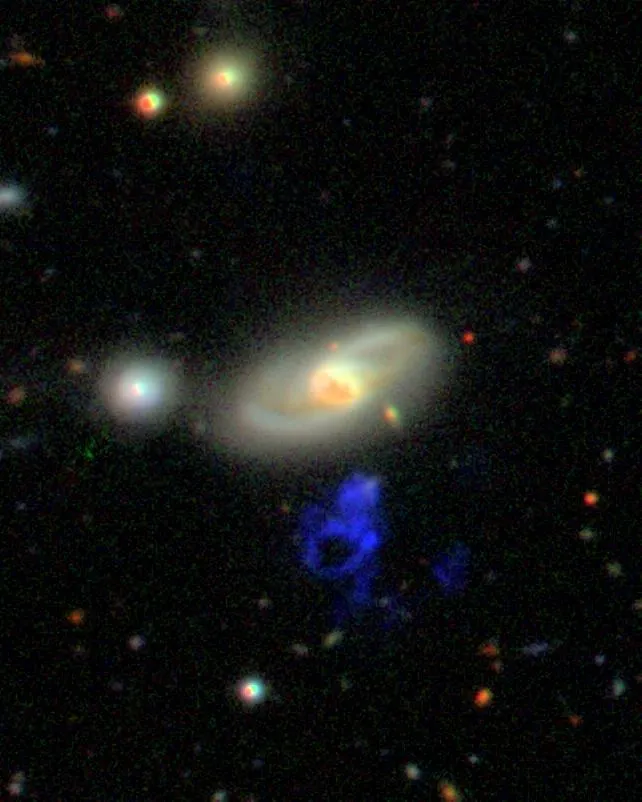
On its forum, Hanny asked about a curious blue object that appeared next to a massive galaxy in a photo. Since then the object, now called "Hanny’s Voorwerp", has aroused the curiosity of amateurs and professionals. What is it?
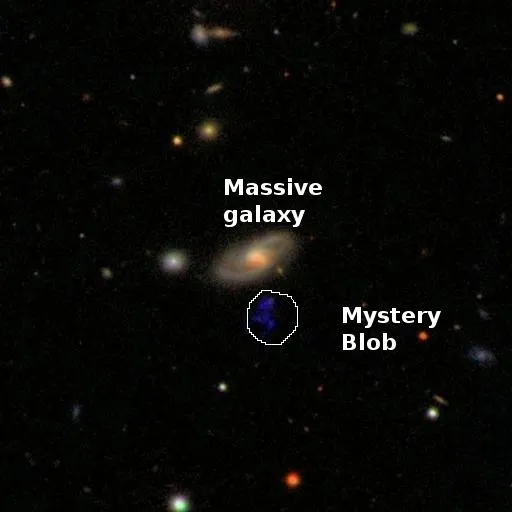
At GalaxyZoo, whose objective we discussed in Help Wanted to Classify Never-Before-Seen Galaxies, they gave the object that name because Voorwerp means "Object" in Dutch. So it was called "Hanny’s Voorwerp" as it is "Hanny's Object".
At GalaxyZoo, they believe -according to the data they have so far- the thing would be like this:
One hundred thousand years ago, a quasar burned 700 million light-years away, shining with a magnitude of 13, several times brighter than the light of the surrounding galaxy. That galaxy, later cataloged as IC 2497, is a massive spiral galaxy that was in the process of interacting with a gas-rich dwarf galaxy.
But something happened to the quasar. Either it turned off or was quickly covered by gas and dust, but it was no longer seen.
What they seem to see is its echo. Or at least, that's what they propose.
What they seem to have is highly ionized gas by nothing they can see. Dust, reflecting ultraviolet light whose source they don't know, and they detect no central source of X-rays. This is why they consider that what they have is a light echo, like the ones we have talked about on other occasions here (For example, in Unveiling the Mysteries of Cassiopeia A and Determining the Power of a Supernova).
They propose that this object is a light echo of a quasar that was there 50,000 to 75,000 years ago, but is now invisible.
To learn more, they need to continue observing and have requested time to observe with the Chandra and Hubble Observatories.
On May 30, the Space Telescope Science Institute announced the approvals for the next observation cycle with Hubble. The proposal to observe the Voorwerp (led by researcher Bill Keel) was approved. More than 20,000 orbits were requested and only 3,500 were accepted, of which 7 now belong to Galaxy Zoo.
When will this be? Well, they must wait for the successful completion of servicing mission four to repair Hubble and install new instruments, currently scheduled for October of this year. After the repairs and checks, they will have to wait for the object to be visible to the telescope. Finally, once the data is taken, they will have to reduce it to produce an image. So it will take a few months, after October.
Sources and related links
- GalaxyZoo Blog: Voorwerp fever
- GalaxyZoo Blog: What’s an Astronomer’s favourite Birthday Gift?
- Hanny's Voorwerp (SDSS J094103.80+344334.2)
About the images
First image
Credit:GalaxyZoo
Second image from the William C. Keel page, image from the William Herschel Telescope.