When a star dies, it explodes as a supernova and its debris, called a supernova remnant, expands into the surrounding environment. There are several different types or categories of supernova remnants. One of them is known as a mixed-morphology supernova remnant.
This type of remnant gets its name from sharing several characteristics with other types of remnants.
More specifically, particles that have been superheated are seen in X-rays at the center. This central region is surrounded by a structure detected in radio emission.
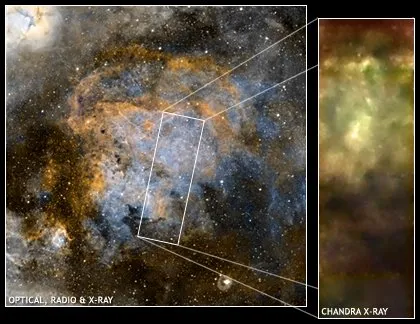
NASA's Chandra X-ray Observatory presents this composite image of the supernova remnant (SNR) W28, in which Dr. Gloria Dubner participated.
The composite image shows a classic example of this class of remnant. It is W28. Each wavelength shows the detailed structure of how the supernova shock wave is interacting or has interacted with the complex environment that surrounded the star. In this image, stars are seen in optical light (green and white) by the Cerro Tololo Inter-American Observatory in Chile. The radio data (in orange) were obtained by the Very Large Array in New Mexico, while the blue comes from X-ray data from the ROSAT satellite.
Data from the Chandra X-ray Observatory add details to the heart of W28 seen in the enlarged rectangle: low-energy X-rays are colored red, medium-energy in green, and the highest-energy X-rays found by Chandra, in blue.
By studying W28 and other remnants, astronomers hope to better understand the complexities involved when a star explodes in a crowded stellar neighborhood.
Sources and related links
- Chandra:W28:A Mixed Bag
- ROSAT/ASCA Observations of the Mixed-Morphology Supernova Remnant W28
The Astrophysical Journal, 575:201–216, 2002 August 10
Jeonghee Rho - Multispectral study of the supernova remnant W 28
Dubner, G.; Velázquez, P.; Castelletti, G.
Boletín de la Asociación Argentina de Astronomía, vol.42, p.50-51
About the images
Credit:
Chandra X-ray: NASA/CXC/HSC/J. Keohane et al; ROSAT X-ray: NASA/ROSAT; Optical: NOAO/CTIO/P.F. Winkler et al; Radio: NSF/NRAO/VLA/G. Dubner et al.