More than 80,000 images from the Spitzer Space Telescope have been combined to create a portrait of the coming of age of stars in our Milky Way.
The image, which depicts an area of the sky 120 degrees wide by two degrees high, was unveiled at the 212th Meeting of the American Astronomical Society in St. Louis.
"This is the highest-resolution, largest, most sensitive infrared picture ever taken of our Milky Way," says Sean Carey of the Spitzer Science Center at the California Institute of Technology in Pasadena.
Carey is the lead investigator of one of the two teams responsible for the new image.
"Where previous surveys saw a single source of light, we now see a cluster of stars. With these data, we can learn how massive stars form, map the spiral arms of the galaxy, and make a better estimate of our galaxy's star formation rate," explains the scientist.
In the image, areas hosting stellar embryos are identified by green streaks, which are organic molecules called polycyclic aromatic hydrocarbons, illuminated by light from nearby newborn stars. On Earth, these molecules are found in automobile exhaust gases and essentially wherever carbon molecules are burned incompletely.
The regions where young stars reside are revealed as "bubbles" or curved ridges in the green clouds. These bubbles are carved by winds from fledgling stars that sweep away their natal dust. The young stars appear as red and yellow dots, and the red wisps that fill almost all the bubbles are composed of graphite dust particles, similar to very small pieces of pencil lead.
Blue specks scattered throughout the photograph are individual old stars in our galaxy. The whitish-blue haze hovering in the middle is starlight from the galaxy's older population of stars. A deep and careful examination of the image also shows the dusty remnants of dying stars as translucent orange spheres.
"With these Spitzer data, we have been able to catalog more than 100 million stars," says Edward Churchwell of the University of Wisconsin, principal investigator of one of the teams.
"This picture shows us that our Milky Way is a crowded and dynamic place. We have a lot to learn. I find a lot of things in this map that I didn't expect to see," adds Carey.
Furious star formation in the Milky Way
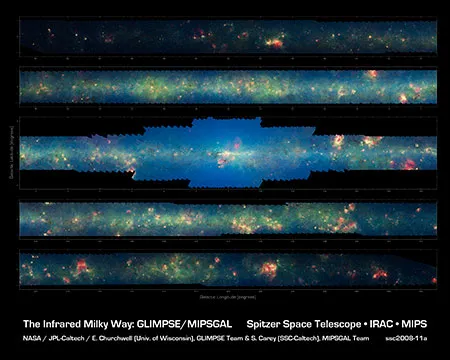
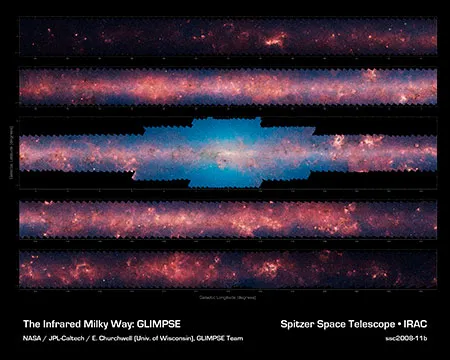
More than 444,580 frames from the Spitzer Space Telescope were combined to form the second image, a portrait of the furious star formation in the inner Milky Way.
As inhabitants of a flat galactic disk, Earth and its solar system have an edge-on view of their host galaxy, like looking at a glass plate from its edge. From our perspective, most of the galaxy is concentrated in a band of light that extends completely around the sky, also known as the galactic plane.
In this mosaic, the galactic plane is divided into five components: the top image is the left side of the plane; the second image corresponds to the area just to the left of the galaxy's center; the galactic center is represented in the middle image; the area to the right of the center is the fourth image; and the farthest left side is the last image. Together, these panels represent more than 50 percent of our entire galaxy.
The red fog permeating the image comes from organic molecules illuminated by the light of massive baby stars. The black regions are dense, dark clouds of dust. The bright arcs of white across the image are massive stellar nurseries. The whitish-blue haze in the middle panel is starlight from the oldest population toward the center of the galaxy.
The image was taken with the Infrared Array Camera, part of the Galactic Legacy Infrared Mid-Plane Survey Extraordinaire (GLIMPSE) project.
Sources and related links
Spitzer Captures Stellar Coming of Age in Our Galaxy
About the images
Credit: NASA/JPL-Caltech/Univ. of Wisconsin