Radio telescope images revealed galactic cannibalism not previously seen with visible-light telescopes. A relationship is found between galactic interactions and the active nuclei of Seyfert galaxies.
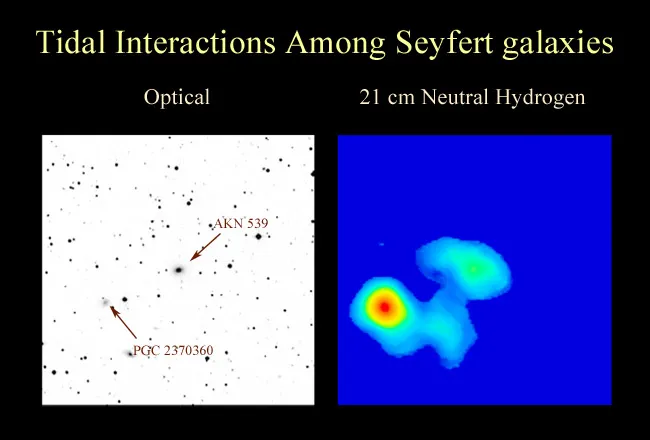
Astronomers have suspected that the very bright nuclei of spiral galaxies called Seyfert Galaxies were generated by supermassive black holes consuming material. But, how does the material reach the black hole? Theories indicate that Seyfert galaxies were altered by a close encounter with neighboring galaxies, bringing some of their gas within the gravitational reach of the black hole. However, astronomers looking at Seyferts with visible-light telescopes note that only a small fraction show any evidence of such encounters. Now, new images of the hydrogen gas in Seyfert galaxies, made with the Very Large Array (VLA) radio telescope, show that most are, in fact, altered by encounters with galactic neighbors.
"The VLA lifted the veil on what is really happening with these galaxies," says Cheng-Yu Kuo of the University of Virginia. "Looking at the gas in these galaxies clearly shows they are cannibalizing their neighbors. It's a dramatic contrast with their appearance in visible light," he adds.
The effect of these encounters is to send gas and dust toward the black hole.
Astronomers chose a number of relatively nearby Seyfert galaxies that had been previously observed with visible-light telescopes. Then they studied them with the VLA, specifically looking for radio waves emitted by hydrogen atoms. The images showed that the vast majority of the Seyferts were altered by their neighbors.
In comparison, similar VLA images of inactive galaxies showed that very few had been altered. "This comparison clearly shows a connection between close galactic encounters and the activity of black holes in their nuclei," says Ya-Wen Tang of Taiwan University.
Sources and related links
- Radio Telescopes Reveal Unseen Galactic Cannibalism
- Prevalence of Tidal Interactions among Local Seyfert Galaxies
Cheng-Yu Kuo
The Astrophysical Journal, 679:1047–1093, 2008 June 1
DOI: 10.1086/587045
About the images
Visible-light (left) and radio (right) images of a pair of galaxies. The radio image shows a stream of gas between the galaxies.
Credit: Kuo et al., NRAO/AUI/NSF