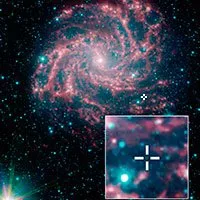
When amateur astronomer Ron Arbour detected a huge explosion 17 million light-years away in the Galaxy NGC 6946 (known as the Fireworks Galaxy), many scientists believed it was the end of a massive star. However, observations with the Spitzer Space Telescope showed, unexpectedly, that a relatively lightweight star was the source of such an outburst.
The explosion, called SN 2008S, was the first detected in February of this year.
"This finding was quite surprising: the star was only ten times the mass of our Sun. We commonly see this type of outburst in stars at least thirty times more massive than the Sun," says José Prieto, from Ohio University, who searched for the source of the explosion in the archives of professional optical and infrared telescope data.
Now, astronomers are wondering if it was really a supernova explosion or not.
When astronomers see a flash of light indicating a possible nearby supernova, their first instinct is to look for the star before its death, or its progenitor, in the archives of visible light observations of the region. But when Prieto and collaborators from Ohio searched for the source in NGC 6946 in observations previously taken by the Large Binocular Telescope Observatory (LBT) in Arizona, they found nothing.
Only when they reviewed the Spitzer archives of observations of the galaxy taken three years earlier did they discover the source.
"The original star could be seen only in three infrared wavelengths. This clearly shows the presence of hot dust around the star, probably dust formed in the stellar wind," says Prieto.
The dust explains how the progenitor star could elude the eyes of the LBT.
According to Prieto, the initial optical observations of the outburst suggest that the event was possibly a type IIn supernova. Stars spend most of their lives fusing hydrogen atoms in their cores. The energy produced causes an outward pressure that counteracts the force of gravity. When the hydrogen runs out, the outward pressure ceases and the core begins to shrink. This causes an increase in the temperature and density of the star, which generates fusion again of heavier elements in the core.
In stars that are several times the mass of our Sun, this process occurs many times until the core reaches iron. At that point the core collapses: it is a type II supernova.
Type IIn supernovae are a subclass that show an abundant amount of hydrogen associated with a dense cloud of gas around the star before exploding, probably created by a strong wind.
Another possibility is that it was a "fake supernova," the super outburst of a luminous blue variable star. These stars eject an enormous amount of material in occasional outbursts, as they reach the end of their lives. The brightness of these explosions can be confused with a supernova. Luminous blue variables are extremely rare, and are thought to be at least thirty times more massive than our Sun. The most famous example is Eta Carinae.
"In any case the result is interesting because astronomers currently think that type IIn supernovae and luminous blue variables are associated with very massive stars, tens of times the mass of the Sun, and not with a star of ten solar masses," adds Prieto.
Prieto submitted his scientific paper to Astrophysical Journal Letters. Shortly after it was accepted, a similar outburst was detected in the nearby galaxy NGC 300. Again, scientists searched the optical archives for the source of the explosion. However, they were able to identify a dust-obscured star in the Spitzer archives.
"These two luminous outbursts could be a new class of violent explosions in dusty massive stars," says Prieto.
Sources and related links
- Stellar Lightweight Causes a Mysteriously Massive Explosion
- Discovery of the Dust-Enshrouded Progenitor of SN 2008S with Spitzer
The Astrophysical Journal Letters, 681:L9–L12, 2008 July 1
José L. Prieto et al.
A Survey About Nothing: Monitoring a Million Supergiants for Failed Supernovae (in press)
Christopher S. Kochanek, John F. Beacom, Matthew D. Kistler, Jose L. Prieto, Krzysztof Z. Stanek, Todd A. Thompson, and Hasan Yueksel
Site of amateur astronomer Ron Arbour
About the images
Infrared image of NGC 6946. The white cross shows a star detected by Spitzer three years earlier, which could be the star that exploded as a supernova in February 2008.
NASA/JPL-Caltech/R. Kennicutt (U. of Ariz./Inst. of Astr., U. of Cambridge) and the SINGS Team