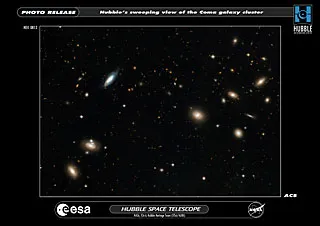
The Hubble Space Telescope captured the magnificent population of the Coma galaxy cluster, one of the densest collections of galaxies known. The Advanced Camera for Surveys observed a large portion of the Coma Cluster, extending across several million light-years. The entire cluster is over 20 million light-years in diameter, nearly spherical in shape and contains thousands of galaxies.
Also known as Abell 1656, it is located 300 million light-years away. This Coma supercluster, whose name comes from its host constellation Coma Berenices, is near the north pole of the Milky Way. This places Coma in an area not obscured by the dust and gas of our Galaxy's plane, making it easily visible to observers here on Earth. We had already commented here about this Coma supercluster in relation to observations from the Spitzer Space Telescope.
Most of the galaxies inhabiting the central portion of the cluster are ellipticals and contain populations of old stars.
Far from the center there are several spiral galaxies containing clouds of cold gas that are giving birth to new stars.
S0 (S-zero) galaxies form a morphological class of galaxies between the better-known ellipticals and spirals. These are lenticular galaxies and consist of older stars and show little evidence of recent star formation and show some structures - perhaps a bar or a ring that could eventually give rise to a disk.
This Hubble image consists of a section of the cluster that is almost a third of the way out from the center of the entire cluster. A bright spiral galaxy is visible in the upper left of the image. It is clearly brighter and bluer than the galaxies around it. A series of dusty spiral arms appear redder against the galaxy's white disk and suggest that it has been disturbed at some point in the past. The other galaxies in the image are ellipticals or S0 galaxies or background galaxies that are much farther away from the cluster sphere.
The data were taken as part of a survey of nearby galaxy-rich clusters. Together they will provide a key database for the study of galaxy formation and evolution. This survey will also help compare galaxies in different environments, whether crowded or isolated, and compare relatively nearby galaxies with more distant ones (with higher redshifts).
Sources and related links
SpaceTelescope:Hubble’s sweeping view of the Coma Galaxy Cluster
(The site has images of different sizes and other related files)
About the images
Credit:NASA, ESA, and the Hubble Heritage Team (STScI/AURA).
Acknowledgment: D. Carter (Liverpool John Moores University) and the Coma HST ACS Treasury Team.