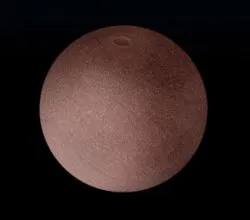
A lively debate on how to define planets failed to forge a common criterion at a meeting on this topic held on Thursday.
Astronomers Neil deGrasse Tyson and Mark Sykes, however, agreed that the issue is much broader than the decision on Pluto's status, but rather a broader view of the Solar System.
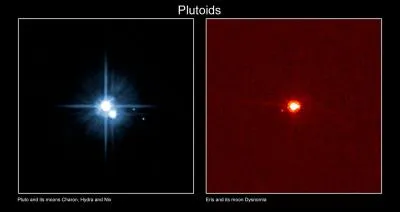
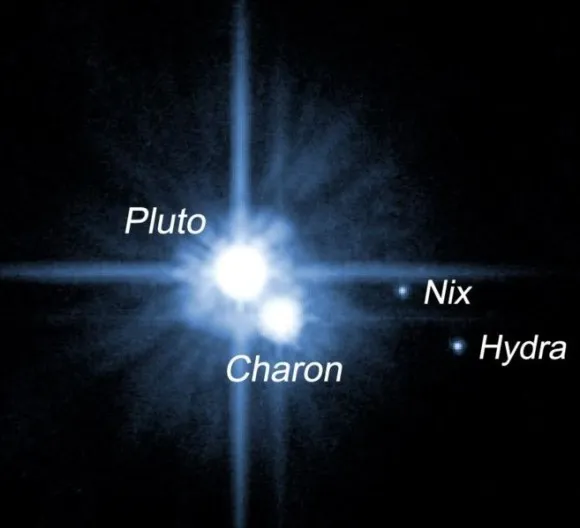
Pluto was demoted to a dwarf planet by the International Astronomical Union (IAU) in August 2006, when the entity redefined the term. And later, it was decided to grant the term Plutoid to trans-Neptunian dwarf planets.
The fact is that Pluto met only two of the three requirements to be considered a planet: it orbits the Sun and is sufficiently massive for gravity to give it a spherical shape, but its neighborhood is not clear of objects. In fact, Pluto's surroundings are a swarm of icy objects, one of which, Eris, is larger than Pluto.
The IAU's new definition generated a storm of complaints and controversy. Alan Stern, for example, head of the New Horizons mission to Pluto, was a prominent critic of the decision.
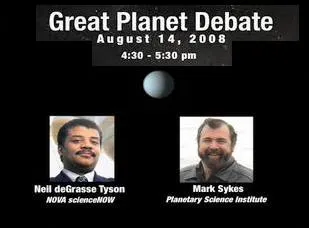
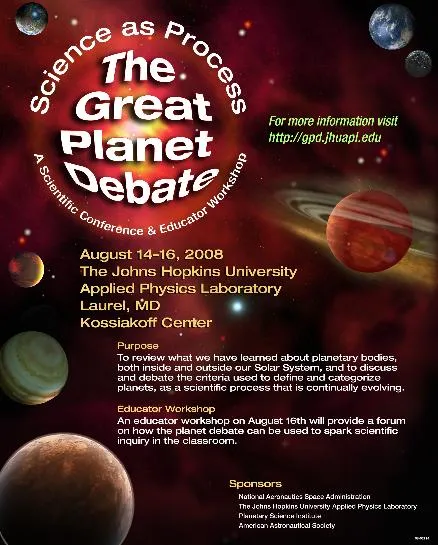
This Thursday, at Johns Hopkins University in Maryland, United States, the meeting called "The Great Planet Debate: Science as Progress" was held, with presentations by several scientists on the properties of planets and the relative merit of different definitions.
On one side was Neil deGrasse Tyson, director of the Hayden Planetarium in New York who generated controversy in 2001 by not including Pluto in a show about the planets at his planetarium.
And on the other side, Sykes, a member of the Dawn mission en route to the asteroids Vesta and Ceres and a member of the American Astronomical Society, Division for Planetary Sciences and researcher at the Planetary Science Institute in Arizona.
Sykes attacked the IAU's definition, complaining that it created an absurd situation where an object can be a planet or not at the same time, depending on where it is located. For example, although Earth is considered a planet in its current location, it would not be if it were in the Kuiper Belt, as it would not be able to be free of other objects.
According to Sykes, it would make more sense to use only roundness as a distinctive characteristic of a planet because it groups objects with similar properties. These objects are distinct from small asteroids and Kuiper Belt objects in that they order their interiors in layers, with dense material in the center and lighter ones higher up; and that they are geologically active, at least in early times after formation.
Tyson did not advocate for a specific definition, but pointed out that Pluto is just one of many objects in the Kuiper Belt and argued that the situation is similar to what happened with Ceres and other asteroids discovered in the 1800s. These were initially called planets until it was discovered that they were part of a huge belt of objects between Mars and Jupiter and were renamed asteroids. That led to a new understanding of the Solar System, instead of continuing to add planets. Tyson sees Pluto's situation in a similar way.
But Sykes, on the contrary, thinks that Ceres has more in common with the official definition of planets, since "It is a round object...it has a rocky core and an icy mantle, and is covered in clay. It could have a subsurface ocean, and if so, could host life."
Tyson did not dispute that, but argued that the overall idea of trying to group diverse objects under the term "planet" is wrong, a position he took from the beginning of the debate. "The word has no more utility. We have gone to those places now. We know a lot about them. We are in desperate need of a new lexicon to accommodate this new knowledge."
He added that Americans are attached to Pluto more than other people. "If you go to Europe and talk about Pluto, they look at you like 'Yes, it's that little thing out there.' You come to the United States and you have 'Pluto, it's my favorite planet!'"
A new perspective
Sykes agreed that the issue transcends Pluto or how many planets there are, but is about broadening our perspective of the Solar System. "It's not a battle about which list you want to have or how many numbers you want," he added.
Tyson agreed that the IAU's decision left something to be desired, although for other reasons. He suggested that the redefinition was premature, pointing out that perhaps it is not yet time to declare a consensus. But he doubts that the organization will reconsider its decision.
Sources and related links
- New Scientist: Great Planet Debate ends in stalemate by David Shiga
- The Great Planet Debate
- The debate over Pluto is reignited
About the images
Logo and poster of the meeting "The Great Planet Debate: Science as Progress"